Opening Tricks Hall of Fame
1.d4 d5 2.c4 e5
A hall of fame of the coolest opening tricks in chess, curated for Black: legendary traps like the Lasker Trap, queen-winning sequences, and miniature-producing ambushes across many openings — each with the theory to back it up when the opponent doesn't bite.
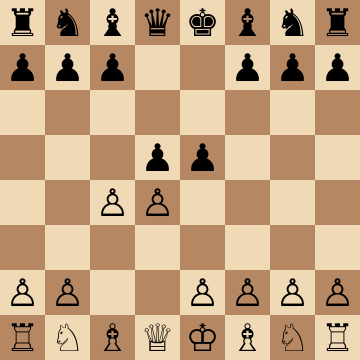
Mainline
1.d4 d5 2.c4 e5 3.dxe5 d4 4.e3 Bb4+ 5.Bd2 dxe3
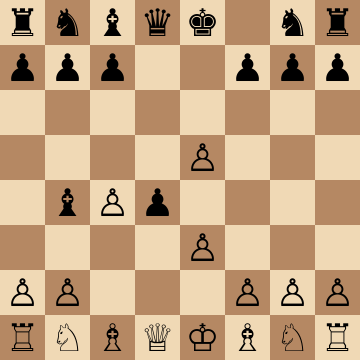
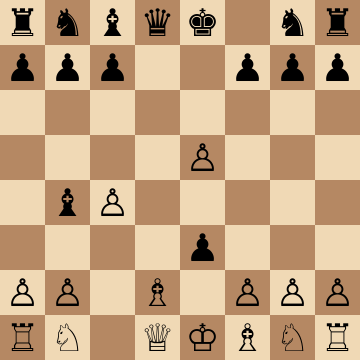
Lasker Trap (Albin Countergambit)
1.d4 d5 2.c4 e5 3.dxe5 d4 4.e3 Bb4+ 5.Bd2 dxe3 6.Bxb4 exf2+ 7.Ke2 fxg1=N+ 8.Rxg1 Bg4+
The most beautiful trap in chess: after the natural 4.e3?, the pawn storms forward and 7...fxg1=N+! underpromotes to a knight with check — the only promotion that wins. Following 8.Rxg1, the skewer 8...Bg4+ picks up the white queen and the game. When White avoids 4.e3 with the correct 4.Nf3, Black continues with a legitimate gambit: ...Nc6, ...Bg4 and queenside castling with a lasting initiative for the pawn.
Study the Albin Countergambit course
Stafford Gambit: Oh No My Queen
1.e4 e5 2.Nf3 Nf6 3.Nxe5 Nc6 4.Nxc6 dxc6 5.d3 Bc5 6.Bg5 Nxe4 7.Bxd8 Bxf2+ 8.Ke2 Bg4#
The internet's favorite ambush. Black offers the queen with 6...Nxe4!, and grabbing it with 7.Bxd8?? runs into 7...Bxf2+ 8.Ke2 Bg4# — checkmate with two bishops while the queen sits captured on d8. Even declining leaves White navigating a minefield of ...Qd4 and ...Ng4 threats. Objectively the gambit is dubious against precise defense, which is exactly why the honest theory matters as much as the fireworks.
Study the Stafford Gambit course
Kieninger Trap (Budapest Gambit)
1.d4 Nf6 2.c4 e5 3.dxe5 Ng4 4.Bf4 Nc6 5.Nf3 Bb4+ 6.Nbd2 Qe7 7.a3 Ngxe5 8.axb4 Nd3#
A smothered mate straight out of the opening. The innocent-looking 6...Qe7 loads the e-file, and when White grabs the bishop with 8.axb4??, the reply 8...Nd3 is mate — the e2-pawn is pinned by the queen and every escape square is occupied by White's own pieces. If White instead defends correctly with 7.Nxe5 or 7.e3, Black regains the e5-pawn with comfortable development and a fully sound game.
Study the Budapest Gambit course
Elephant Trap (Queen's Gambit Declined)
1.d4 d5 2.c4 e6 3.Nc3 Nf6 4.Bg5 Nbd7 5.cxd5 exd5 6.Nxd5 Nxd5 7.Bxd8 Bb4+ 8.Qd2 Bxd2+ 9.Kxd2 Kxd8
A century-old classic that still catches thousands every month. The pin on f6 looks absolute, so 6.Nxd5 appears to win a clean pawn — but 6...Nxd5! breaks it, and after 7.Bxd8 the check 7...Bb4+ regains the queen with interest: Black finishes a full piece up. The quiet 4...Nbd7 sets the trap while being the main move of the Cambridge Springs complex, so nothing is risked if White plays correctly.
Noah's Ark Trap (Ruy Lopez)
1.e4 e5 2.Nf3 Nc6 3.Bb5 a6 4.Ba4 d6 5.d4 b5 6.Bb3 Nxd4 7.Nxd4 exd4 8.Qxd4 c5 9.Qd5 Be6 10.Qc6+ Bd7 11.Qd5 c4
Black's pawns build the ark — a6, b5, c4 — and White's bishop drowns inside it. The bait is the d4-pawn: after 8.Qxd4?, the sequence 8...c5 and 11...c4 traps the b3-bishop with its own pawns on a2 and c2 blocking every exit. A whole piece falls to three pawn moves. The underlying pattern appears throughout the Ruy Lopez; even strong players must constantly guard against ...c5-c4 clamping the Spanish bishop.
Englund Gambit Mate (1.d4 e5)
1.d4 e5 2.dxe5 Nc6 3.Nf3 Qe7 4.Bf4 Qb4+ 5.Bd2 Qxb2 6.Bc3 Bb4 7.Qd2 Bxc3 8.Qxc3 Qc1#
The cheekiest queen raid in the repertoire: ...Qe7 and ...Qb4+ fork their way to b2, and when White plays the natural 6.Bc3 to trap her, 6...Bb4! turns the hunter into prey — the pinned bishop cannot be saved, and 7.Qd2?? even allows mate on c1, delivered by the queen everyone thought was trapped. Against accurate defense the Englund is objectively poor, so treat it as a blitz weapon and know when to bail into ...Nge7 development.
Key ideas
- Learn the classics: the Lasker Trap's underpromotion, smothered-mate patterns, and more famous ambushes.
- Every trick comes with a safety net — sound continuations for when your opponent finds the right reply.
- Recognize trap patterns by mechanism (pins, deflections, discovered attacks), not memorized move-lists.
- Sharpen your tactical radar for your main openings too — trap patterns repeat everywhere.
Typical plans and structures
Each chapter presents one celebrated trick from Black's side: the setup, the bait, the punishment when White grabs it, and — crucially — the honest evaluation and plan when White declines. The showpiece Lasker Trap (1.d4 d5 2.c4 e5 3.dxe5 d4 4.e3? Bb4+ 5.Bd2 dxe3! winning with an underpromotion) headlines a collection spanning queen's-pawn and king's-pawn openings alike. Ideal as a tactical dessert alongside a main repertoire course.
Who should play it
Players of any level who love quick wins and tactical ambushes — especially blitz and online players, where traps score daily.
Study the Opening Tricks Hall of Fame move by move
The first 3 lines of the interactive course, exactly as a signed-out visitor can play them — each move with the coaching note shown on the board.
Line 1 — punishing a blunder
1.d4 Claiming the center. 1...d5 Mirroring White's play. 2.c4 White enters the Queen's Gambit, aiming for a strong center if ...dxc4. 2...e6 Reinforcing the d5 pawn and freeing our dark squared bishop. 3.Nc3 Our opponent develops their knight. 3...Nf6 We bring out our knight as well. 4.Bg5 Pinning the knight. 4...Nbd7 We reinforce our f6 knight. 5.cxd5 Our opponent trades on d5. 5...exd5 We take back with the pawn. 6.Nxd5 White takes on d5 to exploit the pin, but overlooks a tactic that gives us a material edge. 6...Nxd5 We capture their knight, sacrificing the queen. 7.Bxd8 Our opponent accepts the sacrifice. 7...Bb4+ We give check, and our opponent can only block with the queen. 8.Qd2 Only move. 8...Bxd2+ We regain the material. 9.Kxd2 Our opponent takes back. 9...Kxd8 We are a piece up and clearly winning.
Line 2 — punishing a blunder
1.d4 Claiming the center. 1...d5 Mirroring White's play. 2.c4 White enters the Queen's Gambit, aiming for a strong center if ...dxc4. 2...e5 We strike in the center with the Albin Countergambit. 3.dxe5 Our opponent takes the sacrificed pawn. 3...d4 We push the d pawn to disrupt their setup. 4.e3 White offers a pawn trade, aiming to improve their development. 4...Bb4+ We activate the bishop with a check. 5.Bd2 Our opponent blocks with the bishop. 5...dxe3 We take on d3, sacrificing the bishop to capture on f2 and attack their king. 6.Bxb4 White accepts the sacrifice. 6...exf2+ Pulling their king away from the queen. 7.Ke2 Our opponent aims to keep the queen protected, relying on Nf3 if we play ...Bg4+. 7...fxg1=N+ We capture on g1 and promote to a knight, removing the defender with tempo. 8.Rxg1 Our opponent takes the knight. 8...Bg4+ We pressure their king and queen along the diagonal. 9.Kf2 Our opponent steps the king out of danger. 9...Qxd1 We capture their queen and keep a strong attack, with a decisive advantage.
Line 3 — punishing a blunder
1.e4 We claim the center. 1...e5 Our opponent matches our central play. 2.Nf3 Developing the knight and putting pressure on e5. 2...Nc6 Black brings out the knight to reinforce e5. 3.Bb5 We enter the Ruy Lopez, targeting the knight. 3...Nf6 Our opponent develops the knight, aiming to capture on e4. 4.O-O We castle, allowing the capture. 4...Nxe4 Our opponent accepts the sacrifice. 5.d4 We break in the center to open the e file and pressure their knight and king. 5...exd4 Black captures on d4. 6.Re1 Pinning the knight and threatening to capture it. 6...d5 Our opponent pushes the d pawn to protect the knight. 7.Qxd4 We recapture on d4, exploiting the pin on c6. 7...a6 Challenging our bishop. 8.Bxc6+ We take the knight. 8...bxc6 Our opponent takes back. 9.Ng5 We jump in with the knight, pressuring e4. 9...Qf6 Our opponent offers a queen trade to reduce pressure. 10.Nxe4 We sacrifice the queen to open the e file. 10...Qxd4 Our opponent takes the queen. 11.Nf6+ We deliver a double check, and the king must go to d8. 11...Kd8 Only move. 12.Re8# Our opponent fell behind in development to win material, but got checkmated.
The free preview ends here — continue with all 6 lines in the interactive course, with instant feedback on every move you play.
Frequently asked questions
Are opening tricks worth learning, or should I study 'real' openings?
Both — and they reinforce each other. Traps teach concrete tactical mechanisms (deflection, pins, discovered checks) that transfer to every game, and knowing the famous ones also protects you from falling into them yourself.
What happens when my opponent doesn't fall for a trap?
Every trick in the course is chosen so that Black's position stays sound when the trap is declined — you get a normal, playable game rather than a compromised one. That's the difference between a good trap and a cheap one.
What is the Lasker Trap?
The Albin Countergambit's crown jewel: after 1.d4 d5 2.c4 e5 3.dxe5 d4, the natural 4.e3? loses to 4...Bb4+ 5.Bd2 dxe3!, when 6.Bxb4?? exf2+ 7.Ke2 fxg1=N+! underpromotes with devastating effect. It has claimed victims for over a century.
Learn the Opening Tricks Hall of Fame with AI feedback
This page pairs the guide above with an interactive ChessMind AI course: a GM-authored repertoire you study move by move on a real board, then practice against a human-like chess AI opponent with instant feedback and spaced-repetition review, so the key positions actually stick. Start learning, jump straight into practice, or browse all opening courses.
New to a concept? Every term is defined in the chess terms glossary.