Stafford Gambit
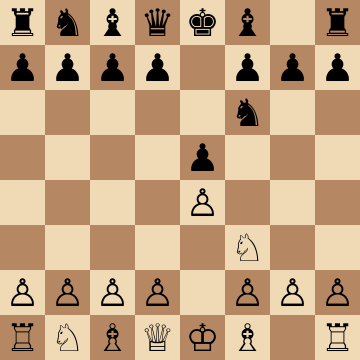
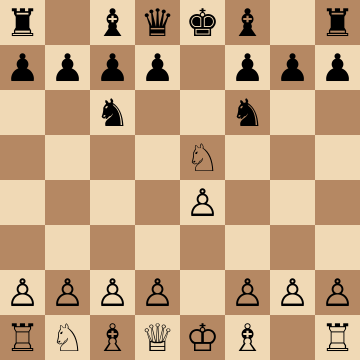
1.e4 e5 2.Nf3 Nf6 3.Nxe5 Nc6
The Stafford Gambit (1.e4 e5 2.Nf3 Nf6 3.Nxe5 Nc6!?) is the internet's most feared trap weapon: Black gives a pawn for rapid development and a minefield of tactics where natural moves lose for White — often in under fifteen moves. Popularized by IM Eric Rosen, it has claimed millions of online victims.
Mainline
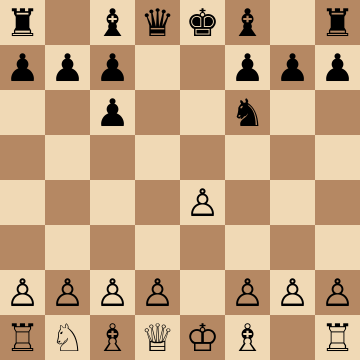
1.e4 e5 2.Nf3 Nf6 3.Nxe5 Nc6 4.Nxc6 dxc6 5.d3 Bc5 6.Be2 h5
Oh No My Queen: 6.Bg5??
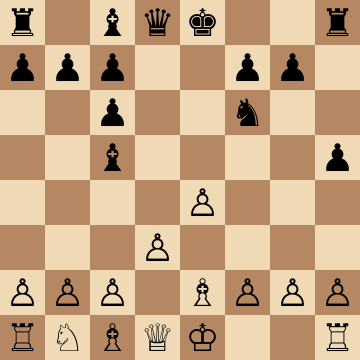
1.e4 e5 2.Nf3 Nf6 3.Nxe5 Nc6 4.Nxc6 dxc6 5.d3 Bc5 6.Bg5 Nxe4 7.Bxd8 Bxf2+ 8.Ke2 Bg4+
The trap that made the Stafford famous. The pin 6.Bg5?? looks completely natural — and loses immediately to 6...Nxe4!. If White grabs the queen with 7.Bxd8, then 7...Bxf2+ 8.Ke2 Bg4+ wins everything back with a mating attack: the king is caught in a crossfire of three black pieces, and White must shed decisive material to survive even briefly. Millions of online games have ended in this exact sequence. Play it fast and confidently.
Castling into It: 7.O-O?! Ng4
1.e4 e5 2.Nf3 Nf6 3.Nxe5 Nc6 4.Nxc6 dxc6 5.d3 Bc5 6.Be2 h5 7.O-O Ng4 8.h3 Qd6 9.hxg4 hxg4
White develops sensibly with 6.Be2, then ruins it by castling into the h-file. After 7...Ng4 8.h3 comes the star move 8...Qd6!, ignoring the attacked knight to threaten mate on h2. Taking with 9.hxg4 hxg4 opens the h-file for Black's rook and renews the mate threat with decisive effect — White must hand back material and shred his own king position to stagger on. The early ...h5 is exactly what makes this whole mechanism work.
Punishing 5.e5: the ...Ne4 Refutation
1.e4 e5 2.Nf3 Nf6 3.Nxe5 Nc6 4.Nxc6 dxc6 5.e5 Ne4 6.d3 Bc5 7.dxe4 Bxf2+ 8.Kxf2 Qxd1
Chasing the knight with 5.e5 feels like a free tempo and is actually the losing moment. The knight steps into e4, and after 6.d3 Black uncorks 6...Bc5! — bishop and knight now both eye f2. Capturing with 7.dxe4?? walks into 7...Bxf2+ 8.Kxf2 Qxd1, winning the queen outright. White's only playable tries are 6.d4 or 6.Qe2, and even there Black gets superb piece activity for the pawn. Know this pattern cold: it converts greedy opponents instantly.
Critical Main Line: 6.Be2 h5 7.c3
1.e4 e5 2.Nf3 Nf6 3.Nxe5 Nc6 4.Nxc6 dxc6 5.d3 Bc5 6.Be2 h5 7.c3 Ng4 8.d4
White's most testing setup: d3, Be2 and now 7.c3, preparing to blunt the c5-bishop with d4 while giving nothing back. Here the course is honest about the gambit — Black fights for practical compensation, not objective advantage. The recipe: 7...Ng4 keeps the f2 pressure alive, and after 8.d4 the bishop drops back to b6 while ...Qd6 and ...h4 keep threats coming. Note that Bxg4 hxg4 always opens the h-file, so White's best defender is rarely eager to touch the knight.
Gambit Declined: 4.Nf3 Retreat
1.e4 e5 2.Nf3 Nf6 3.Nxe5 Nc6 4.Nf3 Nxe4 5.d4 d5
Some players smell danger and retreat with 4.Nf3 rather than capture on c6. The gambit evaporates — and so does White's extra pawn: 4...Nxe4 regains it immediately, and 5...d5 plants a healthy stake in the center with the c6-knight actively posted. Black has equalized by move five and simply plays chess with ...Bd6 or ...Be7, ...O-O and ...Bg4. A reminder that declining the Stafford solves nothing; only precise acceptance tests it.
Key ideas
- Offer the pawn with 3...Nc6 and recapture toward the center — open lines beat material here.
- Aim everything at f2 and g2: ...Bc5, ...Ng4 and ...Qd4 or ...Qh4 create instant mating threats.
- Know the punishments for natural moves — most 'obvious' White setups lose by force.
- Use the modern ...h5 resource to sustain the attack even against careful defenders.
Typical plans and structures
After 5.d3 Bc5, Black's attack plays itself: ...Ng4 hits f2, ...Qd4 or ...Qh4 join in, and the h-pawn's advance (...h5-h4) keeps the initiative alive against g3 setups. White's greedy or casual responses meet catalogued disasters — the famous Oh No My Queen trap among them. Against the accurate defensive setups, the course is honest: Black fights for compensation, not advantage, and it shows the best practical tries plus the move orders that maximize White's chances to go wrong.
Who should play it
Blitz and online players who want a devastating surprise weapon against 2.Nf3, love tactics, and accept objective risk in exchange for spectacular winning percentages.
Study the Stafford Gambit move by move
The first 3 lines of the interactive course, exactly as a signed-out visitor can play them — each move with the coaching note shown on the board.
Line 1 — punishing a blunder
1.e4 White takes the center. 1...e5 We match their center play. 2.Nf3 White develops and attacks our e5 pawn. 2...Nf6 We mirror their development. 3.Nxe5 White takes the pawn. 3...Nc6 We don't recapture, instead we develop quickly and go for the Stafford Gambit. 4.Nxc6 White gives us doubled pawns, maybe underestimating the risk. 4...dxc6 We open lines and keep center control. 5.Nc3 White develops their knight to protect the e4 pawn. 5...Bc5 We activate the bishop, aiming at f2. 6.Bc4 White copies us, keeping pressure on f7. 6...Ng4 We jump with the knight, increasing pressure on f2. 7.O-O White castles, not seeing the danger. 7...Qh4 Our queen joins the attack, threatening checkmate on h2. 8.h3 White tries to drive our knight away. 8...Nxf2 We take on f2 and break open the kingside. 9.Qf3 White brings the queen over, aiming for counterplay on f7. 9...Nxh3+ We capture on h3 with double check. 10.Kh2 White steps out of the checks. 10...Nf2+ We force the king back to g1. 11.Kg1 Their king is forced back. 11...Qh1# Our queen and knight work together to deliver checkmate.
Line 2 — punishing a blunder
1.e4 White takes the center. 1...e5 We match their center play. 2.Nf3 White develops and attacks our e5 pawn. 2...Nf6 We mirror their development. 3.Nxe5 White takes the pawn. 3...Nc6 We don't recapture, instead we develop quickly and go for the Stafford Gambit. 4.Nxc6 White gives us doubled pawns, maybe underestimating the risk. 4...dxc6 We open lines and keep center control. 5.Nc3 White develops their knight to protect the e4 pawn. 5...Bc5 We activate the bishop, aiming at f2. 6.Be2 White prepares to castle and play solidly. 6...h5 We launch the h pawn. 7.h3 White tries to slow our kingside push. 7...Qd4 We activate the queen, threatening checkmate on f2. 8.O-O White castles, defending f2 with the rook. 8...Ng4 The knight jumps in, threatening key squares f2 and h2. 9.hxg4 White takes, but it opens lines toward the king. 9...hxg4 We recapture, activating the rook. 10.g3 White tries to block, but the dark squares are weak. 10...Qe5 We centralize the queen, threatening Qxg3+ since the f2 pawn is pinned. 11.Kg2 White repositions the king to protect g3. 11...Bxf2 We sacrifice the bishop to weaken their kingside. 12.Rxf2 White grabs the bishop. 12...Qh5 We build pressure along the h file, targeting their king. 13.Bf3 White tries one last defense. 13...gxf3+ We capture their bishop. 14.Qxf3 Our opponent takes back. 14...Qh1# Our attack finishes with checkmate.
Line 3 — punishing a blunder
1.e4 White takes the center. 1...e5 We match their center play. 2.Nf3 White develops and attacks our e5 pawn. 2...Nf6 We mirror their development. 3.Nxe5 White takes the pawn. 3...Nc6 We don't recapture, instead we develop quickly and go for the Stafford Gambit. 4.Nxc6 White gives us doubled pawns, maybe underestimating the risk. 4...dxc6 We open lines and keep center control. 5.e5 Our opponent kicks out our knight. 5...Ne4 We jump into the center, setting up a trap. 6.d3 White tries to push us away. 6...Bc5 We develop with tempo and target f2. 7.dxe4 White takes the bait. 7...Bxf2+ We give up the bishop to draw their king away from their queen. 8.Ke2 The king won't give up the queen. 8...Bg4+ Forcing our opponent to give up the queen. 9.Kxf2 Only move. 9...Qxd1 We are a queen up and completely winning.
The free preview ends here — continue with all 8 lines in the interactive course, with instant feedback on every move you play.
Frequently asked questions
Is the Stafford Gambit refuted?
Objectively, White refutes it with precise play — the engine line gives White a clear advantage. Practically, that line requires a sequence of unnatural moves almost nobody finds over the board: the Stafford's online win rates remain outrageous, especially at fast time controls.
Why is the Stafford Gambit so dangerous for White?
Because the losing moves look like good moves: normal development walks into ...Ng4 and ...Qd4 double attacks, and even the defensive g3 runs into ...h5-h4 storms. The defender must know the theory precisely, while the attacker only needs the patterns — an asymmetry that wins games.
Who made the Stafford Gambit famous?
IM Eric Rosen turned it into an internet phenomenon through his streams and the 'Oh No My Queen' videos, where the queen-sacrifice trap delivers smothered-style mates. The gambit itself long predates the streaming era, but its golden age is right now, online.
Learn the Stafford Gambit with AI feedback
This page pairs the guide above with an interactive ChessMind AI course: a GM-authored repertoire you study move by move on a real board, then practice against a human-like chess AI opponent with instant feedback and spaced-repetition review, so the key positions actually stick. Start learning, jump straight into practice, or browse all opening courses.
New to a concept? Every term is defined in the chess terms glossary.