Petroff Defense
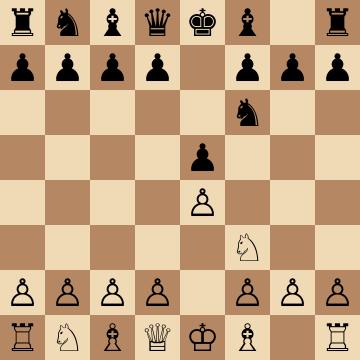
1.e4 e5 2.Nf3 Nf6
The Petroff Defense (1.e4 e5 2.Nf3 Nf6) answers the attack on e5 with a counterattack on e4 — symmetry with a purpose. The choice of Kramnik, Caruana and every player who wants 1.e4 neutralized: solid as granite, with more winning venom than its reputation admits.
Mainline
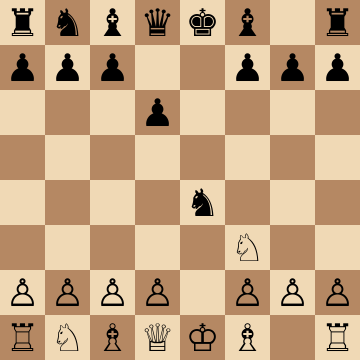
1.e4 e5 2.Nf3 Nf6 3.Nxe5 d6 4.Nf3 Nxe4 5.d4 d5 6.Bd3 Nc6 7.O-O Be7
Classical Main Line (8.c4 Nb4)
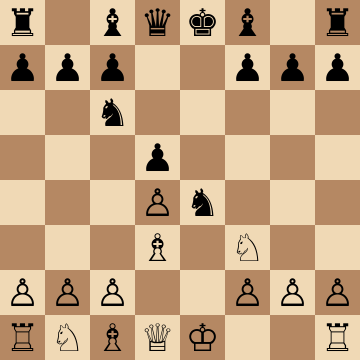
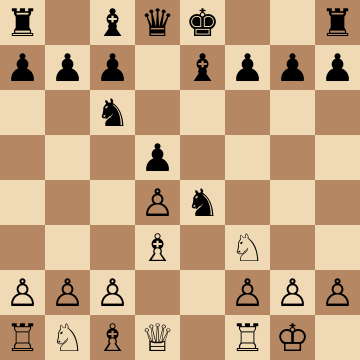
1.e4 e5 2.Nf3 Nf6 3.Nxe5 d6 4.Nf3 Nxe4 5.d4 d5 6.Bd3 Nc6 7.O-O Be7 8.c4 Nb4 9.Be2 O-O 10.Nc3 Bf5
The classical tabiya, tested at world-championship level for over a century. White challenges d5 with c4; Black's 8...Nb4 gains a tempo on the bishop before castling, and 10...Bf5 completes an ideal setup where every piece has its best square. The e4-knight is the star — White must spend real energy evicting it, and the resulting simplifications lead to positions Black understands better. Full development first, then contest the e-file.
Steinitz Attack (3.d4)
1.e4 e5 2.Nf3 Nf6 3.d4 Nxe4 4.Bd3 d5 5.Nxe5 Nd7 6.Nxd7 Bxd7 7.O-O Bd6
White's main alternative strikes in the center immediately, but Black's antidote is forcing and clean: take on e4, support with ...d5, and neutralize the e5-knight with 5...Nd7 — the key move, offering a trade that drains White's initiative. After 7...Bd6 the position is symmetrical with one difference: Black's remaining pieces coordinate more naturally. Know the move order precisely and this dangerous-looking system becomes one of the easiest lines in your repertoire.
Cochrane Gambit (4.Nxf7!?)
1.e4 e5 2.Nf3 Nf6 3.Nxe5 d6 4.Nxf7 Kxf7 5.d4 c5
The pirate's choice: a full piece for two pawns and Black's castling rights. Don't panic and don't cling to material — the modern counter 5...c5! strikes at White's center before it rolls forward, the whole point of the gambit. Black's king walks to g8 by hand via ...g6 and ...Kg7, the extra piece organizes behind the pawns, and White's attack runs dry. Respect the Cochrane enough to learn one precise setup, and it becomes a gift of a free knight.
5.Nc3 Attacking Try
1.e4 e5 2.Nf3 Nf6 3.Nxe5 d6 4.Nf3 Nxe4 5.Nc3 Nxc3 6.dxc3 Be7 7.Be3 O-O 8.Qd2 Nd7 9.O-O-O
White's most popular winning attempt at master level: trade on c3, accept doubled pawns, and castle long for a kingside pawn storm. Black's defensive scheme is well mapped — ...Nd7-f6 or ...Ne5 covers the key squares, ...c6 and ...Be6 restrain the d-file pressure, and the counterattack with ...a5 or ...b5 arrives on time because White's structure can't generate quick threats. Learn the piece placements here; move-for-move memorization is unnecessary.
Quiet 5.Qe2 Queen Trade
1.e4 e5 2.Nf3 Nf6 3.Nxe5 d6 4.Nf3 Nxe4 5.Qe2 Qe7 6.d3 Nf6 7.Bg5 Qxe2+ 8.Bxe2 Be7
Played constantly by White players hoping to bore the Petroff into a draw — and the line where Black's winning technique matters most. The queen trade is forced in essence, but the resulting endgame is not equal by default: Black's setup with ...Be7, ...Nbd7, ...c6 and a later ...Nb6 or ...Re8 keeps all the pieces working, and White's slightly loose queenside (b2, the d3-pawn) offers targets. Symmetry is not sterility; play on.
Stafford Gambit (3...Nc6!?)
1.e4 e5 2.Nf3 Nf6 3.Nxe5 Nc6 4.Nxc6 dxc6 5.d3 Bc5 6.Be2 h5
From the Petroff move order Black can also gamble: 3...Nc6 offers a pawn for ferocious piece activity and some of the internet's most famous traps — ...Ng4, ...Qd4 and ...Bxf2 motifs punish nearly every natural White setup. Objectively White stays better with precise play, which is exactly why the Stafford deserves dedicated study rather than improvisation, from either side. The complete trap map and the honest theory live in the dedicated Stafford Gambit course.
Study the Stafford Gambit course
Key ideas
- Counterattack instead of defending: 2...Nf6 makes White solve problems from move two.
- Neutralize White's initiative early and reach healthy, symmetrical-ish structures with full equality.
- Know the critical tries: the 3.Nxe5 main lines, the 3.d4 Steinitz, and the trendy 5.Nc3 attack.
- Outplay from equality: the Petroff's flat evaluations hide real chances for the better-prepared side.
Typical plans and structures
In the classical main line Black establishes the e4-knight, supports it with ...d5, and completes development with ...Nc6, ...Be7 and ...Bf5 or ...Bg4 — solid structure, active pieces, no weaknesses. White's attacking tries (opposite-side castling setups, the 5.Nc3 lines) get concrete, tested antidotes; the calm tries drift toward balanced middlegames where Black's clarity of plan tells. The course also covers the move-order nuances that keep drawish simplifications on Black's terms, not White's.
How to reach the Petroff Defense
The Petroff is 1.e4 e5 2.Nf3 Nf6. The main line runs 3.Nxe5 d6 4.Nf3 Nxe4 5.d4 d5, when 6.Bd3 leads to the Classical positions and 5.Nc3 or 5.Qe2 are White's sharper and quieter alternatives; 3.d4 is the Steinitz Attack, met by 3...Nxe4 or 3...exd4; 3.Nc3 transposes to a Four Knights after 3...Nc6. The Cochrane Gambit 4.Nxf7 is White's wild try, and 3...Nc6, the Stafford Gambit, is Black's trap-laden alternative to the correct 3...d6.
Pros and cons of the Petroff Defense
Pros
- One of the soundest replies to 1.e4 e5: symmetrical, solid and nearly impossible to attack directly.
- Avoids the Ruy Lopez, the Italian, the Scotch and every other 3.Bb5 or 3.Bc4 system at once.
- Black gets active piece play and a safe king; the endgames are comfortable and the winning chances real against ambitious opponents.
- Less theory than the Sicilian, and the plans repeat across lines.
Cons
- Reputation for dryness: White can steer into symmetrical, drawish positions, and many club players find it hard to win with.
- The trap 3...Nxe4? 4.Qe2 costs a piece and must be known before the first game.
- 5.Nc3 and the Cochrane Gambit demand accurate defense in unfamiliar positions.
- White chooses the character of the game; Black's winning chances depend on White's ambition.
How to play against the Petroff Defense
White's main choices are the Classical 3.Nxe5 d6 4.Nf3 Nxe4 5.d4 d5 6.Bd3, playing for a small edge from the c4 break and the pressure on the e4-knight, and the sharper 5.Nc3, offering to trade knights and open lines toward the black king with queenside castling. The Steinitz 3.d4 leads to open positions with a lead in development, and the Cochrane Gambit 4.Nxf7 is a surprise weapon that is objectively unsound but practically dangerous. Against the Stafford Gambit 3...Nc6, take the pawn, play 4.Nxc6 dxc6 5.d3 and defend precisely; the traps only work against a careless 5.e5 or 5.Nc3. The strategic thread in every line is to punish the e4-knight: c4 and Nc3 to undermine d5, or Re1 and Qe2 to force it away with tempo.
Plans for both sides
White's plan
Play against the e4-knight with c4, Nc3 and Re1, break the symmetry with c4 to win the d5-pawn or the d-file, and use the lead in development for a kingside attack when Black castles early. In the 5.Nc3 lines, castle long and attack with the h-pawn; in the Classical, aim for the better minor piece in a long endgame.
Black's plan
Keep the knight on e4 as long as it is safe, support it with ...d5 and ...Bf5, complete development with ...Be7, ...O-O and ...Nc6 or ...c6, and neutralize c4 with ...Nb4 or ...Be6. Trade pieces when White's initiative is real and play for the endgame where the structure is equal and the pieces are active.
Who should play it
Players who want a dependable, low-risk answer to 1.e4 for serious games — and the patience to convert small edges from equal positions.
History of the Petroff Defense
The defense is named after Alexander Petrov, the strongest Russian player of the early nineteenth century, who analyzed it in his 1824 book, and it is also called the Russian Game; Carl Jaenisch, another Russian master, developed it further. It was a favorite of Pillsbury and Marshall, and Frank Marshall's 3...d6 lines shaped the modern main line. Its reputation as a drawing weapon comes from the elite era of Kramnik, Gelfand and Karpov in the 1990s and 2000s, when it blunted 1.e4 at the highest level; Caruana made it his defense throughout the 2018 world championship match, and it remains the standard for players who want 1.e4 e5 without the Ruy Lopez.
Frequently asked questions
Is the Petroff just a drawing weapon?
Its elite reputation says so, but below the very top it is simply a sound defense with normal winning chances — Black's position is healthy and White's forcing tries run out quickly. Caruana and Kramnik scored plenty of wins from it; club opponents pressing too hard against it lose regularly.
What is the trap every Petroff player must avoid?
The famous 3.Nxe5 Nxe4? mistake (before ...d6!): after 4.Qe2 the pin wins material — 4...Nf6?? 5.Nc6+ discovering on the queen. The correct order is 3...d6 first, kicking the knight, and only then ...Nxe4. The course drills this from move one.
How does Black handle the aggressive 5.Nc3 line?
That's White's trendiest winning attempt (covered from the other side in our Beat the Petroff course): after 5...Nxc3 6.dxc3, Black must respect the attack — timely development, accurate ...Nd7 and queenside castling decisions. This course gives the defensive scheme that keeps the balance and the counterchances.
Is the Petroff Defense good for beginners?
It is a fine first defense to 1.e4 as long as the 3...d6 move order is learned before the first game; the trap 3...Nxe4? 4.Qe2 loses a piece. Its positions are symmetrical and easy to understand, which helps beginners, though attacking players may find them too quiet.
How do you play against the Petroff?
Play the Classical 3.Nxe5 d6 4.Nf3 Nxe4 5.d4 d5 6.Bd3 and press against the e4-knight with c4 and Re1, or choose the sharper 5.Nc3 with queenside castling. The Steinitz 3.d4 and the Cochrane Gambit 4.Nxf7 are the surprise options.
Is the Petroff Defense a drawing weapon?
It is one of the most reliable ways to neutralize 1.e4, which is why elite players used it to hold draws with Black, but it is not passive: Caruana held every game with it in his 2018 world championship match while keeping real winning chances, and at club level the active e4-knight and the open lines give Black plenty of play against careless opponents.
Learn the Petroff Defense with AI feedback
This page pairs the guide above with an interactive ChessMind AI course: a GM-authored repertoire you study move by move on a real board, then practice against a human-like chess AI opponent with instant feedback and spaced-repetition review, so the key positions actually stick. Start learning, jump straight into practice, or browse all opening courses.
New to a concept? Every term is defined in the chess terms glossary.