Beat the Ruy Lopez
1.e4 e5 2.Nf3 Nc6 3.Bb5 a6
The Ruy Lopez is White's most prestigious weapon — so Black needs an answer built to last. This repertoire gives you the timeless classical treatment: 3...a6 and the main-line setup that has defended Black's honor for a century, with sound structure and real counterplay.
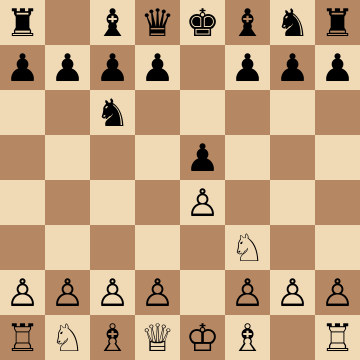
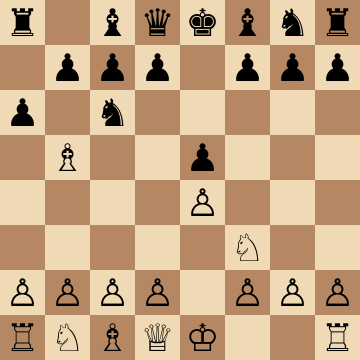
Mainline
1.e4 e5 2.Nf3 Nc6 3.Bb5 a6 4.Ba4 Nf6 5.O-O Be7 6.Re1 b5 7.Bb3 d6
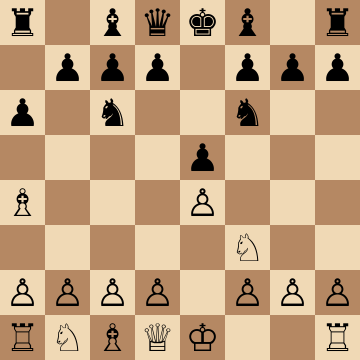
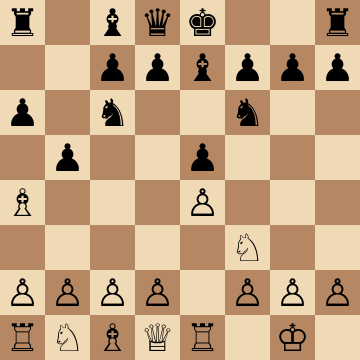
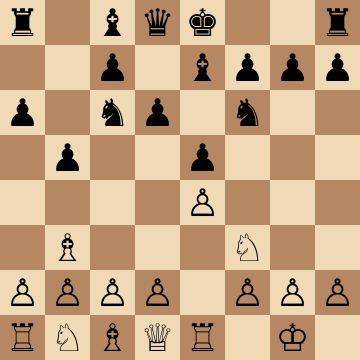
Ruy Lopez Closed (Chigorin main line)
1.e4 e5 2.Nf3 Nc6 3.Bb5 a6 4.Ba4 Nf6 5.O-O Be7 6.Re1 b5 7.Bb3 d6 8.c3 O-O
The grand main line of classical chess: both sides complete development and the game turns on the ...d5 break, the knight manoeuvre ...Na5 and ...c5, and White's d4 push. Slow, deep and hugely instructive — most of what you learn here transfers to every other 1.e4 e5 opening.
Ruy Lopez Exchange Variation (4.Bxc6)
1.e4 e5 2.Nf3 Nc6 3.Bb5 a6 4.Bxc6 dxc6 5.O-O f6
White trades on c6 and plays for the pawn-structure endgame: a healthy four-versus-three on the kingside against Black's doubled c-pawns. Black's compensation is the bishop pair and open lines, and the practical results are fine — as long as you do not drift into the pure endgame unprepared.
Berlin Defense (3...Nf6)
1.e4 e5 2.Nf3 Nc6 3.Bb5 Nf6 4.O-O Nxe4 5.d4 Nd6
The line that changed top-level chess: Black heads straight for a queenless middlegame where the structure is unbalanced but very hard to crack. Reputation for being drawish, reality is that both sides can play for a win — and it removes most of White's preparation in one move.
Marshall Attack (8...d5)
1.e4 e5 2.Nf3 Nc6 3.Bb5 a6 4.Ba4 Nf6 5.O-O Be7 6.Re1 b5 7.Bb3 O-O 8.c3 d5
Black sacrifices a pawn in the main line for a permanent initiative against the white king — the most respected gambit in modern chess. It is a large body of theory, but it is Black's most ambitious try in the whole Ruy Lopez, and White players go out of their way to avoid it.
Study the Marshall Attack course
Ruy Lopez Open Variation (5...Nxe4)
1.e4 e5 2.Nf3 Nc6 3.Bb5 a6 4.Ba4 Nf6 5.O-O Nxe4 6.d4 b5 7.Bb3 d5
Black grabs the pawn and accepts an unbalanced structure with a strong knight on e4 and the bishop pointing at White's king. Concrete and active — the antidote for anyone who finds the Closed Ruy too slow, at the cost of knowing several forcing lines.
Anti-Marshall systems (8.a4 and 8.h3)
1.e4 e5 2.Nf3 Nc6 3.Bb5 a6 4.Ba4 Nf6 5.O-O Be7 6.Re1 b5 7.Bb3 O-O 8.a4
Rather than face the Marshall, most White players insert a4 or h3 first. Black should know the standard answers — ...Bb7 and ...b4, or ...Rb8 — because these move orders are far more common in practice than the Marshall itself.
Key ideas
- Play the classical main line with confidence: ...a6, ...b5, ...Be7 and ...d6 — every move earning its keep.
- Neutralize the Spanish bishop: the ...b5 and ...Na5 mechanisms against Bb3 are core technique.
- Know the whole Spanish family: exchange variation endgames, d3 systems, and the main-line middlegames.
- Trust structure over tricks: this repertoire's timelessness means it never needs relearning.
Typical plans and structures
In the closed main lines Black completes the classical setup and chooses the right regrouping — ...Na5 with ...c5 against Bb3, or the flexible ...Re8 and ...Bf8 maneuvers — while keeping the queenside expansion as a permanent asset. Against the Exchange Variation the course teaches the famous endgame structures where Black's bishop pair compensates the damaged pawns. Modern d3 systems get the patient treatment they deserve: same classical setup, plans adjusted for the slower center.
Who should play it
1.e4 e5 players who want a serious, permanent answer to the Spanish — classical soundness first, with enough middlegame content to play for wins.
Study Beat the Ruy Lopez move by move
The first 3 lines of the interactive course, exactly as a signed-out visitor can play them — each move with the coaching note shown on the board.
Line 1 — the main line
1.e4 Our opponent takes the center. 1...e5 We play the Double King's Pawn game, fighting for the center. 2.Nf3 Our opponent attacks our e5 pawn. 2...Nc6 We develop our knight protecting our pawn. 3.Bb5 Our opponent launches the Spanish opening, also known as Ruy Lopez. 3...a6 We harass the bishop immediately, to figure out the bishop's intentions. 4.Ba4 Our opponent retreats the bishop. 4...Nf6 We bring out the knight, putting pressure on e4. 5.O-O White castles, aiming to open the center with d2 d4 against ...Nf6xe4. 5...Be7 We develop our bishop. 6.Re1 White activates their rook, defending the pawn. 6...b5 We expand on the queenside, threatening their bishop. 7.Bb3 Our opponent pulls their bishop back. 7...d6 Freeing the light squared bishop. 8.c3 Preparing d2 d4. 8...O-O We castle. 9.h3 Our opponent prevents ...Bc8 g4, which would pin their knight. 9...Nb8 We pull the knight back to reroute it via d7. 10.d4 White takes central space and targets the e5 pawn. 10...Nbd7 Reinforcing e5. 11.Nbd2 Our opponent continues developing. 11...Bb7 We fianchetto the light squared bishop. 12.Bc2 A typical Ruy Lopez maneuver to reinforce the e4 pawn. 12...Re8 We activate the rook and clear the f8 square for our bishop. 13.Nf1 White maneuvers their knight to the kingside. 13...Bf8 This move seems passive, but it clears the e file for the rook and prepares to fianchetto the dark squared bishop. 14.Ng3 Our opponent aims to reach the f5 square with their knights. 14...g6 Controlling f5 and preparing to fianchetto. 15.a4 Challenging our queenside pawn structure. 15...c5 We launch a pawn break in the center, with great counterplay.
Line 2 — the main line
1.e4 Our opponent takes the center. 1...e5 We play the Double King's Pawn game, fighting for the center. 2.Nf3 Our opponent attacks our e5 pawn. 2...Nc6 We develop our knight protecting our pawn. 3.Bb5 Our opponent launches the Spanish opening, also known as Ruy Lopez. 3...a6 We harass the bishop immediately, to figure out the bishop's intentions. 4.Ba4 Our opponent retreats the bishop. 4...Nf6 We bring out the knight, putting pressure on e4. 5.O-O White castles, aiming to open the center with d2 d4 against ...Nf6xe4. 5...Be7 We develop our bishop. 6.Re1 White activates their rook, defending the pawn. 6...b5 We expand on the queenside, threatening their bishop. 7.Bb3 Our opponent pulls their bishop back. 7...d6 Freeing the light squared bishop. 8.c3 Preparing d2 d4. 8...O-O We castle. 9.h3 Our opponent prevents ...Bc8 g4, which would pin their knight. 9...Nb8 We pull the knight back to reroute it via d7. 10.d4 White takes central space and targets the e5 pawn. 10...Nbd7 Reinforcing e5. 11.c4 White pushes the c pawn, putting pressure on our queenside structure. 11...c6 We reinforce b5. 12.Nc3 Our opponent continues development. 12...b4 We push the b pawn, targeting their knight and gaining queenside space. 13.Ne2 Our opponent pulls the knight back. 13...Nxe4 We win a pawn, and White has no clear compensation.
Line 3 — the main line
1.e4 Our opponent takes the center. 1...e5 We play the Double King's Pawn game, fighting for the center. 2.Nf3 Our opponent attacks our e5 pawn. 2...Nc6 We develop our knight protecting our pawn. 3.Bb5 Our opponent launches the Spanish opening, also known as Ruy Lopez. 3...a6 We harass the bishop immediately, to figure out the bishop's intentions. 4.Ba4 Our opponent retreats the bishop. 4...Nf6 We bring out the knight, putting pressure on e4. 5.O-O White castles, aiming to open the center with d2 d4 against ...Nf6xe4. 5...Be7 We develop our bishop. 6.Re1 White activates their rook, defending the pawn. 6...b5 We expand on the queenside, threatening their bishop. 7.Bb3 Our opponent pulls their bishop back. 7...d6 Freeing the light squared bishop. 8.c3 Preparing d2 d4. 8...O-O We castle. 9.h3 Our opponent prevents ...Bc8 g4, which would pin their knight. 9...Nb8 We pull the knight back to reroute it via d7. 10.d4 White takes central space and targets the e5 pawn. 10...Nbd7 Reinforcing e5. 11.a4 White puts pressure on b5. 11...Bb7 We fianchetto the bishop, protecting the rook and allowing the a pawn to recapture on b5 if needed. 12.Nbd2 White develops their knight. 12...c5 We launch a pawn break to challenge their center and gain queenside space. 13.Bc2 Our opponent retreats their bishop. 13...Re8 We activate the rook in case the e file opens, having neutralized our opponent's threats and reaching a comfortable position.
The free preview ends here — continue with all 15 lines in the interactive course, with instant feedback on every move you play.
Frequently asked questions
Why choose the classical main line against the Ruy Lopez?
Because it is the best-tested defense in chess history: a century of world-championship practice has confirmed its soundness, and the plans — ...b5, ...d6, the ...Na5-c5 regrouping — are logical enough to carry you through positions no book covers.
What about the Berlin Defense instead?
The Berlin (3...Nf6) is world-class but leads to early queenless middlegames many players find dry. The classical ...a6 repertoire keeps pieces on and gives Black richer winning attempts — a better practical fit for most club and tournament players.
How does Black handle the Exchange Variation?
After 4.Bxc6 dxc6, Black's bishop pair compensates the doubled pawns — the key is knowing the standard endgame plans (which White is usually playing for) and the active piece placements that make the bishops tell. The course covers these structures thoroughly.
Learn Beat the Ruy Lopez with AI feedback
This page pairs the guide above with an interactive ChessMind AI course: a GM-authored repertoire you study move by move on a real board, then practice against a human-like chess AI opponent with instant feedback and spaced-repetition review, so the key positions actually stick. Start learning, jump straight into practice, or browse all opening courses.
New to a concept? Every term is defined in the chess terms glossary.