Reti Opening
1.Nf3
The Reti Opening (1.Nf3) is the ultimate flexible start: develop first, strike at the center when it suits you. Named for the hypermodern pioneer who used it to beat Capablanca, it lets you steer every game toward structures you know better than your opponent.
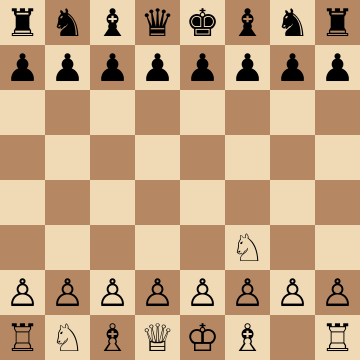
Mainline
1.Nf3 d5 2.g3 Nf6 3.Bg2 e6 4.O-O Be7 5.c4 O-O 6.b3
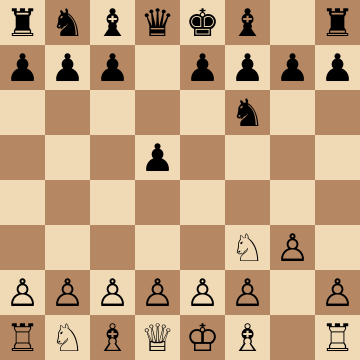
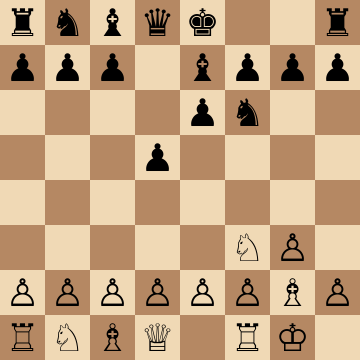
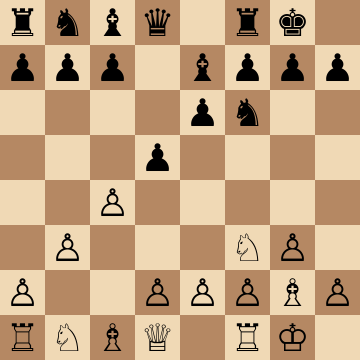
Main Line: Double Fianchetto with c4 and b3
1.Nf3 d5 2.g3 Nf6 3.Bg2 e6 4.O-O Be7 5.c4 O-O 6.b3 c5 7.Bb2 Nc6 8.e3 b6 9.Nc3 Bb7
The repertoire's home position: both bishops fianchettoed, the center fluid, every white piece influencing the central dark squares. The plans are pattern-based rather than memorized — cxd5 followed by d4 at the right moment, Qe2 with Rd1 building behind the d-pawn, or Ne5 supported by f4 when Black's pieces drift. Black's setup is solid but passive; the games are long, the plans are White's to choose, and the b2-bishop wins more endgames than any memorized line ever will.
Reti Gambit Accepted: 2...dxc4
1.Nf3 d5 2.c4 dxc4 3.e3 Nf6 4.Bxc4 e6 5.O-O c5 6.b3
Taking on c4 gives up the center for a pawn White regains by force — 3.e3 and 4.Bxc4 restore material with fast, free development. The result resembles a Queen's Gambit Accepted with extra options for White: 6.b3 posts the bishop on the long diagonal before d4 is even played, and Qe2 with Rd1 builds the classic battery behind the d-pawn. Black's queenside stays home for several more moves, and careless setups run into d4-d5 breaks or Ne5 with pressure against f7.
Advance Variation: 2...d4
1.Nf3 d5 2.c4 d4 3.e3 Nc6 4.exd4 Nxd4 5.Nxd4 Qxd4 6.Nc3 e5 7.d3
Pushing 2...d4 grabs space but plants a pawn White immediately undermines: 3.e3 asks the advanced pawn to justify itself, and after the exchanges on d4 Black's queen stands exposed in the center. White gains time on it with 6.Nc3 and a quick Be3 — every developing move doubles as an attack. The resulting reversed-Benoni structures favor the side with the extra tempo and the safer king; White continues g3, Bg2 and O-O with a comfortable, lasting initiative.
Against the King's Indian Setup: d4 After All
1.Nf3 Nf6 2.g3 g6 3.Bg2 Bg7 4.O-O O-O 5.c4 d6 6.d4 Nbd7 7.Nc3 e5 8.e4
When Black fianchettoes in kind, the Reti shows its transpositional teeth: White simply claims the center with d4 after castling, reaching the Fianchetto King's Indian — statistically one of White's best-scoring anti-KID systems, and it arrives here on White's terms. The g2-bishop defuses Black's usual kingside storm before it starts, and after 8.e4 White chooses between h3 with Be3, the space-gaining d5, or dxe5 into a favorable endgame. The KID player gets a game he never wanted.
Anti-Slav Setup: ...c6 and ...Bf5 Met by Qb3
1.Nf3 d5 2.g3 c6 3.Bg2 Bf5 4.c4 e6 5.Qb3 Qb6 6.c5 Qxb3 7.axb3
The solid Slav-style setup with ...c6 and ...Bf5 carries one built-in cost: the bishop's departure abandons b7, and 5.Qb3 exploits it at once. Black's normal remedy 5...Qb6 walks into 6.c5! with tempo, and after the queen trade 7.axb3 White has a ready-made plan on the board: the half-open a-file, b4-b5 expansion, and a lasting grip on the queenside dark squares. No attack and no risk — just an endgame in which only White has ideas, the Reti's specialty.
Classical Setup with ...c6 and ...Bg4
1.Nf3 d5 2.g3 Nf6 3.Bg2 c6 4.O-O Bg4 5.d3 Nbd7 6.Nbd2 e5 7.e4 dxe4 8.dxe4
Against the ...Bg4 development White borrows a King's Indian Attack shell: d3, Nbd2, then the central counter e4. After the trade on e4 the position looks symmetrical but is not — h3 makes the g4-bishop declare itself, the g2-bishop has a real target on b7, and the d-file endgames come out a shade better for White in every version. This is classic Reti chess: no forcing lines to memorize, just a structure where White's pieces stand a little better and the plans are easier to find.
Key ideas
- Develop with 1.Nf3 and g3 before committing a single central pawn — information first, structure second.
- Pressure d5 from the flanks with c4 and the Bg2 — the hypermodern recipe in its purest form.
- Choose your transpositions: Catalan-style, English-style, or pure Reti — always on your terms.
- Play the double fianchetto with b3: two raking bishops and a middlegame plan that repeats forever.
Typical plans and structures
Against ...d5 setups White plays c4 and b3, exchanging or undermining the center and working the long diagonals; the thematic Ne5 with f4 or the d4 break arrives once Black's setup is fixed. Against King's Indian-style defenses, White claims the center after all with d4 at the right moment — a tempo up on known theory. The course teaches the Reti as a system of decisions: which structure to steer toward against each Black setup, and the plans that follow.
Who should play it
Positional players who value flexibility and move-order mastery over forcing theory — and want one opening that quietly controls what kind of game gets played.
Study the Reti Opening move by move
The first 3 lines of the interactive course, exactly as a signed-out visitor can play them — each move with the coaching note shown on the board.
Line 1 — the main line
1.Nf3 We develop the knight first, entering the Reti! 1...d5 Our opponent takes central space. 2.c4 We challenge their center with a pawn break. 2...e6 Reinforcing d5. 3.g3 We plan to fianchetto on the kingside. 3...Nf6 Our opponent brings out their knight. 4.Bg2 We develop the bishop, preparing to castle. 4...Be7 Our opponent brings out their bishop. 5.O-O We castle. 5...O-O Our opponent castles as well. 6.b3 We reinforce c4 and prepare to fianchetto on the queenside. 6...c5 Our opponent expands on the queenside, pushing the c pawn before bringing out their knight. 7.Bb2 We stick to the plan. 7...Nc6 Our opponent develops their knight toward the center. 8.e3 We push the e pawn to restrict their center. 8...b6 Our opponent clears lines for their bishop. 9.Nc3 We develop the knight, increasing pressure on d5. 9...Bb7 Our opponent fianchettoes their bishop. 10.cxd5 We exchange pawns on d5, preparing a central pawn break. 10...Nxd5 Our opponent recaptures with the knight, avoiding an isolated d5 pawn. 11.Nxd5 We trade knights. 11...Qxd5 Our opponent takes back with the queen. 12.d4 We launch a pawn break. 12...Rad8 Our opponent brings their rook to the d file. 13.Ne5 We centralize the knight, with a discovered attack on their queen. 13...Qd6 Our opponent has to retreat their queen. 14.dxc5 We trade pawns on c5. 14...Qxc5 Our opponent takes back with the queen. 15.Nd7 Forking the queen and rook, and even with the knight pinned, our opponent must move the queen while it stays exposed. 15...Qf5 Our opponent has to move their queen. 16.e4 We keep the queen under pressure, and after it moves to g5 we push the h pawn. If it goes to g6, ...Nd7xf8 hits the queen and wins the exchange.
Line 2 — against an inaccuracy
1.Nf3 We develop the knight first, entering the Reti! 1...d5 Our opponent takes central space. 2.c4 We challenge their center with a pawn break. 2...e6 Reinforcing d5. 3.g3 We plan to fianchetto on the kingside. 3...Nf6 Our opponent brings out their knight. 4.Bg2 We develop the bishop, preparing to castle. 4...Be7 Our opponent brings out their bishop. 5.O-O We castle. 5...O-O Our opponent castles as well. 6.b3 We reinforce c4 and prepare to fianchetto on the queenside. 6...c5 Our opponent expands on the queenside, pushing the c pawn before bringing out their knight. 7.Bb2 We stick to the plan. 7...Nc6 Our opponent develops their knight toward the center. 8.e3 We push the e pawn to restrict their center. 8...b6 Our opponent clears lines for their bishop. 9.Nc3 We develop the knight, increasing pressure on d5. 9...Bb7 Our opponent fianchettoes their bishop. 10.cxd5 We exchange pawns on d5, preparing a central pawn break. 10...exd5 Our opponent takes back with the pawn. 11.d4 We launch a pawn break in the center, aiming to weaken their structure. 11...Rc8 Activating their rook along the c file. 12.Rc1 We bring the rook to the c file as well. 12...Re8 Our opponent develops the rook. 13.Re1 We complete development too. 13...h6 Controlling g5 and making room for the king on h7. 14.dxc5 We trade on c5. 14...bxc5 Our opponent takes back with the pawn. 15.Na4 We reposition the knight, targeting our opponent's hanging pawns in textbook style.
Line 3 — against an inaccuracy
1.Nf3 We develop the knight first, entering the Reti! 1...d5 Our opponent takes central space. 2.c4 We challenge their center with a pawn break. 2...e6 Reinforcing d5. 3.g3 We plan to fianchetto on the kingside. 3...Nf6 Our opponent brings out their knight. 4.Bg2 We develop the bishop, preparing to castle. 4...Be7 Our opponent brings out their bishop. 5.O-O We castle. 5...O-O Our opponent castles as well. 6.b3 We reinforce c4 and prepare to fianchetto on the queenside. 6...c5 Our opponent expands on the queenside, pushing the c pawn before bringing out their knight. 7.Bb2 We stick to the plan. 7...Nc6 Our opponent develops their knight toward the center. 8.e3 We push the e pawn to restrict their center. 8...b6 Our opponent clears lines for their bishop. 9.Nc3 We develop the knight, increasing pressure on d5. 9...Ba6 Our opponent develops the bishop, aiming at c4. 10.Qe2 We bring out the queen, reinforcing the pawn. 10...Rc8 Activating the rook along the c file. 11.Rad1 We bring the rook to the d file. 11...d4 Gaining space, threatening the rook and countering our dark squared bishop. 12.exd4 We trade on d4. 12...cxd4 Our opponent takes back with the pawn. 13.Nb5 We reposition the knight, counterattacking their pawn. 13...d3 Our opponent advances the pawn to target our queen. 14.Qe3 We reposition the queen, preparing a knight maneuver to capture on d3 and unleash our bishops.
The free preview ends here — continue with all 14 lines in the interactive course, with instant feedback on every move you play.
Frequently asked questions
Is the Reti a real attempt for an advantage, or just avoiding theory?
Both: it avoids your opponent's preparation AND poses genuine problems — the pressure against d5 with c4 and Bg2 is a real strategic question, and world champions from Kramnik to Carlsen have used the Reti to win serious games.
What is the hypermodern idea behind 1.Nf3?
Instead of occupying the center immediately, White controls it from a distance — knight, fianchettoed bishop, the c4 lever — and occupies it later, when doing so comes with tempo. Richard Reti proved the concept by beating Capablanca with it in 1924.
How do I choose between the Reti and the English?
They are cousins and often transpose (1.Nf3 with c4 reaches many English positions). The Reti move order dodges 1.c4 e5 — the reversed-Sicilian lines — which many players prefer to avoid; this course leans on that practical advantage.
Learn the Reti Opening with AI feedback
This page pairs the guide above with an interactive ChessMind AI course: a GM-authored repertoire you study move by move on a real board, then practice against a human-like chess AI opponent with instant feedback and spaced-repetition review, so the key positions actually stick. Start learning, jump straight into practice, or browse all opening courses.
New to a concept? Every term is defined in the chess terms glossary.