Beat the Sveshnikov Sicilian
1.e4 c5 2.Nf3 Nc6 3.d4 cxd4 4.Nxd4 Nf6 5.Nc3 e5 6.Ndb5 d6 7.Bg5 a6 8.Na3 b5
The Sveshnikov is one of the most theoretically dense defenses in chess — Carlsen trusted it in a world championship match. This course sidesteps the heaviest theory with the positional 11.c4: White fixes the queenside, cements the d5 outpost, and plays for a stable structural edge the Sveshnikov's dynamism cannot easily disturb.
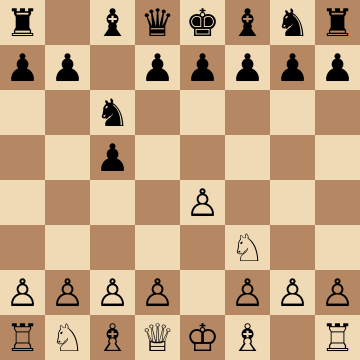
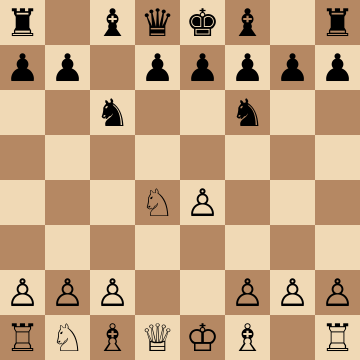
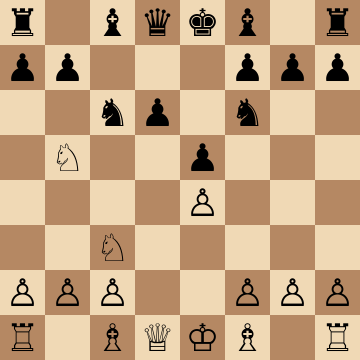
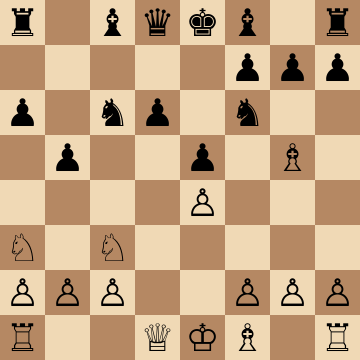
Mainline
1.e4 c5 2.Nf3 Nc6 3.d4 cxd4 4.Nxd4 Nf6 5.Nc3 e5 6.Ndb5 d6 7.Bg5 a6 8.Na3 b5 9.Nd5 Be7 10.Bxf6 Bxf6 11.c4
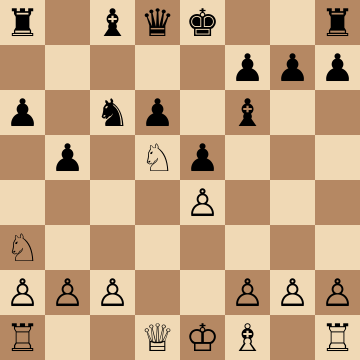
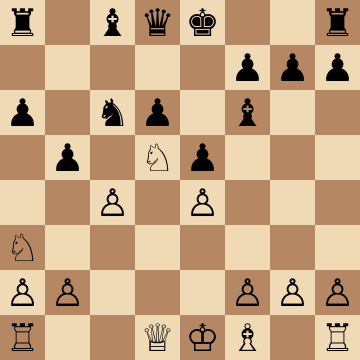
Main Line: 11...b4 12.Nc2
1.e4 c5 2.Nf3 Nc6 3.d4 cxd4 4.Nxd4 Nf6 5.Nc3 e5 6.Ndb5 d6 7.Bg5 a6 8.Na3 b5 9.Nd5 Be7 10.Bxf6 Bxf6 11.c4 b4 12.Nc2 a5 13.g3 O-O 14.Bg2
Black's principled reply to 11.c4 is to close the queenside with ...b4 and ...a5, and here White's plan unfolds in textbook fashion: 13.g3 and 14.Bg2 reinforce d5, the c2 knight reroutes via e3, and the light squares belong to White for the rest of the game. Black's b4 and a5 pawns need permanent babysitting. This is the tabiya the whole course is built around — slow, stable, and structurally better for White.
11...bxc4 12.Bxc4
1.e4 c5 2.Nf3 Nc6 3.d4 cxd4 4.Nxd4 Nf6 5.Nc3 e5 6.Ndb5 d6 7.Bg5 a6 8.Na3 b5 9.Nd5 Be7 10.Bxf6 Bxf6 11.c4 bxc4 12.Bxc4 O-O 13.O-O Bg5
Capturing on c4 opens the b-file but hands White exactly what the system wants: a rock on d5 supported by a bishop that cannot be challenged. After 13.O-O Bg5, Black tries to trade dark-squared bishops and generate ...f5 play; White answers with Nc2-e3, Qh5 pressure or the calm a4-a5 clamp. The a6 and d6 pawns remain weak deep into the endgame — precisely the kind of position Sveshnikov players dread.
The Thematic ...f5 Break
1.e4 c5 2.Nf3 Nc6 3.d4 cxd4 4.Nxd4 Nf6 5.Nc3 e5 6.Ndb5 d6 7.Bg5 a6 8.Na3 b5 9.Nd5 Be7 10.Bxf6 Bxf6 11.c4 b4 12.Nc2 O-O 13.g3 Bg5 14.Bg2 a5 15.O-O f5 16.exf5 Bxf5
Every Sveshnikov player's dream is the ...f5 break — note that Black must first reroute the bishop to g5 to clear the way. Meet it with the recipe: capture with exf5, keep the g2 bishop and d5 knight anchoring the light squares, and do not fear the activity. The e5 pawn ends up backward on an open file, d6 is chronically weak, and Nc2-e3 consolidates everything. Calm piece control beats the pawn storm — the central theme of this course.
7...h6 Sideline
1.e4 c5 2.Nf3 Nc6 3.d4 cxd4 4.Nxd4 Nf6 5.Nc3 e5 6.Ndb5 d6 7.Bg5 h6 8.Bxf6 Qxf6 9.Nd5 Qd8 10.c4
Some opponents insert 7...h6 to force the bishop's hand immediately. Take it: 8.Bxf6 Qxf6 9.Nd5 gains a full tempo on the queen, and after 9...Qd8 10.c4 White has the ideal Sveshnikov bind a move up on normal lines. The dark-square compensation Black relies on is slower here because the e7 bishop is still at home. Play the standard scheme — Be2 or g3, O-O, a4 — with an extra tempo in the bank.
Kalashnikov Move Order (4...e5)
1.e4 c5 2.Nf3 Nc6 3.d4 cxd4 4.Nxd4 e5 5.Nb5 d6 6.N1c3 a6 7.Na3 b5 8.Nd5
Playing ...e5 before ...Nf6 is the Kalashnikov, the Sveshnikov's close cousin — and Black's way of dodging the Bg5 pin. The same positional logic applies: 8.Nd5 occupies the hole immediately, and White follows with c4, Be2 and O-O to reach a bind where the a3 knight rejoins via c2. Because Black never gets ...Nf6 pressure against e4 in time, White's setup is even easier to achieve than in the main Sveshnikov.
Study the Attacking the Kalashnikov Sicilian course
Key ideas
- Follow the main sequence to 9.Nd5, then choose the clean positional path with 10.Bxf6 and 11.c4.
- Anchor the d5-knight forever: c4 secures the outpost that defines White's advantage.
- Fix Black's b5-pawn as a target and dominate the light squares across the whole board.
- Skip the sharpest 9.Bxf6 jungles — your edge comes from structure, not memory duels.
Typical plans and structures
After 11.c4, play revolves around the light squares: White exchanges or pressures the b5-pawn with cxb5 or a4, reroutes the a3-knight via c2-e3 toward d5 and f5, and meets Black's thematic ...f5 break with calm piece control. Black's dark-square counterplay with ...Bg5 and ...Ne7 trades needs accuracy to generate real chances. The resulting middlegames are exactly what a Sveshnikov player hopes to avoid: slow, structural, and easier for White to play at every level.
Who should play it
1.e4 players who respect the Sveshnikov's strength and want a sound, low-volatility system that fights for an edge without memorizing forcing lines to move thirty.
Frequently asked questions
Why choose 11.c4 against the Sveshnikov instead of the main lines?
The 9.Bxf6 gxf6 10.Nd5 f5 complex is a theoretical arms race renewed monthly by engine analysis. 11.c4 delivers a comparable practical edge through structure — the anchored d5-knight, the target on b5 — while cutting the memorization burden by an order of magnitude.
What makes the d5-square so important in the Sveshnikov?
Black's 5...e5 gains time and central presence at the cost of a permanent hole on d5 and a backward d6-pawn. Whether White can actually exploit those is the whole debate of the variation — and c4-based systems are the most ambitious structural attempt to do so.
Is the Sveshnikov still popular after Carlsen played it?
Extremely — the 2018 world championship match made it fashionable from club level to the elite, so a prepared answer is no longer optional for 1.e4 players. Facing it with a clear system like this one turns a feared defense into a known quantity.
Learn Beat the Sveshnikov Sicilian with AI feedback
This page pairs the guide above with an interactive ChessMind AI course: a GM-authored repertoire you study move by move on a real board, then practice against a human-like chess AI opponent with instant feedback and spaced-repetition review, so the key positions actually stick. Start learning, jump straight into practice, or browse all opening courses.
New to a concept? Every term is defined in the chess terms glossary.