Alapin
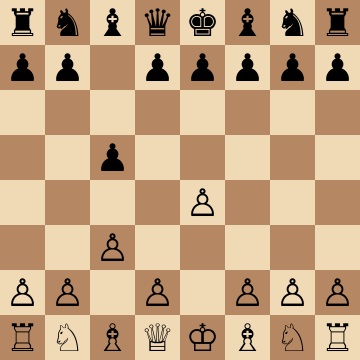
1.e4 c5 2.c3
The Alapin Variation (1.e4 c5 2.c3) sidesteps the enormous theory of the Open Sicilian in one move. White simply prepares d4 to build a full pawn center, meeting both 2...Nf6 and 2...d5 with natural, active development — a practical weapon that puts Sicilian specialists on their own resources from move two.
Mainline
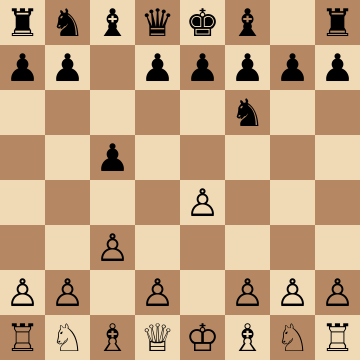
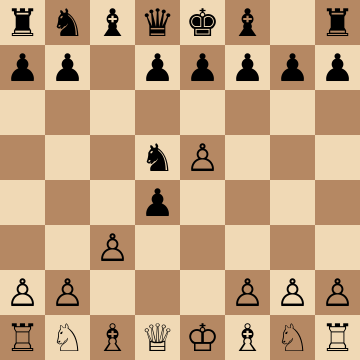
1.e4 c5 2.c3 Nf6 3.e5 Nd5 4.d4 cxd4 5.Nf3 Nc6 6.cxd4 d6 7.Bc4 Nb6 8.Bb5
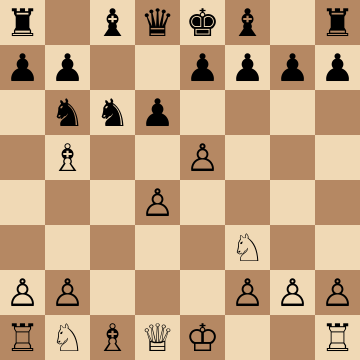
Main Line with 2...Nf6: The 8.Bb5 Pin
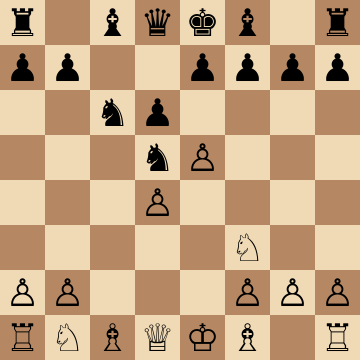
1.e4 c5 2.c3 Nf6 3.e5 Nd5 4.d4 cxd4 5.Nf3 Nc6 6.cxd4 d6 7.Bc4 Nb6 8.Bb5 dxe5 9.Nxe5 Bd7 10.Nxd7 Qxd7
Black's most principled defense meets White's most accurate setup. After 7.Bc4 Nb6, the retreat 8.Bb5 keeps the pin on c6 working: trades on e5 and d7 leave White with the freer game and the d4-d5 break in reserve. Play flows naturally — O-O, Nc3, Re1 — and Black must defend accurately for many moves just to reach a level middlegame. Learn this tabiya well; it is the backbone of the whole repertoire.
2...d5 Barmen Line: Queen to d5
1.e4 c5 2.c3 d5 3.exd5 Qxd5 4.d4 Nf6 5.Nf3 e6 6.Be3 cxd4 7.cxd4
The other main branch: Black trades in the center and posts the queen on d5, where c3 shields it from Nc3. White happily accepts an isolated queen's pawn — d4 buys open lines, a strong e5 outpost, and direct attacking chances with Bd3, O-O and Ne5. Keep pieces on the board: every trade helps the side blockading the IQP, so build up with Nc3 (hitting the queen), Bd3 and Qe2 before committing to the d4-d5 break.
2...Nc6 Move Order: Pinning with ...Bg4
1.e4 c5 2.c3 Nc6 3.d4 cxd4 4.cxd4 d5 5.exd5 Qxd5 6.Nf3 Bg4 7.Be2 e6 8.Nc3
A popular club-level try: Black develops the knight first and pins with ...Bg4 to pressure d4. White should not panic — 7.Be2 breaks the pin's teeth, and 8.Nc3 gains a tempo on the d5 queen while completing development. The resulting IQP positions are the same friendly territory as the Barmen line: White plays for Ne5, Rc1 and the d5 break, while Black's queen keeps getting kicked around the center.
2...g6 Fianchetto: 6.Bb5+ Antidote
1.e4 c5 2.c3 g6 3.d4 cxd4 4.cxd4 d5 5.exd5 Nf6 6.Bb5+ Nbd7 7.Nc3 Bg7 8.Nf3 O-O 9.O-O Nb6
Fianchetto players try to turn the Alapin into a Grunfeld — and 6.Bb5+ is the move that spoils it. The check forces the passive 6...Nbd7, after which White simply holds the extra d5 pawn for a while with Nc3 and Nf3, returning it only on White's terms. Black gets some activity for the pawn but no real targets: keep the extra tempo, finish development, and let the central pawn majority do the strategic work.
Queen Trap Line: 8...Qxd4??
1.e4 c5 2.c3 d5 3.exd5 Qxd5 4.d4 Nc6 5.Nf3 Bg4 6.Be2 cxd4 7.cxd4 Bxf3 8.Bxf3 Qxd4 9.Bxc6+ bxc6 10.Qxd4
The most common Alapin trap at club level, and it wins a queen. Black grabs the d4 pawn believing it is free — but 9.Bxc6+ removes the defender with check, and after 9...bxc6 the recapture 10.Qxd4 simply collects. Even when Black spots the trick in time, the ...Bxf3 trade concedes the bishop pair and leaves White's center standing. Know the mechanism: check first, capture second.
IQP Attacking Setup vs ...e6 Systems
1.e4 c5 2.c3 d5 3.exd5 Qxd5 4.d4 e6 5.Nf3 Nf6 6.Bd3 Be7 7.O-O O-O 8.Qe2 Nc6 9.Rd1
When Black plays the solid ...e6 systems, White gets a textbook isolated-pawn attacking formation: Bd3 aiming at h7, Qe2, Rd1 behind the pawn, and later Bg5 and Ne5. The plans matter more than the moves here — watch for the Bxh7+ Greek gift when Black's knight leaves f6, and for the d4-d5 break the instant Black's pieces drift from the blockade. This structure is where Alapin players win most of their games.
Key ideas
- Prepare d4 with 2.c3 and recapture with the c-pawn, keeping a healthy center instead of trading it away.
- Against 2...Nf6 3.e5 Nd5, gain time on the knight while developing rapidly toward a kingside initiative.
- Against 2...d5 3.exd5 Qxd5, hit the early queen with tempo and enjoy a comfortable lead in development.
- Skip hundreds of pages of Open Sicilian theory — one clear system covers everything Black tries.
Typical plans and structures
Middlegames often feature an isolated queen's pawn on d4: White gets active pieces, ideas of d4-d5 breaks, and attacking chances against the king, while Black tries to blockade and trade toward an endgame. In the 2...Nf6 lines, White's space-gaining e5 pawn supports direct kingside play with Bd3, O-O and Re1. Understanding the typical IQP plans matters far more here than memorizing concrete moves.
Who should play it
1.e4 players tired of preparing against the Najdorf, Dragon and Sveshnikov who want one sound, active answer to the whole Sicilian complex.
Frequently asked questions
Is the Alapin a good weapon against the Sicilian?
Yes — the Alapin is one of the most respected Anti-Sicilians. It has been used at every level, including by elite grandmasters as a surprise weapon, and it denies Black the sharp counterattacking positions Sicilian players choose the opening for.
What is the main line of the Alapin?
After 1.e4 c5 2.c3, Black's two main replies are 2...Nf6 3.e5 Nd5 4.d4 and 2...d5 3.exd5 Qxd5 4.d4. In both cases White builds a strong pawn center and develops naturally with easy-to-understand plans.
Is the Alapin good for beginners and club players?
It is ideal: the plans are logical, the theory is light compared to the Open Sicilian, and the same setup works against nearly everything. You can play it your whole life and keep adding depth as you improve.
Learn the Alapin with AI feedback
This page pairs the guide above with an interactive ChessMind AI course: a GM-authored repertoire you study move by move on a real board, then practice against a human-like chess AI opponent with instant feedback and spaced-repetition review, so the key positions actually stick. Start learning, jump straight into practice, or browse all opening courses.
New to a concept? Every term is defined in the chess terms glossary.