Najdorf Sicilian
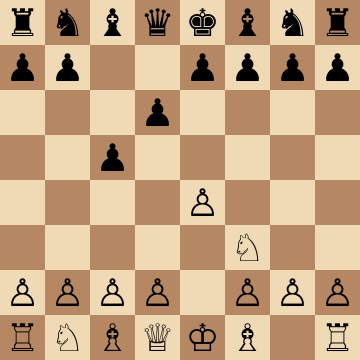
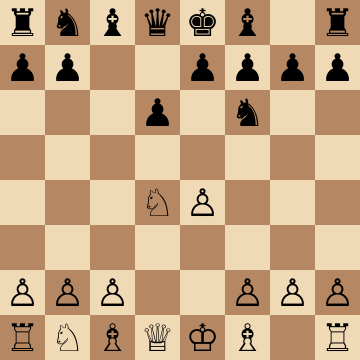
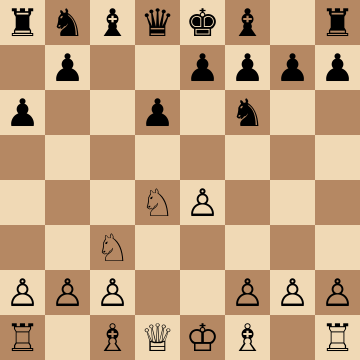
1.e4 c5 2.Nf3 d6 3.d4 cxd4 4.Nxd4 Nf6 5.Nc3 a6
The Najdorf (1.e4 c5 2.Nf3 d6 3.d4 cxd4 4.Nxd4 Nf6 5.Nc3 a6) is the king of the Sicilians — the defense Fischer played in nearly every serious game and Kasparov trusted for two decades. The quiet 5...a6 prepares everything: ...e5, ...b5, ...Be6 — a complete fighting system against 1.e4.
Mainline
1.e4 c5 2.Nf3 d6 3.d4 cxd4 4.Nxd4 Nf6 5.Nc3 a6 6.Be3 e5 7.Nb3 Be6 8.f3 Be7
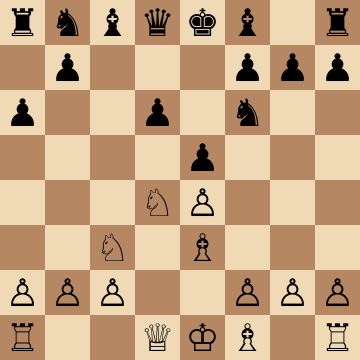
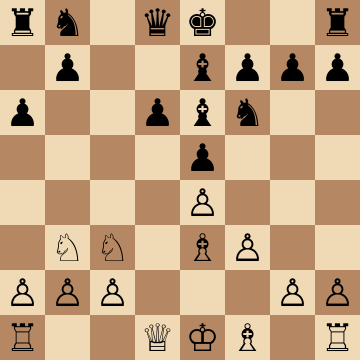
Najdorf English Attack (6.Be3)
1.e4 c5 2.Nf3 d6 3.d4 cxd4 4.Nxd4 Nf6 5.Nc3 a6 6.Be3 e5 7.Nb3 Be6
The modern main line: White plays Be3, f3, Qd2 and castles long for a pawn-storm attack. Black answers ...e5 to kick the knight and fights for d5 with ...Be6, ...Nbd7 and ...b5. Opposite-side castling means both attacks arrive — accuracy here decides more Najdorf games than anything else.
Study the The English Attack vs. Najdorf Sicilian course
Najdorf Main Line (6.Bg5)
1.e4 c5 2.Nf3 d6 3.d4 cxd4 4.Nxd4 Nf6 5.Nc3 a6 6.Bg5 e6 7.f4 Be7
The classical test of the Najdorf and the most analyzed position in chess. White pins the knight and builds with f4 and Qf3; Black chooses between the solid ...Be7 setups and the notorious Poisoned Pawn, where the queen goes hunting on b2 while the position burns. Deep theory, but the ideas are learnable.
Najdorf Classical (6.Be2)
1.e4 c5 2.Nf3 d6 3.d4 cxd4 4.Nxd4 Nf6 5.Nc3 a6 6.Be2 e5 7.Nb3 Be7
The quiet main line: White develops modestly, castles short and plays for a small edge with pressure on d5. Black gets a comfortable game with ...e5 and ...Be6, and the resulting maneuvering positions suit players who prefer understanding over memorization.
Fischer-Sozin Attack (6.Bc4)
1.e4 c5 2.Nf3 d6 3.d4 cxd4 4.Nxd4 Nf6 5.Nc3 a6 6.Bc4 e6 7.Bb3 b5
Bobby Fischer's weapon: the bishop takes aim at f7 and White plays for a direct attack with f4 and a kingside pawn storm. Black neutralizes it by kicking the bishop with ...b5 and completing development quickly — leave it one move too long and the attack arrives first.
Najdorf with 6.h3 (Adams Attack)
1.e4 c5 2.Nf3 d6 3.d4 cxd4 4.Nxd4 Nf6 5.Nc3 a6 6.h3 e5 7.Nde2 h5
A modern top-level try: the quiet h3 prepares g4 without allowing ...Ng4 in reply, keeping every plan open. Black usually strikes back with ...e5 and ...h5 to freeze the kingside before White gets rolling.
Najdorf with 6.f4
1.e4 c5 2.Nf3 d6 3.d4 cxd4 4.Nxd4 Nf6 5.Nc3 a6 6.f4 e5 7.Nf3 Nbd7
White claims the center with a big pawn front and plans a quick e5 or a kingside attack. Black hits back immediately with ...e5, exploiting the fact that f4 loosened the dark squares around White's king.
Key ideas
- Play 5...a6, the most useful move in the Sicilian: it prepares ...e5 and ...b5 while denying b5 to White's pieces.
- Counterattack always: the Najdorf never defends passively — the queenside play arrives with or without castling.
- Learn one coherent answer to each White system: 6.Be3, 6.Bg5, 6.Be2, 6.Bc4 and the sidelines.
- Fight for the win with Black in every game — the Najdorf's whole point is maximum winning chances.
Typical plans and structures
Against the English Attack (6.Be3 with f3 and Qd2), Black plays ...e5, ...Be6 and races on the queenside with ...b5-b4; against 6.Bg5 the sharpest theory in chess awaits, and the course chooses a principled, learnable path through it; against the calm 6.Be2, Black's ...e5 and ...Be7 setup delivers the classic Najdorf middlegame — space-taking, flexible, and full of play. The recurring assets are the half-open c-file, the d5-square battle, and the ...b5 expansion.
Who should play it
Ambitious players ready to invest in the most rewarding defense in chess — maximum fighting chances, backed by the deepest tradition of any Sicilian.
Study the Najdorf Sicilian move by move
The first 3 lines of the interactive course, exactly as a signed-out visitor can play them — each move with the coaching note shown on the board.
Line 1 — the main line
1.e4 Taking control of the center. 1...c5 We launch the Sicilian Defense. 2.Nf3 Aiming for an open Sicilian, our opponent is planning to break with d2 d4 next. 2...d6 The most standard response, we play this to develop our knight to f6 next, without being bothered by e4 e5. 3.d4 Breaking in the center, we now have an open Sicilian. 3...cxd4 Trading pawns in the center. 4.Nxd4 Recapturing. 4...Nf6 Developing the knight, forcing the opponent to play Nc3 interrupting c2 c4. 5.Nc3 Developing the knight, protecting the e4 pawn. 5...a6 We are now playing a Najdorf Sicilian! 6.Bg5 Developing the bishop, this is one of the oldest and most aggressive continuations. 6...e6 This is a standard response, we ...e7 e6 instead of ...e7 e5 to guard the d5 square, since the bishop on g5 is already pressing against our knight, so we need another piece to protect the d5 square. 7.f4 Our opponent advances on the kingside, claiming space and threatening e4 e5 to exploit the pin on our knight. 7...Be7 We bring our the bishop to unpin the knight. 8.Qf3 Our opponent moves the queen to prepare long castling. 8...Qc7 We develop the queen and prevent an e4 e5 push by our opponent. 9.O-O-O Our opponent castles. 9...Nbd7 We bring out the knight, reinforcing f6. 10.g4 Our opponent continues the kingside expansion, preparing for an opposite-side castling battle. 10...b5 We counter their plan by launching a queenside pawn storm that puts pressure on their knight. 11.Bxf6 Our opponent exchanges the bishop to clear the path for their pawns to advance. 11...Nxf6 We take back with the knight. 12.g5 Targeting our knight. 12...Nd7 We reposition the knight, aiming to reroute it via c5 or b6. 13.f5 Our opponent strikes with a pawn break toward e6, sacrificing the g5 pawn. 13...Bxg5+ We take the pawn with check. 14.Kb1 Our opponent sidesteps the check. 14...Ne5 We consolidate on the central dark squares, limiting White's counterplay and testing the pawn sacrifice.
Line 2 — against an inaccuracy
1.e4 Taking control of the center. 1...c5 We launch the Sicilian Defense. 2.Nf3 Aiming for an open Sicilian, our opponent is planning to break with d2 d4 next. 2...d6 The most standard response, we play this to develop our knight to f6 next, without being bothered by e4 e5. 3.d4 Breaking in the center, we now have an open Sicilian. 3...cxd4 Trading pawns in the center. 4.Nxd4 Recapturing. 4...Nf6 Developing the knight, forcing the opponent to play Nc3 interrupting c2 c4. 5.Nc3 Developing the knight, protecting the e4 pawn. 5...a6 We are now playing a Najdorf Sicilian! 6.Bg5 Developing the bishop, this is one of the oldest and most aggressive continuations. 6...e6 This is a standard response, we ...e7 e6 instead of ...e7 e5 to guard the d5 square, since the bishop on g5 is already pressing against our knight, so we need another piece to protect the d5 square. 7.f4 Our opponent advances on the kingside, claiming space and threatening e4 e5 to exploit the pin on our knight. 7...Be7 We bring our the bishop to unpin the knight. 8.Qf3 Our opponent moves the queen to prepare long castling. 8...Qc7 We develop the queen and prevent an e4 e5 push by our opponent. 9.O-O-O Our opponent castles. 9...Nbd7 We bring out the knight, reinforcing f6. 10.g4 Our opponent continues the kingside expansion, preparing for an opposite-side castling battle. 10...b5 We counter their plan by launching a queenside pawn storm that puts pressure on their knight. 11.Bxf6 Our opponent exchanges the bishop to clear the path for their pawns to advance. 11...Nxf6 We take back with the knight. 12.g5 Targeting our knight. 12...Nd7 We reposition the knight, aiming to reroute it via c5 or b6. 13.a3 This move prevents ...b5 b4 for now, but creates a point of contact for us to break with ...b5 b4. 13...Rb8 We prepare to break with ...b5 b4. 14.h4 Continuing with the kingside attack, this move makes f4 f5 possible without losing the g5 pawn. 14...b4 We break on the queenside, forcing a trade. 15.axb4 Traing pawns. 15...Rxb4 We have a balanced game, since we have opened the b file and our opponent's king is exposed.
Line 3 — against an inaccuracy
1.e4 Taking control of the center. 1...c5 We launch the Sicilian Defense. 2.Nf3 Aiming for an open Sicilian, our opponent is planning to break with d2 d4 next. 2...d6 The most standard response, we play this to develop our knight to f6 next, without being bothered by e4 e5. 3.d4 Breaking in the center, we now have an open Sicilian. 3...cxd4 Trading pawns in the center. 4.Nxd4 Recapturing. 4...Nf6 Developing the knight, forcing the opponent to play Nc3 interrupting c2 c4. 5.Nc3 Developing the knight, protecting the e4 pawn. 5...a6 We are now playing a Najdorf Sicilian! 6.Bg5 Developing the bishop, this is one of the oldest and most aggressive continuations. 6...e6 This is a standard response, we ...e7 e6 instead of ...e7 e5 to guard the d5 square, since the bishop on g5 is already pressing against our knight, so we need another piece to protect the d5 square. 7.f4 Our opponent advances on the kingside, claiming space and threatening e4 e5 to exploit the pin on our knight. 7...Be7 We bring our the bishop to unpin the knight. 8.Qf3 Our opponent moves the queen to prepare long castling. 8...Qc7 We develop the queen and prevent an e4 e5 push by our opponent. 9.O-O-O Our opponent castles. 9...Nbd7 We bring out the knight, reinforcing f6. 10.g4 Our opponent continues the kingside expansion, preparing for an opposite-side castling battle. 10...b5 We counter their plan by launching a queenside pawn storm that puts pressure on their knight. 11.Bxf6 Our opponent exchanges the bishop to clear the path for their pawns to advance. 11...Nxf6 We take back with the knight. 12.g5 Targeting our knight. 12...Nd7 We reposition the knight, aiming to reroute it via c5 or b6. 13.h4?! This is inaccurate. The goal is to prepare f4 f5 without losing the g5 pawn, but it's too slow. 13...b4 We push on the queenside, and get ready to add some pressure on the e4 pawn. 14.Nce2 The knight moves away, there are no better squares. 14...Bb7 We develop the bishop and prepare ...Nc5 next. 15.Kb1 This is a typical move, to get the king into a safer square. 15...Nc5 We activate our knight adding pressure on e4. We have a slight edge.
The free preview ends here — continue with all 24 lines in the interactive course, with instant feedback on every move you play.
Frequently asked questions
Why is 5...a6 such an important move?
It stops every piece landing on b5 (knight checks, bishop pins), prepares the space-gaining ...e5 without allowing Ndb5, and readies ...b5 for queenside expansion. One quiet pawn move enables the entire Najdorf plan — that economy is why champions choose it.
Is the Najdorf too much theory for a club player?
The Najdorf has famous depths, but a practical repertoire — one sound line against each White try, plus the recurring plans — is absolutely learnable, and this course is built exactly that way. Understanding the structures carries you further than memorization at every level below master.
Which players made the Najdorf famous?
Miguel Najdorf gave it his name, but Bobby Fischer made it legendary — playing it almost exclusively — and Garry Kasparov carried it through his championship years. Today it remains the most played Sicilian at elite level.
Learn the Najdorf Sicilian with AI feedback
This page pairs the guide above with an interactive ChessMind AI course: a GM-authored repertoire you study move by move on a real board, then practice against a human-like chess AI opponent with instant feedback and spaced-repetition review, so the key positions actually stick. Start learning, jump straight into practice, or browse all opening courses.
New to a concept? Every term is defined in the chess terms glossary.