Accelerated Dragon
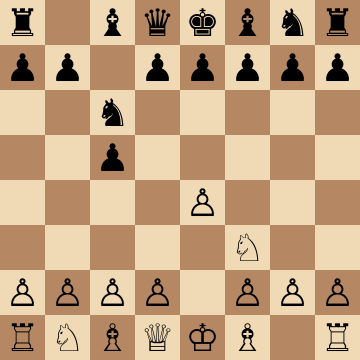
1.e4 c5 2.Nf3 Nc6 3.d4 cxd4 4.Nxd4 g6
The Accelerated Dragon (1.e4 c5 2.Nf3 Nc6 3.d4 cxd4 4.Nxd4 g6) fianchettos the Dragon bishop one move faster than its famous cousin — skipping ...d6 so that ...d5 can come in a single step. The reward is a sound, strategic Sicilian where White's sharpest attacking setups simply don't work.
Mainline
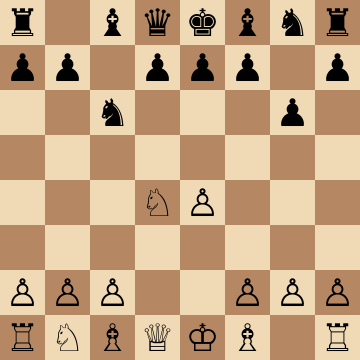
1.e4 c5 2.Nf3 Nc6 3.d4 cxd4 4.Nxd4 g6 5.Nc3 Bg7 6.Be3 Nf6 7.Bc4 O-O 8.Bb3 d6
Classical Main Line with ...Nxd4 and ...b5!
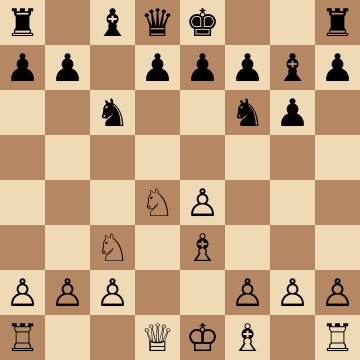
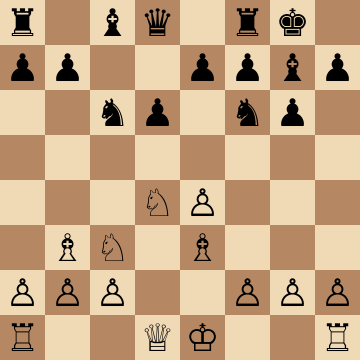
1.e4 c5 2.Nf3 Nc6 3.d4 cxd4 4.Nxd4 g6 5.Nc3 Bg7 6.Be3 Nf6 7.Bc4 O-O 8.Bb3 d6 9.f3 Bd7 10.Qd2 Nxd4 11.Bxd4 b5
Here is the dividend of skipping an early ...d6 tempo-fight: when White sets up Yugoslav-style with f3 and Qd2, Black has ...b5 in one move — no ...a6 needed. The pawn is untouchable in most lines because ...Nxe4! tricks hang over c3, and Black gets the b-file and the long diagonal working together. Follow with ...a5-a4 to harass the b3-bishop, and remember: if White castles long anyway, your attack is faster.
Maroczy Bind: Gurgenidze System
1.e4 c5 2.Nf3 Nc6 3.d4 cxd4 4.Nxd4 g6 5.c4 Nf6 6.Nc3 d6 7.Be2 Nxd4 8.Qxd4 Bg7 9.Be3 O-O 10.Qd2 Be6 11.Rc1 Qa5
The Maroczy Bind is the reason some players avoid the Accelerated Dragon — it shouldn't be. The Gurgenidze recipe gives Black a clear roadmap: trade a pair of knights, post the bishop on e6, and press with ...Qa5 and ...Rfc8 against c4. White's space means nothing if it can't be converted, and the dark squares around d4 belong to your g7-bishop forever. Patience is the skill this line teaches; overextension is the mistake it punishes.
Study the Beat the Accelerated Dragon course
7.Bc4 Qa5 Variation
1.e4 c5 2.Nf3 Nc6 3.d4 cxd4 4.Nxd4 g6 5.Nc3 Bg7 6.Be3 Nf6 7.Bc4 Qa5 8.O-O O-O 9.Bb3 d6 10.h3 Bd7
An aggressive alternative to the automatic ...O-O: the queen comes out first, pinning the c3-knight and setting up ...Nxe4 tricks that force White to spend time on prophylaxis. Once both sides castle, Black regroups with ...Bd7 and ...Rfc8 or breaks with a timely ...b5, and the queen on a5 keeps eyeing both wings. This move order also dodges some of White's sharpest attacking setups, since Qd2 always has to reckon with the pin.
The 8.f3? Qb6! Trap
1.e4 c5 2.Nf3 Nc6 3.d4 cxd4 4.Nxd4 g6 5.Nc3 Bg7 6.Be3 Nf6 7.Bc4 O-O 8.f3 Qb6 9.Bb3 Nxe4
The most important tactical pattern in the whole opening. When White plays the routine Yugoslav move 8.f3 here, 8...Qb6! forks b2 and the d4-knight — and the natural 9.Bb3? loses a pawn by force to 9...Nxe4!, since 10.fxe4 Bxd4 wins the piece back with interest thanks to the loose bishop on e3. Thousands of Dragon-minded White players fall into this exact sequence; check every ...Qb6 and ...Nxe4 idea in your games, because the motif repeats constantly.
Anti-Yugoslav: 7.f3 d5! Break
1.e4 c5 2.Nf3 Nc6 3.d4 cxd4 4.Nxd4 g6 5.Nc3 Bg7 6.Be3 Nf6 7.f3 O-O 8.Qd2 d5 9.exd5 Nxd5 10.Nxc6 bxc6
This is the strategic justification of the Accelerated move order. White builds the feared Yugoslav Attack setup — and Black defuses it with one central strike: 8...d5!, played in a single tempo because ...d6 was never spent. After the forced exchanges Black's pieces are gloriously active, the g7-bishop breathes down the long diagonal, and White's attacking dream is gone; grabbing on d5 with the queen invites ...Qc7 and ...Rd8 with a dangerous initiative for Black.
Key ideas
- Develop the g7-bishop immediately and aim for the freeing ...d5 break in one move, not two.
- Defang the Yugoslav Attack: without an early ...d6, White's sharpest plans lose their target.
- Play healthy, strategic chess on the queenside with ...a5, ...Nc6-e5 hops and pressure on c-file squares.
- Be ready for the Maroczy Bind (5.c4) — the course's centerpiece is a full plan against it.
Typical plans and structures
In the open lines Black castles quickly, plays ...d6 only when useful, and generates queenside play with ...a5 or a timely ...d5 equalizer. Against the critical Maroczy Bind, Black trades a pair of knights, maneuvers with ...Be6, ...Qa5 and ...Rfc8, and probes the dark squares that c4 left behind — patient play that turns White's space into overextension. The Dragon bishop is the constant: nearly every plan feeds the a1-h8 diagonal.
Who should play it
Sicilian players who want Dragon activity with far less theory and risk — and don't mind playing a strategic squeeze against the Maroczy Bind.
Study the Accelerated Dragon move by move
The first 3 lines of the interactive course, exactly as a signed-out visitor can play them — each move with the coaching note shown on the board.
Line 1 — the main line
1.e4 Our opponent claims the center. 1...c5 We launch the Sicilian Defense. 2.Nf3 Our opponent is planning to break with d2 d4 next, entering the open Sicilian. 2...Nc6 We develop our knight, controlling d4. 3.d4 Breaking in the center to open lines for their bishops and centralize their knight. 3...cxd4 We trade pawns in the center. 4.Nxd4 Our opponent takes back with the knight. 4...g6 We enter the Accelerated Dragon! 5.Nc3 Our opponent activates their knight, reinforcing e4. 5...Bg7 We fianchetto the bishop, increasing pressure on their knight. 6.Be3 Our opponent brings their bishop out to defend their knight. 6...Nf6 We develop the knight and prepare to castle. 7.Bc4 Attacking f7 and preventing the ...d7 d5 break. 7...O-O We castle. 8.Bb3 Our opponent retreats their bishop to a safer square on the same diagonal. 8...d6 Freeing the light squared bishop. 9.f3 Our opponent pushes the pawn to reinforce e4 and keep our pieces off g4. 9...Bd7 We bring out the bishop, ready to recapture on c6 if needed. 10.Qd2 Our opponent brings out the queen, aligning with the bishop and preparing to castle long. 10...Nxd4 We trade knights in the center. 11.Bxd4 Our opponent takes back with the bishop. 11...b5 We start a queenside pawn storm, pressuring their knight and bishop as we anticipate long castling. 12.h4 Our opponent aims for h4 h5 to open the file. 12...a5 We stick to the plan, adding another pawn to the attack. 13.a4 Our opponent pushes their a pawn to block our a5 pawn and offer a trade. 13...bxa4 We capture on a4. 14.Nxa4 Our opponent takes back with the knight. 14...Be6 We offer a bishop trade, undermining their queenside and keeping their king awkward while we are already castled and ready to bring our rooks to the open files.
Line 2 — against an inaccuracy
1.e4 Our opponent claims the center. 1...c5 We launch the Sicilian Defense. 2.Nf3 Our opponent is planning to break with d2 d4 next, entering the open Sicilian. 2...Nc6 We develop our knight, controlling d4. 3.d4 Breaking in the center to open lines for their bishops and centralize their knight. 3...cxd4 We trade pawns in the center. 4.Nxd4 Our opponent takes back with the knight. 4...g6 We enter the Accelerated Dragon! 5.Nc3 Our opponent activates their knight, reinforcing e4. 5...Bg7 We fianchetto the bishop, increasing pressure on their knight. 6.Be3 Our opponent brings their bishop out to defend their knight. 6...Nf6 We develop the knight and prepare to castle. 7.Bc4 Attacking f7 and preventing the ...d7 d5 break. 7...O-O We castle. 8.Bb3 Our opponent retreats their bishop to a safer square on the same diagonal. 8...d6 Freeing the light squared bishop. 9.f3 Our opponent pushes the pawn to reinforce e4 and keep our pieces off g4. 9...Bd7 We bring out the bishop, ready to recapture on c6 if needed. 10.Qd2 Our opponent brings out the queen, aligning with the bishop and preparing to castle long. 10...Nxd4 We trade knights in the center. 11.Bxd4 Our opponent takes back with the bishop. 11...b5 We start a queenside pawn storm, pressuring their knight and bishop as we anticipate long castling. 12.O-O-O Our opponent castles queenside. 12...a5 We push the a pawn, targeting their bishop and knight. 13.Nd5 Our opponent centralizes the knight. 13...Nxd5 We capture their knight. 14.Bxg7 Our opponent takes on g7. 14...Kxg7 We take back with the king. 15.Bxd5 Our opponent recaptures on d5. 15...Rc8 We place the rook on the c file, keeping strong pressure against our opponent's king.
Line 3 — the main line
1.e4 Our opponent claims the center. 1...c5 We launch the Sicilian Defense. 2.Nf3 Our opponent is planning to break with d2 d4 next, entering the open Sicilian. 2...Nc6 We develop our knight, controlling d4. 3.d4 Breaking in the center to open lines for their bishops and centralize their knight. 3...cxd4 We trade pawns in the center. 4.Nxd4 Our opponent takes back with the knight. 4...g6 We enter the Accelerated Dragon! 5.Nc3 Our opponent activates their knight, reinforcing e4. 5...Bg7 We fianchetto the bishop, increasing pressure on their knight. 6.Be3 Our opponent brings their bishop out to defend their knight. 6...Nf6 We develop the knight and prepare to castle. 7.Bc4 Attacking f7 and preventing the ...d7 d5 break. 7...O-O We castle. 8.Bb3 Our opponent retreats their bishop to a safer square on the same diagonal. 8...d6 Freeing the light squared bishop. 9.f3 Our opponent pushes the pawn to reinforce e4 and keep our pieces off g4. 9...Bd7 We bring out the bishop, ready to recapture on c6 if needed. 10.h4 Our opponent plans h4 h5 to open the h file. 10...h5 We block the advance with our pawn. 11.Qd2 Our opponent develops their queen, preparing to castle long. 11...Rc8 We activate the rook along the c file. 12.O-O-O Our opponent castles. 12...Ne5 We centralize hthe knight, aiming for ...Ne5 c4. 13.Bg5 Our oponent repositions their bishop, putting pressure on our knight. 13...Rc5 We advance the rook, preparing to expand on the queenside. 14.Kb1 Our opponent sidesteps with the king. 14...b5 We launch an attack against their king, preparing ...b5 b4 to pressure their knight and follow with ... a7 a5.
The free preview ends here — continue with all 13 lines in the interactive course, with instant feedback on every move you play.
Frequently asked questions
What is the difference between the Dragon and the Accelerated Dragon?
The Accelerated Dragon plays ...g6 before ...d6, keeping the option of ...d5 in ONE move. That extra tempo defuses the Yugoslav Attack that terrorizes regular Dragon players — but allows White the Maroczy Bind with c4, which becomes the main strategic battleground.
Is the Accelerated Dragon good for club players?
Excellent — the plans are thematic, the theory is light compared to the main-line Dragon or Najdorf, and the resulting middlegames teach real strategy: piece activity, pawn breaks, and how to play against space. It is one of the most practical Sicilians available.
How does Black handle the Maroczy Bind?
With patience and precise piece placement: trade a pair of minor pieces to ease the cramp, target the dark squares (d4 especially), and strike with ...b5 or ...f5 only when prepared. The course dedicates its deepest chapters to exactly this structure.
Learn the Accelerated Dragon with AI feedback
This page pairs the guide above with an interactive ChessMind AI course: a GM-authored repertoire you study move by move on a real board, then practice against a human-like chess AI opponent with instant feedback and spaced-repetition review, so the key positions actually stick. Start learning, jump straight into practice, or browse all opening courses.
New to a concept? Every term is defined in the chess terms glossary.