Sicilian Kalashnikov
1.e4 c5 2.Nf3 Nc6 3.d4 cxd4 4.Nxd4
The Kalashnikov (1.e4 c5 2.Nf3 Nc6 3.d4 cxd4 4.Nxd4 e5) grabs the center immediately and asks White uncomfortable questions from move four. A little-known cousin of the Sveshnikov with a fraction of its theory, it delivers what Sicilian players crave: unbalanced positions, active pieces, and real winning chances with Black.
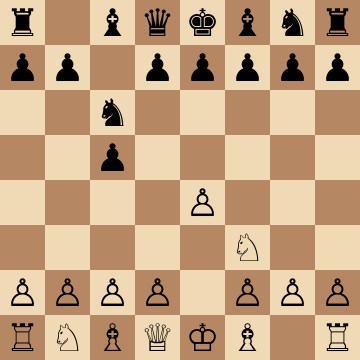
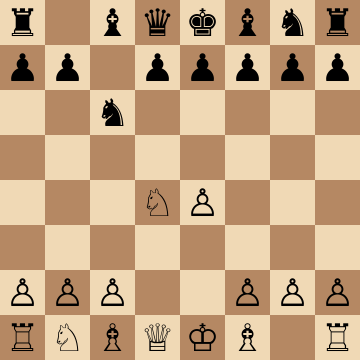
Mainline
1.e4 c5 2.Nf3 Nc6 3.d4 cxd4 4.Nxd4 e5 5.Nb5 d6 6.N1c3 a6 7.Na3 b5 8.Nd5 Nge7
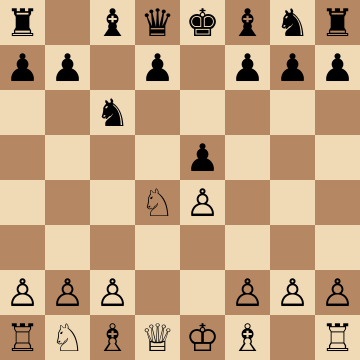
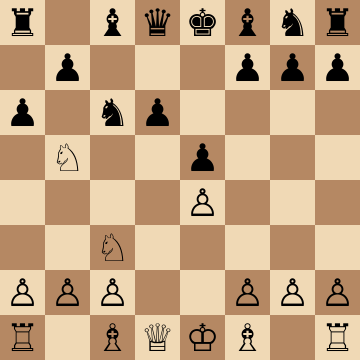
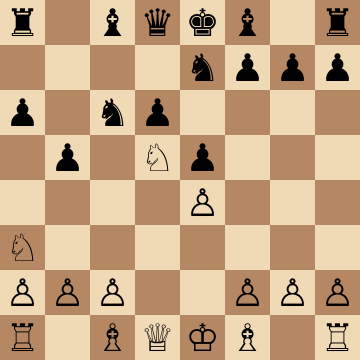
Kalashnikov: 5.Nb5 d6 Main Line
1.e4 c5 2.Nf3 Nc6 3.d4 cxd4 4.Nxd4 e5 5.Nb5 d6 6.N1c3 a6 7.Na3 b5
The tabiya of the whole variation. Black accepts a hole on d5 in exchange for space, the bishop pair and fast queenside expansion. The knight on a3 looks silly but is heading for c2 and e3 to fight for d5, and the entire middlegame is a referendum on whether that square or Black's activity matters more.
Kalashnikov: 6.c4 Maróczy Setup
1.e4 c5 2.Nf3 Nc6 3.d4 cxd4 4.Nxd4 e5 5.Nb5 d6 6.c4 Be7 7.N1c3 a6 8.Na3
White plants a pawn on c4 to deny Black the ...b5 break and turn the d5-hole into a permanent asset. This is the positional test: Black must find counterplay with ...f5 on the kingside or the ...b5 lever anyway, because passive play in this structure loses slowly but surely.
Kalashnikov: 8.Nd5 Central Outpost
1.e4 c5 2.Nf3 Nc6 3.d4 cxd4 4.Nxd4 e5 5.Nb5 d6 6.N1c3 a6 7.Na3 b5 8.Nd5 Nge7
White occupies the hole immediately. Black's answer is the standard one: challenge the outpost with ...Nge7 and be ready to accept doubled pawns after a capture on e7, because the bishop pair and the half-open files are worth more than a cosmetic structural defect.
Kalashnikov: Löwenthal Move Order (5...a6)
1.e4 c5 2.Nf3 Nc6 3.d4 cxd4 4.Nxd4 e5 5.Nb5 a6 6.Nd6+ Bxd6 7.Qxd6 Qf6
The older, sharper cousin: Black offers the dark-squared bishop for time and the initiative. After the queens come off or Black chases the intruder with ...Qf6 and ...Nge7, the position is genuinely unbalanced. Worth knowing even if you play the ...d6 main line, because the move orders overlap constantly.
Study the Beat the Lowenthal Sicilian course
Kalashnikov: ...Be6 Development Plan
1.e4 c5 2.Nf3 Nc6 3.d4 cxd4 4.Nxd4 e5 5.Nb5 d6 6.N1c3 a6 7.Na3 Be6 8.Nc4
Black develops the bishop to contest d5 directly instead of rushing ...b5. White's knight arrives on c4 to hit d6 and e5, and both sides manoeuvre around the same handful of squares. Understanding this slower treatment is what lets you play the Kalashnikov against opponents who refuse to be provoked.
Kalashnikov vs Sveshnikov Structures
1.e4 c5 2.Nf3 Nc6 3.d4 cxd4 4.Nxd4 Nf6 5.Nc3 e5 6.Ndb5 d6 7.Bg5 a6 8.Na3
Insert ...Nf6 before ...e5 and you are in the Sveshnikov, where White pins with Bg5 and heads for the same d5-square. The two systems share a skeleton but differ in one crucial detail — whether Black's knight is committed to f6 — and choosing between them on move four is a repertoire decision worth making consciously.
Study the Beat the Sveshnikov Sicilian course
Key ideas
- Strike with 4...e5 at once, evicting the knight and staking a claim in the center.
- Accept the d5-hole on your terms — active piece play and pawn breaks compensate with interest.
- Expand with ...a6 and ...b5, gaining queenside space and dislodging White's pieces.
- Choose your fight: positional squeezes with ...Be7 and ...Nge7 or direct attacks with ...f5.
Typical plans and structures
Black's standard regrouping — ...a6, ...b5, ...Nge7-g6 or ...Nf6, ...Be7 and ...O-O — prepares the two great breaks: ...f5 for kingside play and ...b4 or ...d5 to liquidate the backward pawn. Against White's Maroczy-style c4 clamp, Black switches to dark-square strategy with ...g6 setups and patient maneuvering. The Kalashnikov's charm is that Black's plans are clearer than White's: many opponents know they should exploit d5 but not how, and drift into passivity while Black's initiative grows.
Who should play it
Sicilian players who want Sveshnikov-style dynamism without the Sveshnikov's crushing theory load — and enjoy surprising well-booked opponents.
Study the Sicilian Kalashnikov move by move
The first 3 lines of the interactive course, exactly as a signed-out visitor can play them — each move with the coaching note shown on the board.
Line 1 — against an inaccuracy
1.e4 natural move. 1...c5 We enter the Sicilian Defense. 2.Nf3 Our opponent develops the knight toward the center. 2...Nc6 natural development, controlling d4. 3.d4 Our opponent breaks in the center. 3...cxd4 typical Sicilian exchange. 4.Nxd4 Our opponent takes back, gaining space. 4...e5 We launch the Kalashnikov, a sharp, imbalanced line of the Sicilian. 5.Nb5 Threatening a jump to d6. 5...d6 Keeping the knight out of d6. 6.N1c3 Reinforcing e4 and aiming at d5. 6...a6 Forcing a retreat. 7.Na3 Our opponent retreats the knight. 7...b5 Threatening a fork on b4. 8.Nd5 Centralizing the knight and preventing the fork. 8...Nge7 We develop the knight. 9.c4 White seeks more space. 9...Nd4 We jump into the center with the knight, sacrificing the b5 pawn for activity. 10.cxb5 White grabs the pawn. 10...Nxd5 Intermezzo, removing their best piece. 11.exd5 Our opponent takes back. 11...g6 We prepare to fianchetto on the kingside. 12.bxa6 White keeps taking; Benko-style ideas emerge. 12...Bg7 We bring the bishop to the long diagonal and prepare to castle. 13.Bd3 White completes development. 13...e4 We sacrifice the e pawn while their king is still uncastled. 14.Bxe4 White takes the pawn. 14...Qh4 We activate the queen, targeting their bishop. 15.Bd3 Our opponent's bishop sidesteps the threat. 15...O-O We castle. 16.O-O Our opponent castles as well. 16...Bg4 We bring out the bishop with tempo against their queen. 17.Qd2 Our opponent repositions the queen. 17...Nf3+ We sacrifice the knight to rip open their kingside with a strong attack.
Line 2 — against an inaccuracy
1.e4 natural move. 1...c5 We enter the Sicilian Defense. 2.Nf3 Our opponent develops the knight toward the center. 2...Nc6 natural development, controlling d4. 3.d4 Our opponent breaks in the center. 3...cxd4 typical Sicilian exchange. 4.Nxd4 Our opponent takes back, gaining space. 4...e5 We launch the Kalashnikov, a sharp, imbalanced line of the Sicilian. 5.Nb5 Threatening a jump to d6. 5...d6 Keeping the knight out of d6. 6.N1c3 Reinforcing e4 and aiming at d5. 6...a6 Forcing a retreat. 7.Na3 Our opponent retreats the knight. 7...b5 Threatening a fork on b4. 8.Nd5 Centralizing the knight and preventing the fork. 8...Nge7 We develop the knight. 9.Bg5 White pins. 9...h6 we hit the intruder. 10.Bh4 retreats, keeps the pin. 10...Qa5+ check, also breaks the pin. 11.c3 Blocking the threat. 11...Nxd5 we capture the central knight. 12.exd5 they capture, hit the knight. 12...Ne7 knight to e7, ready to hop kingside. 13.Bd3 White develops bishop. 13...Nf5 our knight finds an active post. 14.Bxf5 White removes the knight. 14...Bxf5 we recapture, bishop developed. 15.O-O White king safe. 15...g5 we push the bishop. 16.Bg3 bishop retreats. 16...Bg7 We keep the bishop pair, ready to castle and seize the initiative.
Line 3 — against an inaccuracy
1.e4 natural move. 1...c5 We enter the Sicilian Defense. 2.Nf3 Our opponent develops the knight toward the center. 2...Nc6 natural development, controlling d4. 3.d4 Our opponent breaks in the center. 3...cxd4 typical Sicilian exchange. 4.Nxd4 Our opponent takes back, gaining space. 4...e5 We launch the Kalashnikov, a sharp, imbalanced line of the Sicilian. 5.Nb5 Threatening a jump to d6. 5...d6 Keeping the knight out of d6. 6.N1c3 Reinforcing e4 and aiming at d5. 6...a6 Forcing a retreat. 7.Na3 Our opponent retreats the knight. 7...b5 Threatening a fork on b4. 8.Nd5 Centralizing the knight and preventing the fork. 8...Nge7 We develop the knight. 9.Bg5 White pins. 9...h6 we hit the intruder. 10.Bh4 retreats, keeps the pin. 10...Qa5+ check, also breaks the pin. 11.Qd2 alternative defence. 11...Qxd2+ favourable swapâwhite king can't castle. 12.Kxd2 only capture. 12...Nxd5 we trade the central knight. 13.exd5 White must capture. 13...Nb4 threatens the central pawn. 14.c4 only defence. 14...bxc4 we pick off the defender. 15.Bxc4 White recaptures, guards d5. 15...Bb7 after the threat, d5 is lost.
The free preview ends here — continue with all 17 lines in the interactive course, with instant feedback on every move you play.
Frequently asked questions
Is the Kalashnikov Sicilian sound?
Yes — it is a fully respectable member of the ...e5 Sicilian family, played by grandmasters including Teimour Radjabov and Alexander Morozevich. White gets normal chances for an edge, but nothing forcing, and the practical burden of proving it falls on White every game.
Isn't the hole on d5 a serious weakness?
It is a known cost with a known payment plan: Black gets the bishop pair potential, queenside expansion and central breaks in return. Decades of ...e5 Sicilian practice show the d5-square alone wins nothing — White must accomplish something concrete with it before Black's activity lands.
Why choose the Kalashnikov over the Sveshnikov?
The Sveshnikov's main lines run past move twenty-five in forced play — a professional's workload. The Kalashnikov reaches similar dynamic structures with a fifth of the memorization, and its relative rarity means your opponents face it with general knowledge while you play prepared moves.
Learn the Sicilian Kalashnikov with AI feedback
This page pairs the guide above with an interactive ChessMind AI course: a GM-authored repertoire you study move by move on a real board, then practice against a human-like chess AI opponent with instant feedback and spaced-repetition review, so the key positions actually stick. Start learning, jump straight into practice, or browse all opening courses.
New to a concept? Every term is defined in the chess terms glossary.