Scotch Opening
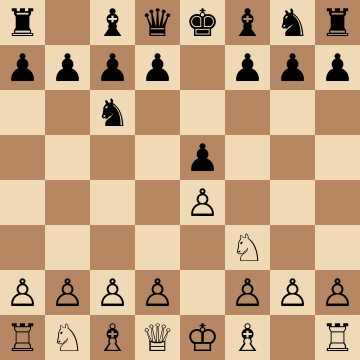
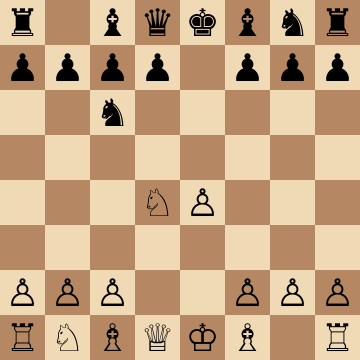
1.e4 e5 2.Nf3 Nc6 3.d4 exd4 4.Nxd4
The Scotch Opening (1.e4 e5 2.Nf3 Nc6 3.d4) resolves the central tension on move three and gets straight to active piece play. Garry Kasparov brought it back to world-championship level in the 1990s, proving the Scotch delivers something rare: open, dynamic positions with a lasting initiative and far less theory than the Ruy Lopez.
Mainline
1.e4 e5 2.Nf3 Nc6 3.d4 exd4 4.Nxd4 Bc5 5.Be3 Qf6 6.c3 Nge7
Classical Variation (4...Bc5 5.Be3)
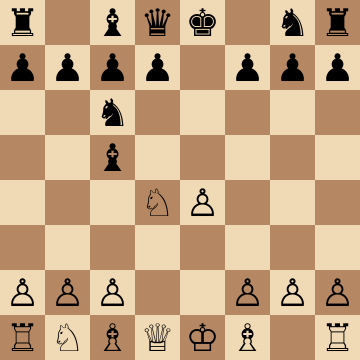
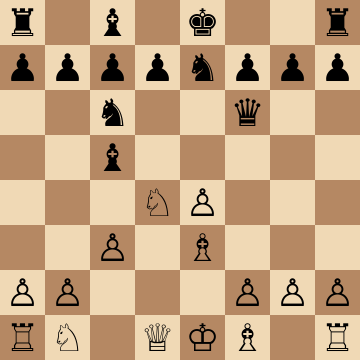
1.e4 e5 2.Nf3 Nc6 3.d4 exd4 4.Nxd4 Bc5 5.Be3 Qf6 6.c3 Nge7 7.Bc4 Ne5 8.Be2 Qg6 9.O-O d6
Black's most natural setup piles pieces onto d4, and White meets it with the time-tested c3 and Be3 shield. When the black queen ventures to g6 eyeing e4 and g2, the cool 9.O-O simply ignores the threat — grabbing on e4 loses the queen to Bd3 tricks, a trap that has caught thousands. White follows with f4 or Nd2, gaining time against Black's exposed queen and building a pleasant space advantage in the center.
Mieses Variation (4...Nf6 5.Nxc6)
1.e4 e5 2.Nf3 Nc6 3.d4 exd4 4.Nxd4 Nf6 5.Nxc6 bxc6 6.e5 Qe7 7.Qe2 Nd5 8.c4 Ba6 9.b3
Kasparov's weapon from his world-championship matches. The point of 5.Nxc6 and 6.e5 is structural: Black's knight gets pushed around and the doubled c-pawns last forever. The pin with 8...Ba6 is Black's main resource, met by the precise 9.b3 — White will untangle with Bb2, g3 and Bg2 or Nd2, keeping the extra kingside pawn majority. The endgames are the promise of this line: four healthy kingside pawns against Black's damaged queenside.
Steinitz Variation (4...Qh4?!)
1.e4 e5 2.Nf3 Nc6 3.d4 exd4 4.Nxd4 Qh4 5.Nc3 Bb4 6.Be2 Qxe4 7.Ndb5 Bxc3+ 8.bxc3 Kd8 9.O-O
The queen sortie 4...Qh4 attacks e4 and looks terrifying — let Black take it. After 5.Nc3 Bb4 6.Be2 Qxe4, the counterblow 7.Ndb5! hits c7 with such force that Black must give up the bishop and shuffle the king to d8 by hand. With 9.O-O White has every piece ready, the open b- and e-files, and a king in the center to hunt; the pawn is trivia. Meet greed with development — this line is the model example.
Scotch Gambit (4.Bc4)
1.e4 e5 2.Nf3 Nc6 3.d4 exd4 4.Bc4 Bc5 5.c3 Nf6 6.cxd4 Bb4+ 7.Nc3 Nxe4 8.O-O Bxc3 9.d5 Bf6 10.Re1 Ne7
Offering the d4-pawn for rapid development turns the Scotch into a genuine attacking system. If Black grabs everything, the famous 9.d5! and 10.Re1 sequence regains the piece with a raging initiative — the e4-knight is pinned and Black's king still sits at home. Quieter Black tries transpose to Italian structures where White's center arrives for free. A complete course on this gambit, with all of Black's defenses mapped, is available separately.
Study the Scotch Gambit course
Center Queen Line (4...Nxd4 5.Qxd4)
1.e4 e5 2.Nf3 Nc6 3.d4 exd4 4.Nxd4 Nxd4 5.Qxd4 d6 6.Bc4 Nf6 7.Nc3 Be7 8.O-O O-O
Trading knights on d4 is a club-level favorite that violates a classical rule at the worst moment: the white queen arrives on d4 and cannot be evicted — there is no ...Nc6 anymore, and ...c5 only weakens d5 for good. White develops effortlessly with Bc4, Nc3 and O-O, enjoying extra space and total freedom of plan: Bg5 and Nd5, or f4 and a kingside pawn storm. No theory required, just a comfortable edge and clear ideas.
Potter Variation (5.Nb3)
1.e4 e5 2.Nf3 Nc6 3.d4 exd4 4.Nxd4 Bc5 5.Nb3 Bb6 6.a4 a6 7.Nc3 Nf6
A practical sidestep against 4...Bc5: the knight retreat gains time on the bishop and keeps more pieces on the board than the main lines. The a4-a5 lunge is the follow-up point — Black must spend a move on ...a6, after which White chooses between Qe2 with Bg5 pressure or a quick Nd5. Ideal when you want Scotch positions with less memorization: the resulting middlegames are fresh, flexible, and easier to play for the side who chose them.
Key ideas
- Open the center immediately with 3.d4 — no slow maneuvering, no hundred-year theory debts.
- Develop actively against both main replies: Be3 lines versus 4...Bc5 and the space-gaining e5 versus 4...Nf6.
- Fight for the initiative from move four with concrete piece play and tactical alertness.
- Reach dynamic middlegames where the better-prepared, more active player wins — usually you.
Typical plans and structures
Against 4...Bc5, White's 5.Be3 with c3 and Bc4 or Qd2 leads to rich piece battles around the d4-knight; against 4...Nf6, the thematic 5.Nxc6 and 6.e5 gains space and forces Black into precise defense. White's typical middlegame assets are the mobile kingside majority, active minor pieces, and attacking chances that flow from the open center. The course provides a complete White repertoire from move three, including the sharp sidelines Black may try.
How to reach the Scotch Opening
After 1.e4 e5 2.Nf3 Nc6 White plays 3.d4. The main line continues 3...exd4 4.Nxd4, when Black has two principal replies: 4...Bc5, attacking the knight and the f2-pawn, and 4...Nf6, attacking e4 and inviting the Mieses Variation 5.Nxc6 bxc6 6.e5. The rarer 4...Qh4 is the Steinitz Variation. White can also decline to recapture: 4.Bc4 is the Scotch Gambit, which often transposes to the Italian, and 4.c3 is the Göring Gambit, offering one or two pawns for development.
Pros and cons of the Scotch Opening
Pros
- Opens the center at once, so White's pieces are active from move four and there is no slow maneuvering to learn.
- Far less theory than the Ruy Lopez, with plans that are easy to understand.
- The Mieses Variation gives White a strategic trump, the queenside pawn majority, and a clear endgame plan.
- The gambit versions, Scotch and Göring, are dangerous surprise weapons at club level.
Cons
- Releasing the central tension early lets Black develop freely; theory considers the position roughly equal.
- The knight on d4 is a target for ...Bc5 and ...Qh4 ideas, and White must often spend tempi with the queen or the knight.
- In the Mieses lines the e5-pawn can become weak and the bishop pair is Black's, not White's.
- Players who love closed maneuvering positions will find the Scotch too open.
How to play against the Scotch Opening
Black's two main lines are both fully reliable. 4...Bc5 keeps the pieces on the board and leads to lively middlegames; the key is to follow up with ...Qf6, ...Nge7 and ...d6 and to meet Be3 and c3 with the ...Ne5 and ...Qg6 regrouping rather than passive play. 4...Nf6 accepts the Mieses structure, where Black should play ...Qe7, ...Nd5 and ...Ba6 quickly, break the e5-pawn's support with ...f6 or ...d6, and welcome an endgame where the doubled c-pawns matter less than the active pieces. Against the Scotch Gambit, 4...Nf6 5.e5 d5 is the cleanest route; against the Göring Gambit, decline with 4...d5 or take once and return the pawn. The single rule that applies everywhere: keep pressure on e4 or e5, because the early d4 leaves White's center without pawn support.
Plans for both sides
White's plan
Use the open center for fast development, then decide the middlegame plan by the structure: in the Mieses lines advance the queenside majority with c4, Nc3 and b3, and defend e5 with pieces rather than pawns; in the classical lines complete development with Be3, c3, Bc4 or Be2 and Nd2 and play for the f4 break. Trade off Black's active dark-squared bishop when possible.
Black's plan
Develop with tempo against the d4-knight, hit e4 or e5 immediately, and break with ...d5 as soon as it is safe. In the Mieses, treat the c-pawns as a source of central control rather than a weakness, and put the bishop on a6 or b7 to pressure White's queenside. Go into endgames with active pieces gladly.
Who should play it
1.e4 players who want an ambitious alternative to the Italian and Ruy Lopez — open positions, real initiative, manageable theory.
History of the Scotch Opening
The Scotch takes its name from a correspondence match between the Edinburgh and London chess clubs in 1824 to 1828, which the Scots won partly thanks to 3.d4. It was popular in the romantic era, then fell out of favor when Steinitz and Tarrasch showed that the early exchange eased Black's game. Jacques Mieses kept it alive in the early twentieth century, and it was largely forgotten until Kasparov revived it against Karpov in 1990 and used it repeatedly through the decade. Since then it has been a regular choice for players from Radjabov to Carlsen who want an Open Game without the weight of Ruy Lopez theory.
Frequently asked questions
Is the Scotch a good alternative to the Ruy Lopez?
Yes — that is precisely the role Kasparov gave it in his world championship matches against Karpov. It promises comparable ambition with a fraction of the theoretical burden, and Black cannot steer the game into the slow, well-mapped channels e4-e5 players know best.
What are Black's main defenses to the Scotch?
The two pillars are 4...Bc5, developing with pressure on d4, and 4...Nf6, counterattacking e4 — met by 5.Be3 and 5.Nxc6 followed by 6.e5 respectively. Both lead to the open, piece-driven middlegames this course prepares you to dominate.
Is the Scotch good for improving players?
Excellent — the open center teaches active piece play, initiative and concrete calculation, the exact skills that build chess strength. And because the theory is compact, your study time goes into understanding positions rather than memorizing branches.
Is the Scotch Game a good opening?
Yes. It has been played at world championship level since Kasparov revived it in 1990 and is fully sound. It leads to open positions with clear plans and needs far less memorization than the Ruy Lopez.
Is the Scotch opening aggressive?
Moderately. The center opens at once and White's pieces are active early, so tactics arrive quickly, but the main lines are strategic rather than a direct king attack. The Scotch Gambit and Göring Gambit are the genuinely aggressive versions.
What is the difference between the Scotch Game and the Scotch Gambit?
In the Scotch Game White recaptures on d4 with the knight, 4.Nxd4, keeping material level. In the Scotch Gambit White plays 4.Bc4 instead, leaving the pawn on d4 for a lead in development, and often transposes into Italian Game positions.
How do you play against the Scotch?
Reply 4...Bc5 with ...Qf6 and ...Nge7 for an active game, or 4...Nf6 and meet 5.Nxc6 bxc6 6.e5 with ...Qe7, ...Nd5 and ...Ba6. Against the gambits, decline with ...d5 or return the pawn quickly rather than defending it.
What is the ECO code for the Scotch Game?
The Scotch is classified under ECO C44 for the gambit lines and C45 for the main lines after 4.Nxd4. The Scotch Four Knights is found under C47.
Learn the Scotch Opening with AI feedback
This page pairs the guide above with an interactive ChessMind AI course: a GM-authored repertoire you study move by move on a real board, then practice against a human-like chess AI opponent with instant feedback and spaced-repetition review, so the key positions actually stick. Start learning, jump straight into practice, or browse all opening courses.
New to a concept? Every term is defined in the chess terms glossary.