Vienna Gambit
1.e4 e5 2.Nc3 Nf6 3.f4
The Vienna Gambit (1.e4 e5 2.Nc3 followed by f4) is an easy-to-learn attacking system. It mixes the aggression of a gambit with sensible piece development, making it popular with online players.
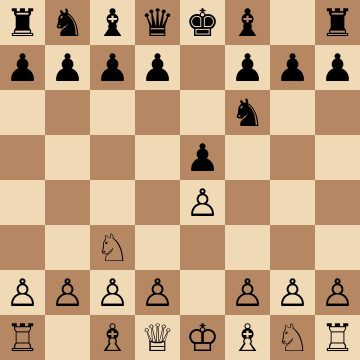
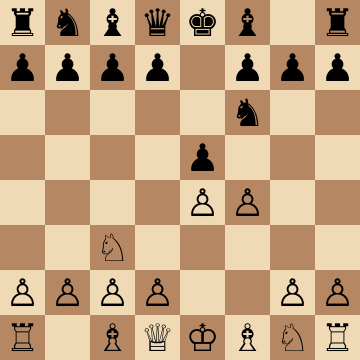
Mainline
1.e4 e5 2.Nc3 Nf6 3.f4 d5 4.fxe5 Nxe4 5.Nf3
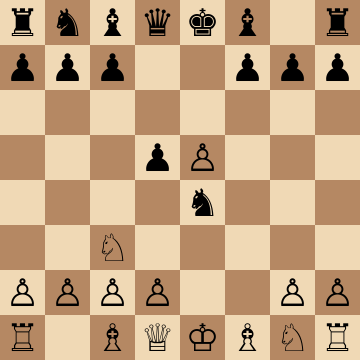
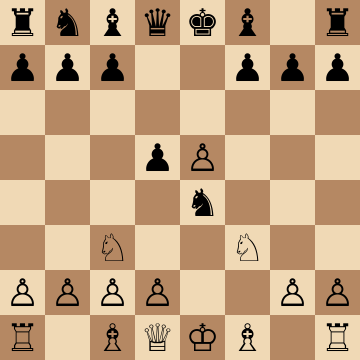
Main Line with 3...d5
1.e4 e5 2.Nc3 Nf6 3.f4 d5 4.fxe5 Nxe4 5.Nf3
The only critical answer: Black counters in the center before the f-file opens. White happily plays 4.fxe5 and 5.Nf3, when the e5 wedge cramps Black's kingside and the knight covers the sensitive g1–a7 diagonal checks. Plans of d3, Qe2 and long-term pressure down the half-open f-file give White the easier game to play — every other Black third move scores worse.
Gambit Accepted with 3...exf4
1.e4 e5 2.Nc3 Nf6 3.f4 exf4 4.e5 Qe7 5.Qe2 Ng8 6.Nf3
Taking the pawn is the move the Vienna Gambit is waiting for: 4.e5! immediately hits the f6-knight, and because 2.Nc3 already guards e4 there is no ...Qh4+ resource like in the King's Gambit. After the forced retreat White regains the pawn at leisure with a big lead in development and space — many club games are effectively decided by move ten here.
Declined Setup with 3...d6
1.e4 e5 2.Nc3 Nf6 3.f4 d6 4.Nf3 Nc6 5.Bb5
The solid decline transposes into a favorable King's Gambit Declined structure: White develops with Nf3 and Bb5, castles short, and chooses the moment for fxe5 or f5 on his own terms. Black avoids the tactics but concedes the center and the initiative — exactly the kind of quiet position where the extra kingside space converts into a slow, pleasant attack.
Copycat 3...Bc5 Punishment
1.e4 e5 2.Nc3 Nf6 3.f4 Bc5 4.fxe5 Nxe4 5.Qg4
Natural development walks into the opening's signature trap: after 4.fxe5 the knight grab 4...Nxe4? runs into 5.Qg4!, forking g7 and the loose knight. Both recaptures lose material and grabbing the rook's pawn loses the knight — a line worth knowing move-for-move, because online opponents fall into it constantly.
Key ideas
- Develop naturally with Nc3, then strike with f4.
- Attacking chances without a huge amount of theory to memorize.
- A practical, fun weapon that scores well in fast time controls.
- Rich tactical ideas that reward the better-prepared player.
Typical plans and structures
Against the critical 3...d5, White plays 4.fxe5 Nxe4 5.Nf3, develops with d3 and Qe2 ideas, and uses the space wedge on e5 plus the half-open f-file for a lasting kingside initiative. If Black defends passively with 3...d6, White gets a favorable King's Gambit structure where f4-f5 or fxe5 comes on White's terms. The infamous trap lines — including the queen-winning punishments of 3...exf4? — are part of the package: knowing them wins games outright at every fast time control.
Who should play it
Players who want an aggressive, low-theory 1.e4 opening that is fun to play and easy to pick up.
Study the Vienna Gambit move by move
The first 3 lines of the interactive course, exactly as a signed-out visitor can play them — each move with the coaching note shown on the board.
Line 1 — punishing a blunder
1.e4 We claim the center. 1...e5 Our opponent responds symmetrically. 2.Nc3 We develop our knight, protecting our e4 pawn and leaving open the option to push our f pawn next move. 2...Nf6 Our opponent develops their knight. 3.f4 We launch the Vienna Gambit. 3...exf4?! This is the most common response in online games, our opponent accepts our gift but allows us to expand in the center while gaining tempos. 4.e5! We advance in the center and drive their knight backwards. 4...Ng8 Our opponent retreats, their knight has no choice since the knight can't jump to h5 without being captured. 5.Nf3 We develop guarding against ...Qh4 check from our opponent. 5...d6 Our e5 pawn is too annoying, so our opponent opponent strikes in the center hoping to get rid of it. 6.d4 We increase our control of the center, and prepare to recapture the pawn we gave away with Bxf4. 6...dxe5 Our opponent trades in the center. 7.Bb5+! We don't bother recapturing the pawn, and instead given an annoying check. 7...c6 Our opponent blocks the check. 8.Bc4! We retreat the bishop and set our sights on the f7 pawn. We don't mind being two pawns down because we are far ahead in development. 8...exd4 Our opponent captures another pawn, they don't have great alternatives since we were threatening Nxe5 anyway. 9.Bxf4 We recapture the f4 pawn and leave our knight on c3 hanging, but it's all part of the plan. 9...dxc3? Our opponent captures, falling for a very powerful trap we have set up. 10.Bxf7+! We take the pawn with a check. 10...Ke7 Our opponent probably thought they could just play this, and keep defending their queen, but we have seen much further. 11.Qe2+!! We give a check again. We leave our bishop on f7 hanging, but that's OK. 11...Kxf7 Our opponent captures our bishop, they had no choice, since other moves would have allowed mate or lost the queen immediately. 12.Ne5+ We bring our knight forward with a check. 12...Kf6 Our opponent moves the king forward. The alternative was going into the e file. 13.Bg5+! We give a check again, and at this point we are guaranteed to win our opponent's queen. 13...Kxg5 Our opponent captures our bishop to avoid losing the queen on the spot. 14.Nf7+ An amazing fork, we attack the king, queen and rook. 14...Kg6 The king has to move. 15.Nxh8+! We could have taken the queen, but why settle for just a queen when you can also win a rook AND A QUEEN? 15...Kf6 Moving to h6 (or g5) would have allowed another fork, losing the queen, so our opponent tries something different (spoiler alert: it won't work). 16.O-O+ We castle with tempo, bringing our rook into the attack. 16...Bf5 Our opponent blocks the check, practically the only move. 17.Rxf5+! We sacrifice our rook to break through the defense. 17...Kxf5 The king's dance continues, they are forced to recapture. 18.Rf1+ We give another check, forcing the king to g5 where it will be attacked by our knight. 18...Kg5 The only move. 19.Nf7+ We finally get to deliver this check, forking the king and queen again. 19...Kg6 The king moves, the game is almost over. 20.Qg4+! Again, why bother taking the queen when you can force something even better? 20...Qg5 There's nothing better than blocking with the queen. 21.Qxg5# Our opponent's king made half the moves of this game, but can finally rest, as we delivered checkmate.
Line 2 — punishing a blunder
1.e4 We claim the center. 1...e5 Our opponent responds symmetrically. 2.Nc3 We develop our knight, protecting our e4 pawn and leaving open the option to push our f pawn next move. 2...Nf6 Our opponent develops their knight. 3.f4 We launch the Vienna Gambit. 3...exf4?! This is the most common response in online games, our opponent accepts our gift but allows us to expand in the center while gaining tempos. 4.e5! We advance in the center and drive their knight backwards. 4...Ng8 Our opponent retreats, their knight has no choice since the knight can't jump to h5 without being captured. 5.Nf3 We develop guarding against ...Qh4 check from our opponent. 5...d6 Our e5 pawn is too annoying, so our opponent opponent strikes in the center hoping to get rid of it. 6.d4 We increase our control of the center, and prepare to recapture the pawn we gave away with Bxf4. 6...dxe5 Our opponent trades in the center. 7.Bb5+! We don't bother recapturing the pawn, and instead given an annoying check. 7...c6 Our opponent blocks the check. 8.Bc4! We retreat the bishop and set our sights on the f7 pawn. We don't mind being two pawns down because we are far ahead in development. 8...exd4 Our opponent captures another pawn, they don't have great alternatives since we were threatening Nxe5 anyway. 9.Bxf4 We recapture the f4 pawn and leave our knight on c3 hanging, but it's all part of the plan. 9...dxc3? Our opponent captures, falling for a very powerful trap we have set up. 10.Bxf7+! We take the pawn with a check. 10...Ke7 Our opponent probably thought they could just play this, and keep defending their queen, but we have seen much further. 11.Qe2+!! We give a check again. We leave our bishop on f7 hanging, but that's OK. 11...Kxf7 Our opponent captures our bishop, they had no choice, since other moves would have allowed mate or lost the queen immediately. 12.Ne5+ We bring our knight forward with a check. 12...Ke8 By going into the e file, our opponent walks into a discovered check. 13.Nxc6+! We give a check attacking the queen. 13...Qe7 Covering the check, there's nothing better. 14.Nxe7 We are a queen up and win easily.
Line 3 — against an inaccuracy
1.e4 We claim the center. 1...e5 Our opponent responds symmetrically. 2.Nc3 We develop our knight, protecting our e4 pawn and leaving open the option to push our f pawn next move. 2...Nf6 Our opponent develops their knight. 3.f4 We launch the Vienna Gambit. 3...exf4?! This is the most common response in online games, our opponent accepts our gift but allows us to expand in the center while gaining tempos. 4.e5! We advance in the center and drive their knight backwards. 4...Ng8 Our opponent retreats, their knight has no choice since the knight can't jump to h5 without being captured. 5.Nf3 We develop guarding against ...Qh4 check from our opponent. 5...d6 Our e5 pawn is too annoying, so our opponent opponent strikes in the center hoping to get rid of it. 6.d4 We increase our control of the center, and prepare to recapture the pawn we gave away with Bxf4. 6...dxe5 Our opponent trades in the center. 7.Bb5+! We don't bother recapturing the pawn, and instead given an annoying check. 7...c6 Our opponent blocks the check. 8.Bc4! We retreat the bishop and set our sights on the f7 pawn. We don't mind being two pawns down because we are far ahead in development. 8...exd4 Our opponent captures another pawn, they don't have great alternatives since we were threatening Nxe5 anyway. 9.Bxf4 We recapture the f4 pawn and leave our knight on c3 hanging, but it's all part of the plan. 9...Qe7+ This is the best move, but very hard to find. Our opponent gives a check to anticipate our Bxf7 idea. 10.Ne5 We cover the check centralizing the knight. 10...f6 Our opponent challenges our knight, taking advantage of the pin. 11.O-O! This is a very important move, we need to get out of the pin and bring our rook into the game. 11...dxc3 Our opponent captures our knight, but now our queen is guarding the d8 square so the king can't escape. 12.Bf7+ We give a check and force our opponent to give up their queen for our pieces. 12...Qxf7 This capture is forced. 13.Nxf7 We have gained the queen for three pieces. 13...Kxf7 Taking our third minor piece. 14.Qd8! Even though a queen is not always better than three minor pieces, here we are much better because of our strong initiative and the fact our opponent hasn't finished development, so we may gain material in the near future.
The free preview ends here — continue with all 18 lines in the interactive course, with instant feedback on every move you play.
Frequently asked questions
What makes the Vienna Gambit different from the King's Gambit?
The preparatory 2.Nc3 first develops a piece and defends e4, so when f4 comes on move three it arrives with extra support. Several of the King's Gambit's problem lines simply don't exist in the Vienna move order — aggression with a seatbelt.
What happens if Black takes the gambit pawn with 3...exf4?
Accepting immediately is a serious mistake in the Vienna move order: 4.e5! hits the f6-knight, and after it moves, Qg4 or Nf3-d5 ideas generate huge threats — many games end quickly. The critical test is instead 3...d5, which this course covers in depth.
Is the Vienna Gambit good for beginners?
It is one of the best aggressive openings for improving players: the setup is easy to remember, the attacking plans are thematic, the traps score constantly online, and the underlying ideas — development, initiative, f-file pressure — teach good chess habits.
What is the best response to the Vienna Gambit?
The main line 3...d5 is the engine-approved answer, striking back in the center before White's attack develops. That is exactly why this course drills the 4.fxe5 Nxe4 5.Nf3 positions in depth — against the best defense, White still gets the more comfortable, easier-to-play game.
Is the Vienna Gambit sound at higher levels?
It is a fully respectable weapon up to master level: White risks little, the worst case against perfect defense is a roughly balanced middlegame with active pieces, and everything short of the precise main line gives White a real advantage. Grandmasters keep using it as a practical surprise in rapid and blitz.
Learn the Vienna Gambit with AI feedback
This page pairs the guide above with an interactive ChessMind AI course: a GM-authored repertoire you study move by move on a real board, then practice against a human-like chess AI opponent with instant feedback and spaced-repetition review, so the key positions actually stick. Start learning, jump straight into practice, or browse all opening courses.
New to a concept? Every term is defined in the chess terms glossary.