Elephant Gambit
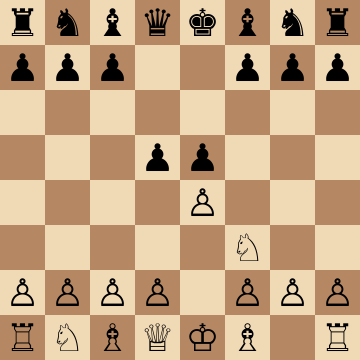
1.e4 e5 2.Nf3 d5
The Elephant Gambit (1.e4 e5 2.Nf3 d5!?) counterattacks in the center on move two, ignoring the attack on e5 entirely. Made famous online by Witty Alien, it drags 1.e4 players out of every prepared line by move three and rewards the player who actually knows the resulting positions.
Mainline
1.e4 e5 2.Nf3 d5 3.exd5 e4 4.Qe2 Nf6 5.d3 Be7
Main Line: 3.exd5 e4 (Paulsen Attack)
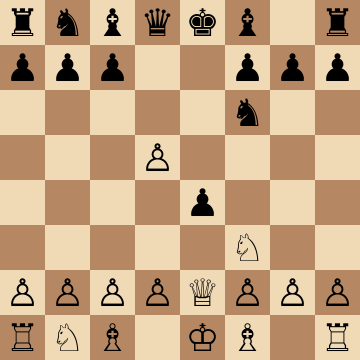
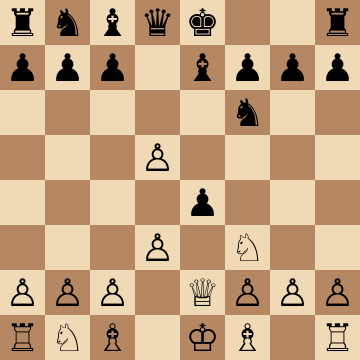
1.e4 e5 2.Nf3 d5 3.exd5 e4 4.Qe2 Nf6 5.d3 Be7 6.dxe4 O-O 7.Nc3 Re8
The critical test and the heart of the gambit. After 3...e4 the f3-knight is attacked, and 4.Qe2 pins the pawn — so Black simply develops: 4...Nf6, 5...Be7 and castles. With 7...Re8 every White piece on the e-file feels the pressure; the queen on e2 blocks the f1-bishop, and Black regains material with ...Nxd5 or ...Bb4 tricks while White untangles. This is where the Elephant's practical value shows: one side knows the position, the other is on move seven of an opening they have never studied.
Modern 3...Bd6 Variation
1.e4 e5 2.Nf3 d5 3.exd5 Bd6 4.d4 e4 5.Ne5 Nf6 6.Nc3 O-O
Instead of pushing the e-pawn immediately, Black offers a second pawn for pure development speed. The bishop lands on its dream diagonal toward h2, ...e4 comes with tempo anyway, and after castling Black threatens ...Re8 and ...Bxe5 followed by ...Qxd5. White's extra pawn on d5 is weak and often falls; meanwhile every natural developing move for Black also builds an attack. A great practical choice for rapid and blitz.
Greedy 3.Nxe5 and the Qg5 Trap
1.e4 e5 2.Nf3 d5 3.Nxe5 dxe4 4.Bc4 Qg5 5.Nxf7 Qxg2 6.Rf1 Bg4
When White grabs on e5 and develops with 4.Bc4, the fork 4...Qg5! hits both g2 and the e5-knight at once. The greedy 5.Nxf7 walks into 5...Qxg2 6.Rf1 Bg4! — the bishop strikes at d1 through the wide-open diagonal, and White's position falls apart with the king trapped in the center. White's only real try is 5.d4, defending the knight while the c1-bishop hits the queen; know that resource, and you know why this trap keeps scoring online.
Knight Retreat: 4.Ne5 Qxd5
1.e4 e5 2.Nf3 d5 3.exd5 e4 4.Ne5 Qxd5 5.d4 exd3 6.Nxd3 Nf6 7.Nc3
Hopping the attacked knight to e5 looks active but lets Black regain the pawn immediately: 4...Qxd5 hits the knight, and after 5.d4 the en passant capture 5...exd3 dissolves White's center. The resulting position is nearly symmetrical with Black fully mobilized — the queen retreats to d8 or a5 when kicked, the pieces flow to natural squares, and the gambiteer has achieved the dream scenario: equality with easier play by move eight.
Classical 4...Qe7 (Old Main Line)
1.e4 e5 2.Nf3 d5 3.exd5 e4 4.Qe2 Qe7 5.Nd4 Qe5 6.Nb3 Qxd5 7.Nc3
The historical treatment: 4...Qe7 unpins the e4-pawn, genuinely threatening ...exf3, so the knight must run to d4. Then 5...Qe5 forks knight and d5-pawn, and Black restores material equality. The catch is that Black's queen has moved three times, and 7.Nc3 develops with tempo — which is exactly why modern Elephant theory prefers 4...Nf6. Study this line to understand what Black is improving on, and to punish White players who only know the old refutations.
Key ideas
- Strike with 2...d5 and seize central space or a lead in development while White untangles.
- After 3.exd5 e4, chase the f3-knight and cramp White's kingside development.
- Develop with tempo — ...Nf6, ...Be7 or ...Bd6 and quick castling, with open lines for the initiative.
- Win on surprise value: almost no 1.e4 player has serious preparation against the Elephant.
Typical plans and structures
In the 3.exd5 e4 main line, Black gains space and time against the displaced knight, develops rapidly and often regains the d5-pawn with ...Qxd5 or ...Nxd5 while keeping the more active pieces. If White grabs with 3.Nxe5, Black hits back with ...Bd6 and ...dxe4 ideas, opening lines toward f2. The course is honest about the objective evaluation — White keeps an edge with precise play — and focuses on the practical poison: the positions where natural moves lose for White.
Who should play it
Blitz and rapid players, streamers and romantics who want a fun, aggressive surprise weapon against 1.e4 and don't mind a calculated objective risk.
Study the Elephant Gambit move by move
The first 3 lines of the interactive course, exactly as a signed-out visitor can play them — each move with the coaching note shown on the board.
Line 1 — punishing a blunder
1.e4 Our opponent takes control of the center. 1...e5 We take control of the center as well. 2.Nf3 Developing the knight and attacking our pawn. 2...d5 We launch the Elephant Gambit! We break in the center immediately. 3.exd5 This capture makes sense, inviting our queen to recapture and become exposed. 3...e4! We don't want to expose our queen. Instead, we immediately disrupt our opponent's coordination. 4.Qe2 Our opponent counterattacks by pinning our pawn. 4...Nf6 We protect it with the knight. 5.Nc3 Increasing pressure on e4 and preventing ...Qxd5. 5...Be7 We sacrifice another pawn to gain tempos and castle quickly. 6.Nxe4 Our opponent accepts the sacrifice. 6...O-O We castle to activate the rook as soon as possible. 7.d3 Reinforcing the knight on e4 and opening lines for their dark squared bishop. 7...Nxd5 We recapture one of the pawns and centralize our knight as well. 8.Bd2 Our opponent aims to castle queenside, since their f1 bishop is blocked by the queen. 8...Re8 Our rook is very active on the e file, targeting the king and queen aligned there. 9.O-O-O Our opponent castles to step out of our rook's influence. 9...f5 Attacking their knight. 10.Nc3?? Our opponent pulls back, but this allows a tactical sequence that costs them their queen. 10...Nxc3 We capture the piece, opening lines that will allow us to check their king if they recapture. 11.Bxc3 Our opponent takes back with their bishop. 11...Bg5+ We give check, clearing the e file with tempo and threatening their queen with our rook. 12.Bd2 Our opponent doesn't have any other option but to respond to the check. 12...Rxe2 We are a queen up and completely winning.
Line 2 — against an inaccuracy
1.e4 Our opponent takes control of the center. 1...e5 We take control of the center as well. 2.Nf3 Developing the knight and attacking our pawn. 2...d5 We launch the Elephant Gambit! We break in the center immediately. 3.exd5 This capture makes sense, inviting our queen to recapture and become exposed. 3...e4! We don't want to expose our queen. Instead, we immediately disrupt our opponent's coordination. 4.Qe2 Our opponent counterattacks by pinning our pawn. 4...Nf6 We protect it with the knight. 5.Nc3 Increasing pressure on e4 and preventing ...Qxd5. 5...Be7 We sacrifice another pawn to gain tempos and castle quickly. 6.Nxe4 Our opponent accepts the sacrifice. 6...O-O We castle to activate the rook as soon as possible. 7.d3 Reinforcing the knight on e4 and opening lines for their dark squared bishop. 7...Nxd5 We recapture one of the pawns and centralize our knight as well. 8.Bd2 Our opponent aims to castle queenside, since their f1 bishop is blocked by the queen. 8...Re8 Our rook is very active on the e file, targeting the king and queen aligned there. 9.O-O-O Our opponent castles to step out of our rook's influence. 9...f5 Attacking their knight. 10.h4! Our opponent plays a clever continuation, we can't take that knight without getting into unpleasant pressure after dxe4. 10...Nc6 We develop our knight, and now the threat ...fxe4 is becoming real. 11.Nfg5 This knight jump creates a serious threat of Qh5 against our king. 11...g6 We keep the queen from jumping in. 12.Qf3 Activating the queen slightly, and preventing us from taking ...fxe4 due to Qf7 followed by mate. 12...Nd4 We harass the queen out of its active square. 13.Qg3 Moving the queen to a safe square. 13...Qd7 We still can't take the knight since dxe4 followed by Bc4+ is too dangerous. Instead, we develop the queen and prepare a jump to a4. 14.c3 Our oponent wants to chase our knight away. 14...Qa4! We ignore the threat and activate our queen, we have a very complex game, with approximately balanced chances.
Line 3 — punishing a blunder
1.e4 Our opponent takes control of the center. 1...e5 We take control of the center as well. 2.Nf3 Developing the knight and attacking our pawn. 2...d5 We launch the Elephant Gambit! We break in the center immediately. 3.exd5 This capture makes sense, inviting our queen to recapture and become exposed. 3...e4! We don't want to expose our queen. Instead, we immediately disrupt our opponent's coordination. 4.Qe2 Our opponent counterattacks by pinning our pawn. 4...Nf6 We protect it with the knight. 5.Nc3 Increasing pressure on e4 and preventing ...Qxd5. 5...Be7 We sacrifice another pawn to gain tempos and castle quickly. 6.Nxe4 Our opponent accepts the sacrifice. 6...O-O We castle to activate the rook as soon as possible. 7.Nxf6+ Our opponent trades knights. 7...Bxf6 We recapture the knight, bringing the bishop to a more active diagonal. 8.d3?? Our opponent's development is too slow, allowing us to take advantage with agressive play along the e file. 8...Re8 We pin their queen to the king, forcing our opponent to block the file. 9.Be3 Our opponent blocks with the bishop, leaving the b2 pawn undefended. 9...Bxb2 We take the pawn, severely damaging their pawn structure and gaining a tempo on their rook. 10.Rb1 Targeting our bishop. 10...Bc3+ We retreat with a check, forcing their king to move and lose castling rights. 11.Kd1 Our opponent moves the king to a less comfortable square. 11...Qxd5 We take the central pawn, creating multiple threats and securing a decisive advantage.
The free preview ends here — continue with all 15 lines in the interactive course, with instant feedback on every move you play.
Frequently asked questions
Is the Elephant Gambit sound?
Objectively White keeps an advantage with accurate play — the Elephant is a practical weapon, not a theoretical equalizer. Its value is that the accurate path is narrow, unnatural, and almost never known below master level.
Why is the Elephant Gambit popular online?
Content creators — Witty Alien above all — showed how quickly 1.e4 players collapse against it in blitz. The surprise factor is enormous: by move three your opponent is on their own, while you have seen every typical position in this course.
What is Black's idea after 3.exd5?
The main move is 3...e4, gaining time on the f3-knight and space in the center; the alternative 3...Bd6 keeps pieces on for a rapid attack. Both lead to sharp, unbalanced play where initiative outweighs the pawn.
Learn the Elephant Gambit with AI feedback
This page pairs the guide above with an interactive ChessMind AI course: a GM-authored repertoire you study move by move on a real board, then practice against a human-like chess AI opponent with instant feedback and spaced-repetition review, so the key positions actually stick. Start learning, jump straight into practice, or browse all opening courses.
New to a concept? Every term is defined in the chess terms glossary.