The English Attack vs. Najdorf Sicilian
1.e4 c5 2.Nf3 d6 3.d4 cxd4 4.Nxd4 Nf6 5.Nc3 a6 6.Be3 e5
The Najdorf is the king of the Sicilians — and the English Attack (6.Be3, f3, Qd2, O-O-O, g4) is White's most principled answer. Both kings castle to opposite wings and the fastest attack wins: this is the sharpest mainstream battleground in 1.e4 chess, where preparation converts directly into points.
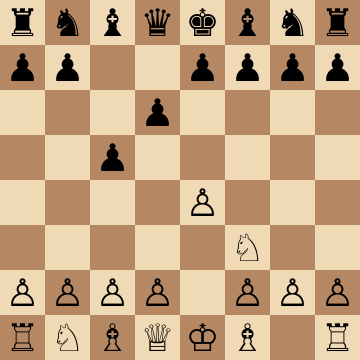
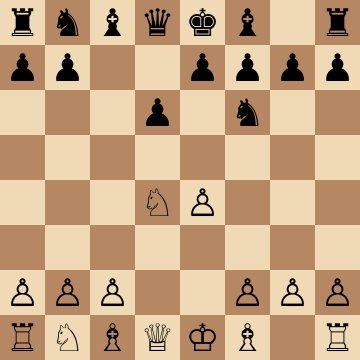
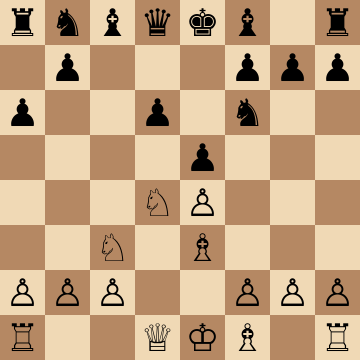
Mainline
1.e4 c5 2.Nf3 d6 3.d4 cxd4 4.Nxd4 Nf6 5.Nc3 a6 6.Be3 e5 7.Nb3 Be6 8.f3 Be7 9.Qd2 O-O 10.O-O-O Nbd7
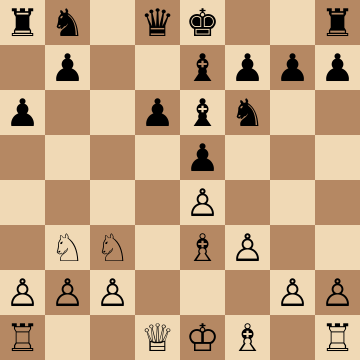
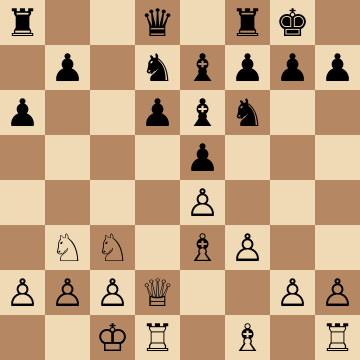
Main Line Race: 11.g4 b5 12.g5
1.e4 c5 2.Nf3 d6 3.d4 cxd4 4.Nxd4 Nf6 5.Nc3 a6 6.Be3 e5 7.Nb3 Be6 8.f3 Be7 9.Qd2 O-O 10.O-O-O Nbd7 11.g4 b5 12.g5 b4 13.Ne2 Ne8 14.f4 a5 15.f5
The tabiya that defines the English Attack: both sides sprint at the enemy king, and 13.Ne2 followed by 14.f4 and 15.f5 shows White's machinery at full speed — the f-pawn hits e6 while g5-g6 looms. Black's ...b4 and ...a5 race arrives on the queenside, but White's pawns are already touching the defenses. Tempo counting is everything here; the course maps each branch so you always know whether to push, trade, or insert Kb1.
6...e6 Setup: g4 Before Castling
1.e4 c5 2.Nf3 d6 3.d4 cxd4 4.Nxd4 Nf6 5.Nc3 a6 6.Be3 e6 7.f3 b5 8.Qd2 Nbd7 9.g4 h6 10.O-O-O Bb7 11.h4
Against the Scheveningen-flavored 6...e6, White uses the same skeleton with an extra gear: 9.g4 comes before castling, gaining time because Black has no quick central strike. After 10.O-O-O and 11.h4 the pawns roll automatically — g5 will pry open the f6-knight's cover whether or not Black castles. Black's ...b5-b4 needs three more moves to bite, and that arithmetic is the whole story of this variation.
Modern 8...h5 Restraint: 9.Nd5
1.e4 c5 2.Nf3 d6 3.d4 cxd4 4.Nxd4 Nf6 5.Nc3 a6 6.Be3 e5 7.Nb3 Be6 8.f3 h5 9.Nd5 Bxd5 10.exd5 Nbd7 11.Qd2 g6 12.O-O-O
Top players popularized 8...h5 to stop g4 once and for all — so the course switches plans instead of arguing. 9.Nd5! trades into a favorable structure: after 10.exd5 White owns the c-file half-open, the e4-square, and a target on h5 that makes Black's kingside castling permanently risky. Play Kb1, Rg1 and a slow g3-h3 or c4 expansion; Black saved the kingside but signed up for a worse endgame.
6...Ng4 Sidestep: 7.Bg5 h6 8.Bh4
1.e4 c5 2.Nf3 d6 3.d4 cxd4 4.Nxd4 Nf6 5.Nc3 a6 6.Be3 Ng4 7.Bg5 h6 8.Bh4 g5 9.Bg3 Bg7 10.Be2
The knight jab 6...Ng4 tries to trade off White's best attacker, and 7.Bg5 keeps the bishop alive at the cost of a forcing sequence. Black must lunge with ...h6 and ...g5 to justify the idea, and 10.Be2 asks the g4-knight to explain itself — after it retreats or trades, the pawns on g5 and h6 are lasting hooks for h4 breaks. White's play is straightforward; Black's kingside never fully recovers.
12...Nh5 Sideline: Knight to f4
1.e4 c5 2.Nf3 d6 3.d4 cxd4 4.Nxd4 Nf6 5.Nc3 a6 6.Be3 e5 7.Nb3 Be6 8.f3 Be7 9.Qd2 O-O 10.O-O-O Nbd7 11.g4 b5 12.g5 Nh5 13.Nd5
Rather than join the pawn race, some Najdorf players reroute the attacked knight toward f4 with 12...Nh5. The clean response is 13.Nd5: exchange the e6-bishop or the e7-bishop, then meet ...Nf4 with Bxf4 and recapture, keeping the extra kingside space with zero counterplay against your king. Positional players love this branch — the storm slows down, but every trade drifts toward a favorable ending for White.
Key ideas
- Set up with Be3, f3 and Qd2 — one scheme against both 6...e5 and 6...e6 move orders.
- Castle long and storm with g4-g5 and h4, prying open the king Black just castled.
- Meet Black's ...b5-b4 counterattack with precise timing — the race is won in single tempi.
- Master the thematic sacrifices (Nd5, Bxb5) that regularly decide these opposite-castling battles.
Typical plans and structures
After 6...e5 7.Nb3, White restrains ...d5 with f3, castles long and rolls the kingside pawns; Black counters with ...b5, ...Nb6-c4 or ...a5 against White's king. Every move is double-edged: g4-g5 drives the f6-knight to open the attack, while Kb1 and timely prophylaxis keep Black's initiative one step behind. The course covers the critical 6...e5 and 6...e6 branches, the ...h5 restraining systems, and the standard piece sacrifices that every English Attack player must know by heart.
Who should play it
Serious, ambitious players who relish sharp theoretical battles and want to meet the Najdorf head-on rather than sidestep it.
Study the English Attack vs. Najdorf Sicilian move by move
The first 3 lines of the interactive course, exactly as a signed-out visitor can play them — each move with the coaching note shown on the board.
Line 1 — the main line
1.e4 Taking control of the center. 1...c5 Launching a Sicilian Defense. 2.Nf3 Preparing to open the center with 3.d4. 2...d6 The most popular Sicilian setup. 3.d4 Starting an open Sicilian. 3...cxd4 Swapping pawns in the center. 4.Nxd4 Recapturing. 4...Nf6 Developing and attacking our e4 pawn. 5.Nc3 Developing and protecting the e4 pawn. 5...a6 We have reached the Najdorf Sicilian. 6.Be3 We begin an English Attack, the start of this course. 6...e5 Taking center and driving the knight away. If our opponent chose ...e6, that would become a Scheweningen Sicilian (instead of a Najdorf). 7.Nb3 This retreat aims to create a kingside attack in most lines. 7...Be6 Developing and supporting a potential central break with ...d6 d5. 8.f3 A typical move in the English Attack. It protects the e4 pawn and supports a future g2 g4 to launch a kingside attack. 8...Be7 Developing the bishop and preparing castles. 9.Qd2 The queen goes to d2 in the English Attack. 9...Nbd7 The knight goes to d7 in these lines. One reason is to jump to b6 next, to support ...d6 d5 or invade with ...Nc4. 10.O-O-O We castle long in the English Attack. 10...b5 The most typical attacking setup, our opponent may play ...b4 or ...Nb6-Nc4 next. 11.g4 Launching the attack, it's important we have g4 g5 ready to kick out the knight from f6. 11...Nb6 Preparing ...Nc4 or ...d6 d5. 12.g5 We kick out the knight from f6 (making ...d6 d5 difficult). We can continue with a kingside attack, or a knight jump to d5.
Line 2 — the main line
1.e4 Taking control of the center. 1...c5 Launching a Sicilian Defense. 2.Nf3 Preparing to open the center with 3.d4. 2...d6 The most popular Sicilian setup. 3.d4 Starting an open Sicilian. 3...cxd4 Swapping pawns in the center. 4.Nxd4 Recapturing. 4...Nf6 Developing and attacking our e4 pawn. 5.Nc3 Developing and protecting the e4 pawn. 5...a6 We have reached the Najdorf Sicilian. 6.Be3 We begin an English Attack, the start of this course. 6...e5 Taking center and driving the knight away. If our opponent chose ...e6, that would become a Scheweningen Sicilian (instead of a Najdorf). 7.Nb3 This retreat aims to create a kingside attack in most lines. 7...Be6 Developing and supporting a potential central break with ...d6 d5. 8.f3 A typical move in the English Attack. It protects the e4 pawn and supports a future g2 g4 to launch a kingside attack. 8...Be7 Developing the bishop and preparing castles. 9.Qd2 The queen goes to d2 in the English Attack. 9...Nbd7 The knight goes to d7 in these lines. One reason is to jump to b6 next, to support ...d6 d5 or invade with ...Nc4. 10.O-O-O We castle long in the English Attack. 10...O-O Our opponent castles. 11.g4 We launch a pawn storm on the kingside, aiming to target our opponent's pieces and open lines. 11...b5 Our opponent counterattacks on the queenside with the same idea, but we started earlier. 12.g5 Threatening their knight. 12...b4 Our opponent pushes the b pawn, attacking our knight as well. 13.Ne2 We retreat the knight, preparing a future f3 f4 push. 13...Ne8 Our opponent pulls the knight back. 14.f4 We are faster on the kingside, already threatening f4 f5 and a pawn break, while our opponent is behind on this plan.
Line 3 — the main line
1.e4 Taking control of the center. 1...c5 Launching a Sicilian Defense. 2.Nf3 Preparing to open the center with 3.d4. 2...d6 The most popular Sicilian setup. 3.d4 Starting an open Sicilian. 3...cxd4 Swapping pawns in the center. 4.Nxd4 Recapturing. 4...Nf6 Developing and attacking our e4 pawn. 5.Nc3 Developing and protecting the e4 pawn. 5...a6 We have reached the Najdorf Sicilian. 6.Be3 We begin an English Attack, the start of this course. 6...e5 Taking center and driving the knight away. If our opponent chose ...e6, that would become a Scheweningen Sicilian (instead of a Najdorf). 7.Nb3 This retreat aims to create a kingside attack in most lines. 7...Be6 Developing and supporting a potential central break with ...d6 d5. 8.f3 A typical move in the English Attack. It protects the e4 pawn and supports a future g2 g4 to launch a kingside attack. 8...Be7 Developing the bishop and preparing castles. 9.Qd2 The queen goes to d2 in the English Attack. 9...Nbd7 The knight goes to d7 in these lines. One reason is to jump to b6 next, to support ...d6 d5 or invade with ...Nc4. 10.O-O-O We castle long in the English Attack. 10...O-O Our opponent castles. 11.g4 We launch a pawn storm on the kingside, aiming to target our opponent's pieces and open lines. 11...b5 Our opponent counterattacks on the queenside with the same idea, but we started earlier. 12.g5 Threatening their knight. 12...Nh5 Black repositions the knight to the side, aiming to block our pawns and keep control of the f4 square. 13.Nd5 We jump in with the knight, exploiting the d5 outpost. 13...Bxd5 Our opponent captures the knight. 14.exd5 We recapture with a comfortable advantage: more space, clear targets, and a faster kingside attack.
The free preview ends here — continue with all 9 lines in the interactive course, with instant feedback on every move you play.
Frequently asked questions
What is the English Attack against the Najdorf?
It is the setup Be3, f3, Qd2, O-O-O with a g4 pawn storm, named for the English grandmasters (Nunn, Short, Chandler) who developed it in the 1980s. It became White's main weapon against the Najdorf because it poses direct, king-hunting questions in every line.
Why does White play the modest-looking 8.f3?
The move is the system's backbone: it defends e4 so pieces stay free for the attack, prepares the g4 advance, and blunts ...Ng4 harassment of the e3-bishop. Slow for one move, it enables everything fast that follows.
Is the English Attack too theoretical for club players?
It is theory-rich, but the theory is thematically coherent: the same storming plan, the same sacrifices, the same racing logic recur everywhere. This course teaches the recurring patterns first and the concrete lines second, which is how the variation becomes learnable.
Learn the English Attack vs. Najdorf Sicilian with AI feedback
This page pairs the guide above with an interactive ChessMind AI course: a GM-authored repertoire you study move by move on a real board, then practice against a human-like chess AI opponent with instant feedback and spaced-repetition review, so the key positions actually stick. Start learning, jump straight into practice, or browse all opening courses.
New to a concept? Every term is defined in the chess terms glossary.