The Dragon Sicilian
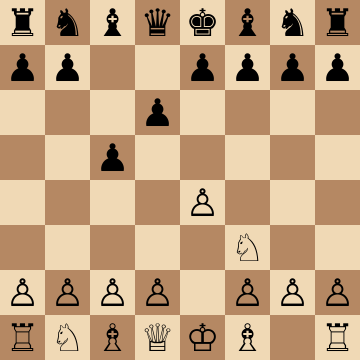
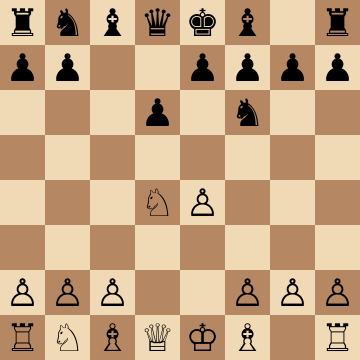
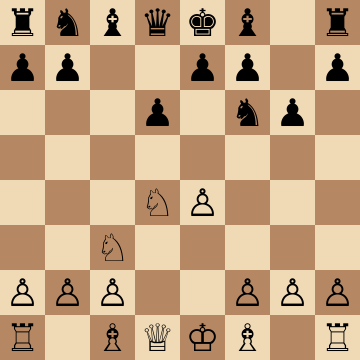
1.e4 c5 2.Nf3 d6 3.d4 cxd4 4.Nxd4 Nf6 5.Nc3 g6
The Dragon Sicilian (1.e4 c5 2.Nf3 d6 3.d4 cxd4 4.Nxd4 Nf6 5.Nc3 g6) is the most exciting defense in chess: Black fianchettos the mighty Dragon bishop and races White in a mutual king hunt. When White castles long, both sides attack at full speed — one tempo often decides everything.
Mainline
1.e4 c5 2.Nf3 d6 3.d4 cxd4 4.Nxd4 Nf6 5.Nc3 g6 6.Be3 Bg7 7.f3 O-O 8.Qd2 Nc6 9.Bc4 Bd7 10.O-O-O Rc8
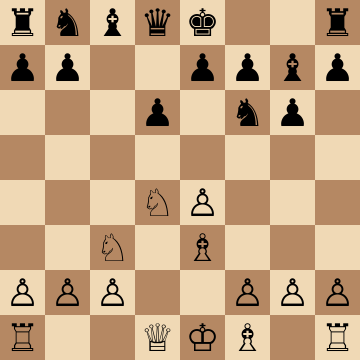
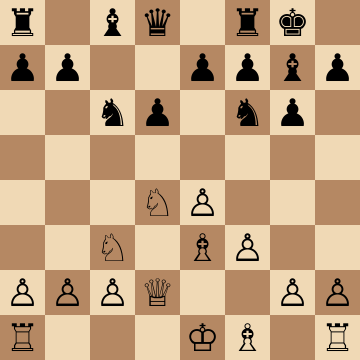
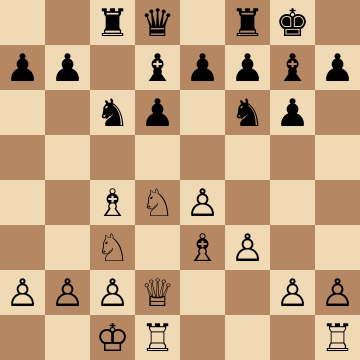
Dragon Yugoslav Attack (9.Bc4)
1.e4 c5 2.Nf3 d6 3.d4 cxd4 4.Nxd4 Nf6 5.Nc3 g6 6.Be3 Bg7 7.f3 O-O 8.Qd2 Nc6 9.Bc4
The critical test and the most famous race in chess: White castles long, throws the h-pawn forward and aims to trade off the Dragon bishop; Black sacrifices on c3 and pours down the c-file. Both attacks are one tempo apart, which is why the theory runs deep — but the plans are simple to state and that is what makes them learnable.
Study the Beat the Dragon Sicilian course
Dragon Classical Variation (6.Be2)
1.e4 c5 2.Nf3 d6 3.d4 cxd4 4.Nxd4 Nf6 5.Nc3 g6 6.Be2 Bg7 7.O-O O-O
White castles short and plays a normal game instead of racing. Black gets exactly the position the Dragon is built for: pressure on the long diagonal, the c-file, and the ...d5 break at the right moment. Less theory than the Yugoslav and, at club level, a very comfortable middlegame for Black.
Levenfish Attack (6.f4)
1.e4 c5 2.Nf3 d6 3.d4 cxd4 4.Nxd4 Nf6 5.Nc3 g6 6.f4 Nc6 7.Nxc6 bxc6
An early f4 that punishes the automatic 6...Bg7. Black's cleanest answer is to develop the queenside first — ...Nc6 hits d4 and takes the sting out of the pawn front. Short, sharp and worth knowing because the punishment line is genuinely dangerous.
Accelerated Dragon (2...Nc6, no ...d6)
1.e4 c5 2.Nf3 Nc6 3.d4 cxd4 4.Nxd4 g6 5.Nc3 Bg7
The same setup one move faster: by leaving the pawn on d7 Black keeps ...d5 in one go and dodges the Yugoslav Attack entirely. The price is the Maroczy Bind with c4 — a positional squeeze rather than a race, so pick this if you would rather manoeuvre than calculate.
Study the Accelerated Dragon course
Dragon with 9.O-O-O
1.e4 c5 2.Nf3 d6 3.d4 cxd4 4.Nxd4 Nf6 5.Nc3 g6 6.Be3 Bg7 7.f3 O-O 8.Qd2 Nc6 9.O-O-O d5
White castles long immediately and Black hits the centre with ...d5 while the king is still finding its feet. Concrete and forcing: the resulting endgames are pleasant for Black, which is exactly why many White players prefer 9.Bc4 first.
Dragadorf (...a6 and ...b5 instead of ...O-O)
1.e4 c5 2.Nf3 d6 3.d4 cxd4 4.Nxd4 Nf6 5.Nc3 g6 6.Be3 Bg7 7.f3 a6 8.Qd2 b5
A Dragon and Najdorf hybrid: Black delays castling and starts the queenside expansion first, so White's kingside storm has no target yet. A modern surprise weapon for players who like the Dragon ideas but not the sharpest Yugoslav theory.
Key ideas
- Unleash the Dragon bishop on g7 — the most powerful minor piece in Black's entire opening repertoire.
- Counterattack down the half-open c-file with ...Rc8 and the thematic exchange sacrifice ...Rxc3.
- In opposite-side castling races, know the tempo-critical move orders that keep Black's attack first.
- Fight for the full point in every game — the Dragon punishes routine play brutally.
Typical plans and structures
In the Yugoslav-style main lines White castles long and storms the kingside with h4-h5; Black counters on the c-file with ...Rc8, ...Ne5-c4 and the famous ...Rxc3 exchange sacrifice, shattering White's queenside cover. The Dragon bishop both defends the king and spearheads the counterattack. Against quieter setups with Be2 and O-O, Black gets easy equality and takes over the initiative with ...a6, ...b5 or central breaks — the course covers both worlds.
Who should play it
Fearless tacticians who want maximum winning chances with Black and enjoy sharp, concrete positions where preparation and courage beat rating.
Study the Dragon Sicilian move by move
The first 3 lines of the interactive course, exactly as a signed-out visitor can play them — each move with the coaching note shown on the board.
Line 1
1.e4 Our opponent takes the center. 1...c5 We launch the Sicilian defense. 2.Nf3 Our opponent develops and prepares d2 d4. 2...d6 We keep many Sicilian options open. 3.d4 Our opponent enters an Open Sicilian. 3...cxd4 We must trade the pawns. 4.Nxd4 Our opponent recaptures and may gain a strong center with c2 c4 if we don't prevent it. 4...Nf6 We develop and hit the e4 pawn, preventing c2 c4. 5.Nc3 Our opponent develops and defends the pawn. 5...g6 We launch a Dragon Sicilian! This is one of the sharpest and most exciting Sicilians, our opponent needs to be ready. 6.Be3 Our opponent begins to setup an English Attack (may continue with f2 f3). 6...Bg7 We fianchetto our bishop and prepare to castle. 7.f3 Our opponent reinforces the center and prevents a knight jump to g4. This is the best continuation. 7...O-O We castle, inviting a kingside attack, but we are ready to create massive counterplay. 8.Qd2 Our opponent prepares to castle long. 8...Nc6 We develop while creating pressure on d4, and threatening ...d6 d5 (the knight prevents e4 e5). 9.Bc4 Attacking f7 and preventing the ...d6 d5 break. 9...Bd7 We complete our development, and prepare to activate our rooks and queen. 10.O-O-O Our opponent secures his king, and is ready to launch a pawn storm on the kingside. 10...Rc8 We threaten a discovered attack on the bishop. 11.Bb3 Our opponent keeps the bishop on the diagonal, but moves to a safer square. 11...Ne5 We open the c file for our rook, and prepare a knight jump to c4. 12.h4 Our opponent launches an attack, threatening h4 h5 to open the file. 12...h5 We have to stop h4 h5, since that attack could be TOO FAST. 13.Bg5 This bishop creates pressure on the knight and e7 pawn, and prepares the g2 g4 break. 13...Rc5 Since bishop is gone from e3, we can activate our rook. We support ...b7 b5, and the rook sometimes defends the kingside along the 5th rank. 14.Kb1 Our opponent secures the king, away from the c file. 14...b5 We launch our queenside pawn storm. 15.g4 Our opponent launches an attack on us too! 15...a5 We continue our attack and will try ...a5 a4 next trapping the bishop. The game is close to equal and very exciting!
Line 2
1.e4 Our opponent takes the center. 1...c5 We launch the Sicilian defense. 2.Nf3 Our opponent develops and prepares d2 d4. 2...d6 We keep many Sicilian options open. 3.d4 Our opponent enters an Open Sicilian. 3...cxd4 We must trade the pawns. 4.Nxd4 Our opponent recaptures and may gain a strong center with c2 c4 if we don't prevent it. 4...Nf6 We develop and hit the e4 pawn, preventing c2 c4. 5.Nc3 Our opponent develops and defends the pawn. 5...g6 We launch a Dragon Sicilian! This is one of the sharpest and most exciting Sicilians, our opponent needs to be ready. 6.Be3 Our opponent begins to setup an English Attack (may continue with f2 f3). 6...Bg7 We fianchetto our bishop and prepare to castle. 7.f3 Our opponent reinforces the center and prevents a knight jump to g4. This is the best continuation. 7...O-O We castle, inviting a kingside attack, but we are ready to create massive counterplay. 8.Qd2 Our opponent prepares to castle long. 8...Nc6 We develop while creating pressure on d4, and threatening ...d6 d5 (the knight prevents e4 e5). 9.Bc4 Attacking f7 and preventing the ...d6 d5 break. 9...Bd7 We complete our development, and prepare to activate our rooks and queen. 10.O-O-O Our opponent secures his king, and is ready to launch a pawn storm on the kingside. 10...Rc8 We threaten a discovered attack on the bishop. 11.Bb3 Our opponent keeps the bishop on the diagonal, but moves to a safer square. 11...Ne5 We open the c file for our rook, and prepare a knight jump to c4. 12.h4 Our opponent launches an attack, threatening h4 h5 to open the file. 12...h5 We have to stop h4 h5, since that attack could be TOO FAST. 13.g4 Our opponent launches a kingside attack at all costs. 13...hxg4 We must take the pawn, otherwise we may be attacked with gxh5, or squeezed with g4 g5. 14.h5 This was the point of the sacrifice, opening the h file for the rook. 14...Nxh5 We are forced to capture. We are walking on a tight rope, but all is fine if we can remember our line! 15.Bh6 Trading off our bishop, the king's greatest defender. One threat is 16.Rxh5 winning. 15...Kh7! Our best defense is attacking the bishop and forcing our opponent to take right away. 16.Bxg7 Our opponent takes our bishop. 16...Kxg7 We recapture, but now our king is on the much safer g7 square. 17.Rxh5? Trying to break through with brute force does not work here. 17...gxh5 We must take the rook, and want to play ...e7 e6 next to involve our queen. 18.Qg5+ Bringing the queen into the game before we prevent it with ...e6. 18...Ng6 Even though our position looks dangerous, we defend ourselves with ...e6 and ...Rc5 and win by material.
Line 3
1.e4 Our opponent takes the center. 1...c5 We launch the Sicilian defense. 2.Nf3 Our opponent develops and prepares d2 d4. 2...d6 We keep many Sicilian options open. 3.d4 Our opponent enters an Open Sicilian. 3...cxd4 We must trade the pawns. 4.Nxd4 Our opponent recaptures and may gain a strong center with c2 c4 if we don't prevent it. 4...Nf6 We develop and hit the e4 pawn, preventing c2 c4. 5.Nc3 Our opponent develops and defends the pawn. 5...g6 We launch a Dragon Sicilian! This is one of the sharpest and most exciting Sicilians, our opponent needs to be ready. 6.Be3 Our opponent begins to setup an English Attack (may continue with f2 f3). 6...Bg7 We fianchetto our bishop and prepare to castle. 7.f3 Our opponent reinforces the center and prevents a knight jump to g4. This is the best continuation. 7...O-O We castle, inviting a kingside attack, but we are ready to create massive counterplay. 8.Qd2 Our opponent prepares to castle long. 8...Nc6 We develop while creating pressure on d4, and threatening ...d6 d5 (the knight prevents e4 e5). 9.Bc4 Attacking f7 and preventing the ...d6 d5 break. 9...Bd7 We complete our development, and prepare to activate our rooks and queen. 10.O-O-O Our opponent secures his king, and is ready to launch a pawn storm on the kingside. 10...Rc8 We threaten a discovered attack on the bishop. 11.Bb3 Our opponent keeps the bishop on the diagonal, but moves to a safer square. 11...Ne5 We open the c file for our rook, and prepare a knight jump to c4. 12.h4 Our opponent launches an attack, threatening h4 h5 to open the file. 12...h5 We have to stop h4 h5, since that attack could be TOO FAST. 13.g4 Our opponent launches a kingside attack at all costs. 13...hxg4 We must take the pawn, otherwise we may be attacked with gxh5, or squeezed with g4 g5. 14.h5 This was the point of the sacrifice, opening the h file for the rook. 14...Nxh5 We are forced to capture. We are walking on a tight rope, but all is fine if we can remember our line! 15.Rxh5 This is a common sacrifice that we always need to calculate. It just doesn't work here. 15...gxh5 We take the rook and want to continue with ...e6, ...Rc5 or ...Qa5 next. 16.Bh6 Threatening 17.Qg5 which would be a forced mate (the cover 17...Ng6 doesn't work because the f7 pawn is pinned). 16...e6 We prevent 17.Qg5, the attack doesn't work and we are materially winning.
The free preview ends here — continue with all 29 lines in the interactive course, with instant feedback on every move you play.
Frequently asked questions
Is the Dragon Sicilian sound at high levels?
Yes — it has been defended by elite players from Veselin Topalov to Magnus Carlsen, who has used it at the very highest level. White gets serious attacking tries, but Black's resources have held up to decades of analysis.
Why is it called the Dragon?
The name, credited to Fyodor Duz-Khotimirsky, comes from the resemblance of Black's kingside pawn structure (d6, e7, f7, g6, h7) to the constellation Draco — the dragon. The g7-bishop breathing fire down the long diagonal made the name irresistible.
What is the exchange sacrifice ...Rxc3 about?
Giving up rook for knight on c3 wrecks White's pawn cover in front of the long-castled king and removes a key defender of e4. It is often objectively strong, and knowing when to play it is one of the core skills this course teaches.
Learn the Dragon Sicilian with AI feedback
This page pairs the guide above with an interactive ChessMind AI course: a GM-authored repertoire you study move by move on a real board, then practice against a human-like chess AI opponent with instant feedback and spaced-repetition review, so the key positions actually stick. Start learning, jump straight into practice, or browse all opening courses.
New to a concept? Every term is defined in the chess terms glossary.