Beat the Dragon Sicilian
1.e4 c5 2.Nf3 d6 3.d4 cxd4 4.Nxd4 Nf6 5.Nc3 g6 6.Be3 Bg7 7.f3 O-O 8.Qd2 Nc6 9.O-O-O
Against the Dragon Sicilian, half measures fail — so this course teaches the English Attack setup: Be3, f3, Qd2 and long castling, followed by throwing the h-pawn at Black's king. It is one of the sharpest battlegrounds in all of chess, and the better-prepared player almost always wins it.
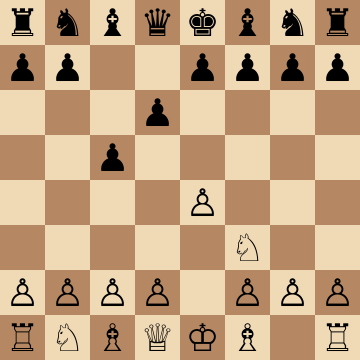
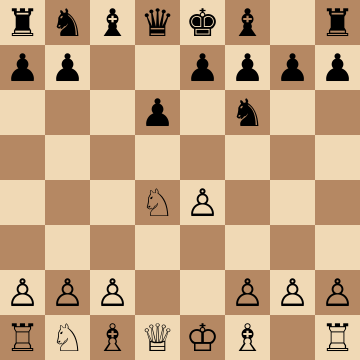
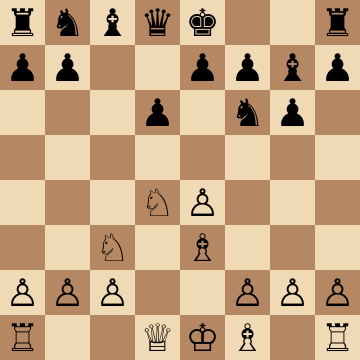
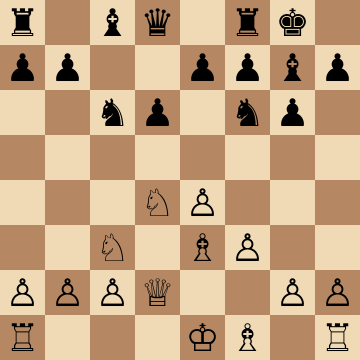
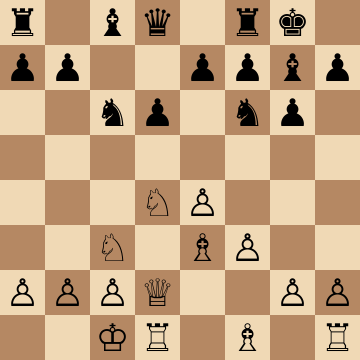
Mainline
1.e4 c5 2.Nf3 d6 3.d4 cxd4 4.Nxd4 Nf6 5.Nc3 g6 6.Be3 Bg7 7.f3 O-O 8.Qd2 Nc6 9.O-O-O
Yugoslav Main Line: 9.O-O-O d5
1.e4 c5 2.Nf3 d6 3.d4 cxd4 4.Nxd4 Nf6 5.Nc3 g6 6.Be3 Bg7 7.f3 O-O 8.Qd2 Nc6 9.O-O-O d5 10.exd5 Nxd5 11.Nxc6 bxc6 12.Bd4 e5 13.Bc5 Be6 14.Ne4 Re8
Black's most principled reply to 9.O-O-O is the immediate 9...d5 break, striking before the h-pawn arrives. The course recipe is 10.exd5 and 12.Bd4, forcing 12...e5, after which 13.Bc5 and 14.Ne4 leave White pressing against the weakened dark squares and the c6 and a7 pawns. Memorize this sequence — it defuses Black's one genuine equalizing attempt and steers into positions where only White plays for two results.
Classical Yugoslav with 9.Bc4
1.e4 c5 2.Nf3 d6 3.d4 cxd4 4.Nxd4 Nf6 5.Nc3 g6 6.Be3 Bg7 7.f3 O-O 8.Qd2 Nc6 9.Bc4 Bd7 10.O-O-O Rc8 11.Bb3 Ne5 12.h4 h5 13.Bg5
The older main road: 9.Bc4 clamps down on the ...d5 break before castling long. Black regroups with ...Bd7, ...Rc8 and ...Ne5, and the modern defense adds ...h5 to slow White's storm. Here 13.Bg5 begins the classic maneuvering battle — White pries open the h-file with a later g4, while watching for exchange sacrifices on c3. This is the sharpest theory in the Dragon, and the better-prepared side scores heavily.
9...Nxd4 with Kb1 and the h-file Storm
1.e4 c5 2.Nf3 d6 3.d4 cxd4 4.Nxd4 Nf6 5.Nc3 g6 6.Be3 Bg7 7.f3 O-O 8.Qd2 Nc6 9.O-O-O Nxd4 10.Bxd4 Be6 11.Kb1 Qa5 12.h4 Rfc8 13.h5
Trading on d4 simplifies but concedes White a free hand. The quiet 11.Kb1 is the professional touch — it sidesteps every ...Rxc3 and ...Qxa2 trick before committing to the attack. Then h4-h5 comes with full force: open the h-file, trade the g7-bishop, and bring the queen to h6. Black's queenside gestures with ...Qa5 and ...Rfc8 are consistently one tempo short in this structure.
Meeting the ...Rxc3 Exchange Sacrifice
1.e4 c5 2.Nf3 d6 3.d4 cxd4 4.Nxd4 Nf6 5.Nc3 g6 6.Be3 Bg7 7.f3 O-O 8.Qd2 Nc6 9.Bc4 Bd7 10.O-O-O Rc8 11.Bb3 Ne5 12.h4 Nc4 13.Bxc4 Rxc4 14.h5 Nxh5 15.g4 Nf6 16.Bh6
Every Dragon player dreams of rook lifts to c4 and sacrifices on c3 wrecking White's queenside — so this chapter shows the antidote in the sharpest setting. After 14.h5 White ignores the rook's activity and blasts open the h-file; 15.g4 and 16.Bh6 remove the g7-defender on schedule. Fischer's formula applies literally here: sacrifice, sacrifice, mate. Count tempi, not material — White's attack arrives first when you know the move order.
Punishing the Premature 6...Ng4?
1.e4 c5 2.Nf3 d6 3.d4 cxd4 4.Nxd4 Nf6 5.Nc3 g6 6.Be3 Ng4 7.Bb5+ Bd7 8.Qxg4
A trap worth its weight in rating points: 6...Ng4?, hitting the e3-bishop, looks active but loses material on the spot. The zwischenzug 7.Bb5+! forces 7...Bd7, and only then does White capture the knight with 8.Qxg4 — after 8...Bxb5 9.Nxb5 White is simply a piece up. This is precisely why the Yugoslav move order starts with 6.Be3: the natural-looking knight hop fails tactically.
Dragadorf Setup with ...a6 and ...b5
1.e4 c5 2.Nf3 d6 3.d4 cxd4 4.Nxd4 Nf6 5.Nc3 g6 6.Be3 Bg7 7.f3 a6 8.Qd2 h5 9.O-O-O b5
Some Dragon players delay castling and mix in Najdorf moves — ...a6, ...b5, sometimes ...h5 — hoping to attack without offering a king as a target. White's cure is direct: castle long anyway, then open the center with a timely e5 or Nd5 while Black's king still sits on e8. With the Black monarch stuck in the middle, opening files favors White decisively; do not chase the b5-pawn, chase the king.
Key ideas
- Set up with Be3, f3 and Qd2, castle long, and launch h4-h5 directly at the fianchettoed king.
- Open the h-file with h5xg6 at the right moment — many attacks crash through with a rook lift or Bh6.
- Trade the Dragon bishop with Bh6 when it favors you, defanging Black's key attacker and defender.
- Know Black's ...Rxc3 sacrifice and c-file counterplay cold, so the race is decided in your favor.
Typical plans and structures
White's attack follows a famous scheme: h4-h5, open the h-file, Bh6 to remove the defender, and mate down the h-file — Bobby Fischer summarized it as 'sac, sac, mate.' The skill lies in the details: when to insert Bc4 and Kb1, how to meet ...Rxc3 and the ...b5 rush, and when to switch from attack to a winning endgame. The course builds the full move-order map so Black's counterplay always arrives one tempo late.
Who should play it
1.e4 players who meet the Dragon regularly and want to fight for the initiative in the critical main lines instead of ducking into sidelines.
Study Beat the Dragon Sicilian move by move
The first 3 lines of the interactive course, exactly as a signed-out visitor can play them — each move with the coaching note shown on the board.
Line 1 — punishing a blunder
1.e4 We claim the center. 1...c5 Our opponent plays the Sicilian Defense. 2.Nf3 We develop our knight. 2...d6 Our opponent reinforces the center. 3.d4 We go for an open Sicilian. 3...cxd4 Our opponent captures the pawn. 4.Nxd4 We recapture with the knight. 4...Nf6 Our opponent develops attacking our central pawn. 5.Nc3 We develop our knight protecting the pawn. 5...g6 Our opponent chooses the Dragon Sicilian! One of the sharpest responses to 1.e4. 6.Be3 We develop the bishop going for the English Attack! We plan to continue with a standard setup that includes Qd2, f3, castling long and then attacking on the kingside. 6...Bg7 Our opponent fianchettoes their bishop. 7.f3 We protect the e4 pawn and guard against knight jumps to g4. 7...O-O Our opponent castles short. 8.Qd2 We develop our queen and clear the way to castle long next move. 8...Nc6 Our opponent develops their knight covering the e5 square. Their plan is ...d6 d5 next move (since we can no longer respond with e4 e5). 9.O-O-O We castle long without bothering to prevent ...d6 d5 (the alternative was playing Bc4). This line has become the main line amog top players in recent years. 9...Nxd4 This trade is possible, but far less common than ...d6 d5. 10.Bxd4 We recapture the piece. 10...Be6 The bishop develops, adding some pressure against our a2 pawn, and clearing the c file for the rook to activate. 11.Kb1 This is a standard move, we make our king a little safer and give extra protection to the pawn on a2. We also anticipate our opponent's plan to activate the queen with ...Qa5. 11...Qc7 Developing the queen and clearing the path for ...Rfc8 next move. 12.h4 We go straight for an attack, we plan h4 h5 sacrificing a pawn to open the h file. 12...Rfc8 Our opponent activates their rook along the c file. 13.h5 We offer our pawn as sacrifice in order to open the h file. 13...Nxh5?? Accepting this pawn is almost universally a mistake in this line of the Dragon. 14.Bxg7 We trade bishops in order to eliminate the defender of the h6 square, now our invasion is unstoppable. 14...Kxg7 Recapturing the piece. 15.g4 We want to open the h file. 15...Nf6 The knight retreats, still guarding the pawn on h7. 16.Qh6+ Our queen does not miss the chance to jump to this square. 16...Kg8 The king retreats. 17.e5!! We have a brilliant sequence to break through the defense. First, we give up this pawn in order to open the b1 h7 diagonal. 17...dxe5 The knight was under attack, so there's no choice but to accept this pawn. 18.g5 We attack the knight again. 18...Nh5 The knight moves away, blocking the h file. Our opponent is still hoping to keep the position together, but their hope will vanish next move. 19.Rxh5! We sacrifice an exchange in order to finish opening the b1 h7 diagonal. 19...gxh5 Our opponent is forced to take the rook. 20.Bd3 We have an unstoppable threat against h7, according to Stockfish we're completely winning at +6.5.
Line 2 — against an inaccuracy
1.e4 We claim the center. 1...c5 Our opponent plays the Sicilian Defense. 2.Nf3 We develop our knight. 2...d6 Our opponent reinforces the center. 3.d4 We go for an open Sicilian. 3...cxd4 Our opponent captures the pawn. 4.Nxd4 We recapture with the knight. 4...Nf6 Our opponent develops attacking our central pawn. 5.Nc3 We develop our knight protecting the pawn. 5...g6 Our opponent chooses the Dragon Sicilian! One of the sharpest responses to 1.e4. 6.Be3 We develop the bishop going for the English Attack! We plan to continue with a standard setup that includes Qd2, f3, castling long and then attacking on the kingside. 6...Bg7 Our opponent fianchettoes their bishop. 7.f3 We protect the e4 pawn and guard against knight jumps to g4. 7...O-O Our opponent castles short. 8.Qd2 We develop our queen and clear the way to castle long next move. 8...Nc6 Our opponent develops their knight covering the e5 square. Their plan is ...d6 d5 next move (since we can no longer respond with e4 e5). 9.O-O-O We castle long without bothering to prevent ...d6 d5 (the alternative was playing Bc4). This line has become the main line amog top players in recent years. 9...Nxd4 This trade is possible, but far less common than ...d6 d5. 10.Bxd4 We recapture the piece. 10...Be6 The bishop develops, adding some pressure against our a2 pawn, and clearing the c file for the rook to activate. 11.Kb1 This is a standard move, we make our king a little safer and give extra protection to the pawn on a2. We also anticipate our opponent's plan to activate the queen with ...Qa5. 11...Qc7 Developing the queen and clearing the path for ...Rfc8 next move. 12.h4 We go straight for an attack, we plan h4 h5 sacrificing a pawn to open the h file. 12...Rfc8 Our opponent activates their rook along the c file. 13.h5 We offer our pawn as sacrifice in order to open the h file. 13...Qa5 This is counterintuitive, since the queen just moved to c7 last move, but this is the best sequence for Black, adding a bit of pressure on a2. 14.hxg6 We trade pawns to open the h file. 14...fxg6 Our opponent recaptures with the f pawn to keep the file somewhat closed. 15.a3 We play this to avoid tricks like ...Rxc3 and ...Qxa2. We have a very complicated game, but our attack is far more promising than our opponent's counterplay.
Line 3 — punishing a blunder
1.e4 We claim the center. 1...c5 Our opponent plays the Sicilian Defense. 2.Nf3 We develop our knight. 2...d6 Our opponent reinforces the center. 3.d4 We go for an open Sicilian. 3...cxd4 Our opponent captures the pawn. 4.Nxd4 We recapture with the knight. 4...Nf6 Our opponent develops attacking our central pawn. 5.Nc3 We develop our knight protecting the pawn. 5...g6 Our opponent chooses the Dragon Sicilian! One of the sharpest responses to 1.e4. 6.Be3 We develop the bishop going for the English Attack! We plan to continue with a standard setup that includes Qd2, f3, castling long and then attacking on the kingside. 6...Bg7 Our opponent fianchettoes their bishop. 7.f3 We protect the e4 pawn and guard against knight jumps to g4. 7...O-O Our opponent castles short. 8.Qd2 We develop our queen and clear the way to castle long next move. 8...Nc6 Our opponent develops their knight covering the e5 square. Their plan is ...d6 d5 next move (since we can no longer respond with e4 e5). 9.O-O-O We castle long without bothering to prevent ...d6 d5 (the alternative was playing Bc4). This line has become the main line amog top players in recent years. 9...Nxd4 This trade is possible, but far less common than ...d6 d5. 10.Bxd4 We recapture the piece. 10...Be6 The bishop develops, adding some pressure against our a2 pawn, and clearing the c file for the rook to activate. 11.Kb1 This is a standard move, we make our king a little safer and give extra protection to the pawn on a2. We also anticipate our opponent's plan to activate the queen with ...Qa5. 11...Qa5? Our opponent fails to see our response, now their queen is exposed to a discovered attack. 12.Nd5! We attack the queen and the pawn on e7. 12...Qxd2 Trading queens, but giving up a pawn. 13.Nxe7+ We take the pawn with a check, this is the intermediate move we were aiming for. 13...Kh8 The only response. 14.Rxd2 We recapture the queen, and all we need to do now is retreat with our knight without getting in trouble. 14...Rae8 Attacking our knight right away, we just need to respond correctly. 15.Bxf6 We give up our bishop pair in order to faciliate our knight's escape route. 15...Bxf6 Recapturing the piece. 16.Nd5 We have a healthy pawn up, and a backward d6 pawn to focus on next. We have a near decisive advantage.
The free preview ends here — continue with all 12 lines in the interactive course, with instant feedback on every move you play.
Frequently asked questions
What is the best way to beat the Dragon Sicilian?
The most testing approach is the Be3-f3-Qd2 attacking setup with opposite-side castling — the plan this course teaches. It aims directly at the Dragon king and has been White's main weapon at every level for decades.
Isn't the Dragon too dangerous to attack head-on?
It is dangerous for the unprepared — which cuts both ways. The main lines are well mapped, and White's attack is objectively the faster one in many critical variations. With the move orders in this course, you are the one playing from memory and understanding.
How do I handle Black's ...Rxc3 exchange sacrifice?
Sometimes you decline it, sometimes you take and consolidate — the answer is concrete and depends on the exact position. The course covers the main sacrifice moments and gives you the judgment criteria, so the thematic shot never catches you off guard.
Learn Beat the Dragon Sicilian with AI feedback
This page pairs the guide above with an interactive ChessMind AI course: a GM-authored repertoire you study move by move on a real board, then practice against a human-like chess AI opponent with instant feedback and spaced-repetition review, so the key positions actually stick. Start learning, jump straight into practice, or browse all opening courses.
New to a concept? Every term is defined in the chess terms glossary.