Grunfeld Defense
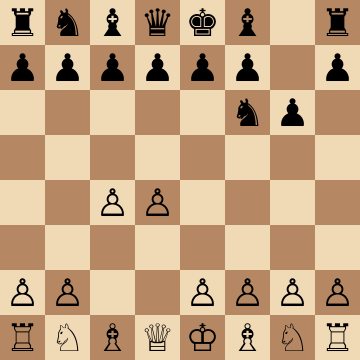
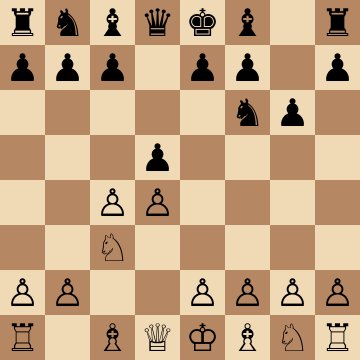
1.d4 Nf6 2.c4 g6 3.Nc3 d5
The Grunfeld Defense (1.d4 Nf6 2.c4 g6 3.Nc3 d5) hands White a broad pawn center and then dismantles it with pieces — the hypermodern idea at its purest and most successful. The choice of Fischer, Kasparov and Carlsen when they needed to win with Black.
Mainline
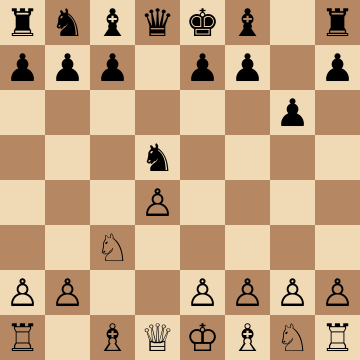
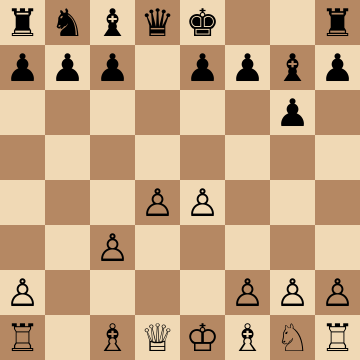
1.d4 Nf6 2.c4 g6 3.Nc3 d5 4.cxd5 Nxd5 5.e4 Nxc3 6.bxc3 Bg7 7.Nf3 c5 8.Rb1 O-O 9.Be2 cxd4 10.cxd4 Qa5+
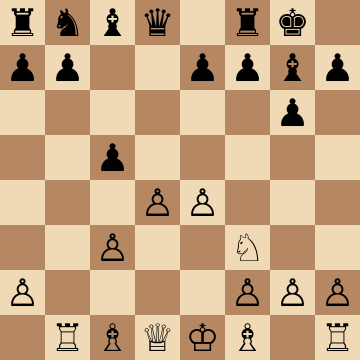
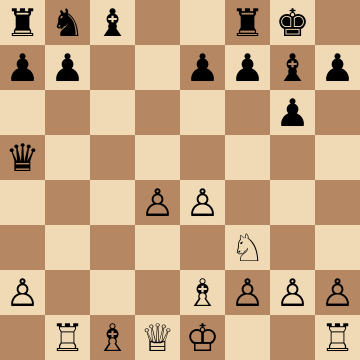
Exchange 8.Rb1: The 10...Qa5+ Pawn Grab
1.d4 Nf6 2.c4 g6 3.Nc3 d5 4.cxd5 Nxd5 5.e4 Nxc3 6.bxc3 Bg7 7.Nf3 c5 8.Rb1 O-O 9.Be2 cxd4 10.cxd4 Qa5+ 11.Bd2 Qxa2 12.O-O Bg4 13.Bg5 h6
White's 8.Rb1 sacrifices the a2 pawn for time and a big center — and modern theory says: take it. After 10...Qa5+ and 11...Qxa2 the queen escapes via e6 or a4 in every critical line, while ...Bg4 and ...Nc6 chip at d4. The course maps the forcing sequences precisely, because this is the sharpest test of the Grunfeld: survive the initiative with accurate moves and the extra queenside pawn wins the endgame on autopilot.
Exchange 7.Bc4: Classical Counterplay
1.d4 Nf6 2.c4 g6 3.Nc3 d5 4.cxd5 Nxd5 5.e4 Nxc3 6.bxc3 Bg7 7.Bc4 c5 8.Ne2 Nc6 9.Be3 O-O 10.O-O Bg4 11.f3 Na5 12.Bd3 cxd4 13.cxd4 Be6
The classical battleground: White builds the ideal center with Bc4 and Ne2, and Black dismantles it piece by piece — ...Bg4 provokes the loosening f3, ...Na5 harasses the bishop, and after the trades on d4 the bishop resettles on e6. When White pushes 14.d5, the bishop drops back to d7 and the d5 pawn itself becomes the target; when White holds still, ...Rc8 and ...Qa5 pile up. Fischer and Kasparov both trusted Black here, and the assessment has never changed: dynamic balance.
Study the Beat the Grunfeld course
Russian System: Hungarian 7...a6
1.d4 Nf6 2.c4 g6 3.Nc3 d5 4.Nf3 Bg7 5.Qb3 dxc4 6.Qxc4 O-O 7.e4 a6 8.Be2 b5 9.Qb3 c5 10.dxc5 Be6
Against 5.Qb3, Black concedes the center temporarily and then hunts the white queen for the rest of the opening. The Hungarian plan with 7...a6 and 8...b5 gains space with tempo, and 9...c5 followed by ...Be6 keeps hitting her majesty while Black's pieces flood out. White's broad center looks impressive but must be defended by a queen who has already moved four times. Concrete, forcing, and rich in practical chances — exactly what the Grunfeld promises.
Modern Exchange: 7.Be3 and ...Qa5
1.d4 Nf6 2.c4 g6 3.Nc3 d5 4.cxd5 Nxd5 5.e4 Nxc3 6.bxc3 Bg7 7.Be3 c5 8.Qd2 Qa5 9.Rc1 O-O
The modern treatment 7.Be3 defends d4 before developing the kingside, hoping to castle long and attack. Black's precise response pins the position down: 7...c5 and 8...Qa5 attack c3 immediately, forcing White's pieces into defensive postures before any attack begins. Castle short, develop with ...Bg4 or ...Nc6 and ...Rd8, and remember the golden Grunfeld rule — every exchange of central pawns converts White's space into Black's targets.
4.Bf4: The 5...c5! Counterstrike
1.d4 Nf6 2.c4 g6 3.Nc3 d5 4.Bf4 Bg7 5.e3 c5 6.dxc5 Qa5 7.Rc1 Ne4 8.cxd5 Nxc3 9.Qd2 Qxa2 10.bxc3
Club players love 4.Bf4 for its solid reputation — and 5...c5! demolishes that reputation. The point is tactical: 6.dxc5 Qa5 pins the c3 knight, 7...Ne4 piles on, and after the forced sequence Black regains everything with an active queen on a2 while White's structure is wrecked. Even White's better tries leave Black with effortless equality, which is why this line has quietly retired 4.Bf4 at higher levels. Learn the sequence once; it plays itself.
5.Bg5 Ne4!: The Tactical Answer
1.d4 Nf6 2.c4 g6 3.Nc3 d5 4.Nf3 Bg7 5.Bg5 Ne4 6.cxd5 Nxg5 7.Nxg5 e6 8.Nf3 exd5
The pin 5.Bg5 looks annoying until you know the antidote: 5...Ne4! offers the trade on Black's terms. After 6.cxd5 Nxg5 7.Nxg5 e6, the d5 pawn comes straight back, and Black keeps the two bishops with the g7 monster unopposed on the long diagonal. White has spent tempi trading a good bishop for a knight — precisely the kind of small win the Grunfeld converts. If White declines with 6.Bh4, then ...Nxc3 and ...dxc4 damage the queenside anyway.
Key ideas
- Let White build the center, then besiege it: ...Bg7, ...c5 and the queenside levers hit d4 all game.
- Play with perpetual activity — the Grunfeld's compensation is dynamic, and passivity is its only poison.
- Master the Exchange structures: the c3-d4-e4 center versus the g7-bishop is the defining battle.
- Enjoy sound tactics: the Grunfeld's activity comes inside a fully correct, world-championship-tested defense.
Typical plans and structures
In the Exchange main lines Black castles, strikes with ...c5 and ...Qa5 or ...Bg4, and trades central pawns to leave White's remaining center a target rather than a weapon; endgames with the queenside majority are a standard Grunfeld reward. Against 4.Nf3 and the fianchetto systems, Black keeps the same recipe — quick development, central pressure, timely ...c5. The course organizes the theory around these recurring structures so the workload stays honest.
Who should play it
Dynamic players comfortable with concrete, active chess who want Black's most respected fighting answer to 1.d4.
Frequently asked questions
Is the Grunfeld too theoretical for club players?
It has deep theory at the top, but its backbone is one repeating idea — pressure the center with pieces — and this course teaches structure-first. Club players mostly meet natural setups where understanding the ...c5 and ...Bg4 mechanisms goes further than memorized novelties.
What makes the Grunfeld different from the King's Indian?
Both fianchetto, but the Grunfeld strikes at the center immediately with 3...d5 and plays against White's pawns with pieces, while the King's Indian locks the center and attacks with pawns. Grunfeld middlegames are open and concrete; KID middlegames are closed and strategic.
What is White's most dangerous try against the Grunfeld?
The Exchange Variation with 7.Nf3 and 8.Rb1 (as in the main line here) and the modern 7.Bc4 systems are the critical tests, both aiming to prove the center outweighs Black's activity. The course gives a complete, current repertoire against each.
Learn the Grunfeld Defense with AI feedback
This page pairs the guide above with an interactive ChessMind AI course: a GM-authored repertoire you study move by move on a real board, then practice against a human-like chess AI opponent with instant feedback and spaced-repetition review, so the key positions actually stick. Start learning, jump straight into practice, or browse all opening courses.
New to a concept? Every term is defined in the chess terms glossary.