Trompowsky Attack
1.d4 Nf6 2.Bg5
The Trompowsky Attack — 1.d4 followed by 2.Bg5, whatever Black does — sidesteps the entire mainstream of 1.d4 theory on move two. You get a solid, positionally rich game with surprise value that lasts: Nimzo, King's Indian and Grunfeld specialists all find their preparation useless.
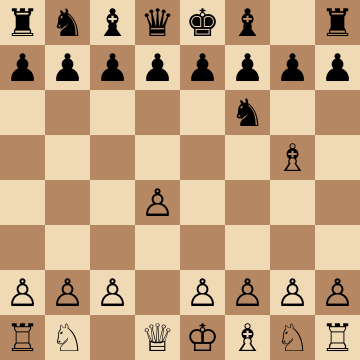
Mainline
1.d4 Nf6 2.Bg5 Ne4 3.Bf4 c5 4.f3 Qa5+ 5.c3 Nf6 6.d5
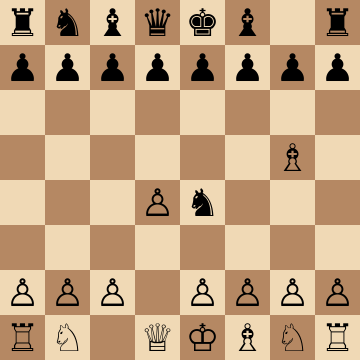
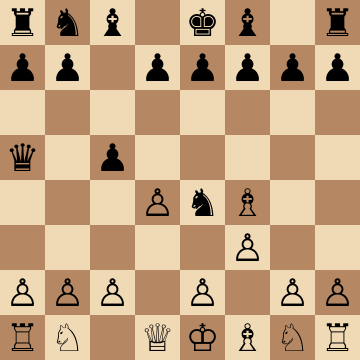
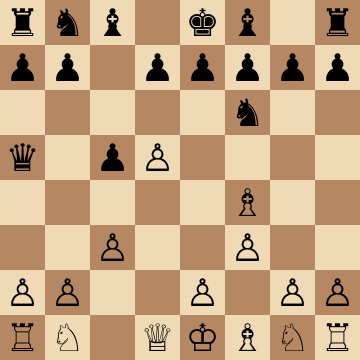
Trompowsky: 2...Ne4 3.Bf4 Main Line
1.d4 Nf6 2.Bg5 Ne4 3.Bf4 c5 4.f3 Qa5+ 5.c3 Nf6 6.d5
The most tested line. Black kicks the bishop, White keeps it with 3.Bf4 and then challenges the knight with f3. The check on a5 is Black's main resource; after c3 and d5 White has grabbed space and the position becomes an unusual Benoni where Black's queen is misplaced on a5.
Trompowsky: 2...e6 Modern Attack
1.d4 Nf6 2.Bg5 e6 3.e4 h6 4.Bxf6 Qxf6 5.Nf3
White grabs the full centre with e4 and happily trades the bishop for the knight. The resulting position is a big-centre versus bishop-pair race: if White consolidates with c3, Bd3 and O-O, the space advantage tells; if Black opens the game with ...d5 or ...c5 at the right moment, the two bishops speak.
Trompowsky: 2...d5 Classical Reply
1.d4 Nf6 2.Bg5 d5 3.Bxf6 exf6 4.e3 Bd6 5.c4
Black accepts doubled f-pawns in return for the bishop pair and a half-open e-file. This is the most solid answer and the one you must be ready for. White plays against the structure with c4, Nc3 and Qb3, aiming at d5 and b7 while keeping the position closed enough that the bishops cannot breathe.
Trompowsky: Vaganian Gambit (2...c5)
1.d4 Nf6 2.Bg5 c5 3.d5 Qb6 4.Nc3 Qxb2 5.Bd2 Qb6
Black snatches the b2-pawn and White gets a development lead plus the open b-file. The critical moment is whether Black's queen can retreat in time; every tempo White gains chasing her is a piece brought into the attack. Sharp, forcing and very much worth knowing before you meet it over the board.
Trompowsky: 3.h4 Aggressive Line
1.d4 Nf6 2.Bg5 Ne4 3.h4 c5 4.d5 Qb6 5.Nd2
Instead of retreating, White offers the bishop and gains time on the h-file. The idea is thoroughly modern: the rook's pawn is a piece in the attack, and Black's knight on e4 turns out to be a target rather than a strength. Requires precise play from both sides and is a nightmare for the unprepared.
Trompowsky: 2...g6 Fianchetto Answer
1.d4 Nf6 2.Bg5 g6 3.Bxf6 exf6 4.e3 d5 5.c4
King's Indian and Grünfeld players often meet the Trompowsky this way and get the structure wrong. After Bxf6 the fianchetto plan loses much of its point, because the bishop that was supposed to dominate the long diagonal now stares at its own pawn on f6. White plays c4 and a normal, comfortable game.
Key ideas
- Play 2.Bg5 against everything: one system replaces a library of main-line theory.
- Meet 2...Ne4 with 3.Bf4 — the bishop keeps its influence and Black's knight must justify its travels.
- Double Black's f-pawns with Bxf6 when it favors you: a structural edge that lasts into the endgame.
- Keep the surprise working: most Black players face the Trompowsky a few times a year, you play it weekly.
Typical plans and structures
Against the critical 2...Ne4 3.Bf4 c5, White grabs the center with f3 and d5 — the main line where the course invests its deepest work. Against 2...e6 or 2...d5, White chooses between Bxf6 structures (doubled pawns, then a slow squeeze with e3, c4 and long-term pressure) and flexible setups with e3 and Nd2. The recurring trumps: an unbalanced structure Black rarely knows, the two-bishop trades on White's terms, and middlegame plans you have rehearsed and your opponent is improvising.
Who should play it
1.d4 players who want a complete, low-maintenance repertoire weapon with genuine bite — ideal if you would rather understand one system deeply than memorize five defenses' main lines.
Study the Trompowsky Attack move by move
The first 3 lines of the interactive course, exactly as a signed-out visitor can play them — each move with the coaching note shown on the board.
Line 1 — the main line
1.d4 We claim the center. 1...Nf6 Our opponent develops the knight. 2.Bg5 We bring the bishop out, pressuring the knight. This is the Trompowsky! 2...Ne4 Our opponent jumps into the center with the knight, counterattacking the bishop. 3.Bf4 We retreat the bishop. 3...c5 Our opponent launches a pawn break to challenge our center and develop their queen. 4.f3 Attacking their knight. 4...Qa5+ Our opponent gives a check witht the queen. 5.c3 We block the check, renewing the threat on the knight. 5...Nf6 Our opponent retreats the knight. 6.d5 We grab more central space while releasing the tension between c5 and d4. 6...e6 Putting pressure on d5. 7.e4 Reinforcing d5. 7...exd5 Our opponent trades. 8.exd5 We take back. 8...d6 Blocking the pawn and freeing their light squared bishop. 9.Qd2 We develop the queen. 9...Be7 Our opponent moves the bishop, preparing to castle. 10.c4 We offer a queen trade, keeping d5 defended. 10...Qxd2+ Our opponent captures on d2. 11.Nxd2 We take back with the queen. 11...Nh5 Our opponent challenges our bishop. 12.Be3 We retreat the bishop, keeping a space advantage and a healthier pawn structure for the long term.
Line 2 — against an inaccuracy
1.d4 We claim the center. 1...Nf6 Our opponent develops the knight. 2.Bg5 We bring the bishop out, pressuring the knight. This is the Trompowsky! 2...Ne4 Our opponent jumps into the center with the knight, counterattacking the bishop. 3.Bf4 We retreat the bishop. 3...c5 Our opponent launches a pawn break to challenge our center and develop their queen. 4.f3 Attacking their knight. 4...Qa5+ Our opponent gives a check witht the queen. 5.c3 We block the check, renewing the threat on the knight. 5...Nf6 Our opponent retreats the knight. 6.d5 We grab more central space while releasing the tension between c5 and d4. 6...d6 Freeing the light squared bishop. 7.e4 We take central space. 7...g6 Our opponent prepares to fianchetto. 8.Nd2 We develop our knight. 8...Bg7 Our opponent activates the bishop and prepares to castle. 9.a4 We expand on the queenside. 9...O-O Our opponent castles. 10.g4 We launch a pawn storm on the kingside. 10...Nbd7 Our opponent brings out their knight. 11.h4 We enjoy extra space on both flanks, which allows us to launch a strong attack against their king.
Line 3 — punishing a blunder
1.d4 We claim the center. 1...Nf6 Our opponent develops the knight. 2.Bg5 We bring the bishop out, pressuring the knight. This is the Trompowsky! 2...Ne4 Our opponent jumps into the center with the knight, counterattacking the bishop. 3.Bf4 We retreat the bishop. 3...c5 Our opponent launches a pawn break to challenge our center and develop their queen. 4.f3 Attacking their knight. 4...Nf6 Our opponent pulls the knight back. 5.dxc5 We take on c5. 5...b6 Our opponent sacrifices the pawn to accelerate their development. 6.e4 We do not take the pawn, choosing a central push to open lines for our pieces. 6...bxc5 Our opponent captures on c5. 7.e5 We push the e pawn, targeting their knight. 7...Ng8 Our opponent retreats the knight to its starting square. 8.Na3 We develop the knight. 8...Nc6 Our opponent brings out their knight. 9.Bb5 We activate our bishop with pressure on c6. 9...Qa5+ Our opponent gives a check with the queen. 10.c3 We block with the pawn. 10...Qc7 Our opponent pulls their queen back to c7, targeting our pawn. 11.Qa4 We develop the queen, preparing Qe4 so that ... Nc6xe5 runs into a fork on their rook and knight. 11...e6 Our opponent blocks our pawn, as e5 e6 would have opened a discovered attack on their queen. 12.Bxc6 We capture their knight, compromising their pawn structure and exploiting their weaknesses with our lead in development.
The free preview ends here — continue with all 17 lines in the interactive course, with instant feedback on every move you play.
Frequently asked questions
What exactly defines the Trompowsky Attack?
The position after 1.d4 with 2.Bg5 — played whether Black responds 1...Nf6 (the pure Trompowsky) or 1...d5 (the related Pseudo-Trompowsky/Hopton). The defining idea is the immediate queen's-bishop sortie before Black's setup gets a say.
Is the Trompowsky sound or just a surprise weapon?
Both: it is theoretically respectable — used by elite players from Julian Hodgson to Magnus Carlsen, and famously by Vladimir Kramnik — while ALSO carrying surprise value, because most Black repertoires give it a fraction of the attention the main lines get.
What is Black's most critical answer?
2...Ne4, hitting the bishop immediately, followed by ...c5 — met by 3.Bf4 and the ambitious f3 and d5 center. That tabiya is the theoretical heart of the Trompowsky and the centerpiece of this course's repertoire.
Learn the Trompowsky Attack with AI feedback
This page pairs the guide above with an interactive ChessMind AI course: a GM-authored repertoire you study move by move on a real board, then practice against a human-like chess AI opponent with instant feedback and spaced-repetition review, so the key positions actually stick. Start learning, jump straight into practice, or browse all opening courses.
New to a concept? Every term is defined in the chess terms glossary.