Catalan Opening
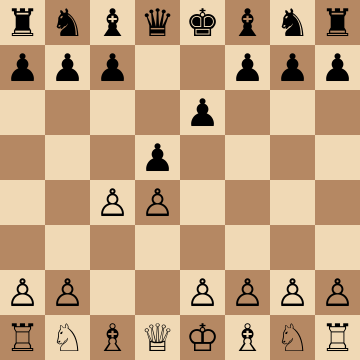
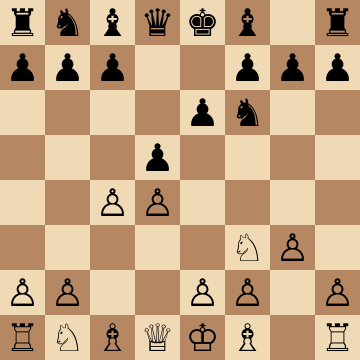
1.d4 d5 2.c4 e6 3.Nf3 Nf6 4.g3
The Catalan combines a d4 setup with a kingside fianchetto (g3, Bg2), aiming a powerful bishop down the long diagonal. It offers White a lasting positional squeeze with low risk.
Mainline
1.d4 d5 2.c4 e6 3.Nf3 Nf6 4.g3 Be7 5.Bg2 O-O 6.O-O dxc4 7.Qc2 a6 8.Qxc4 b5
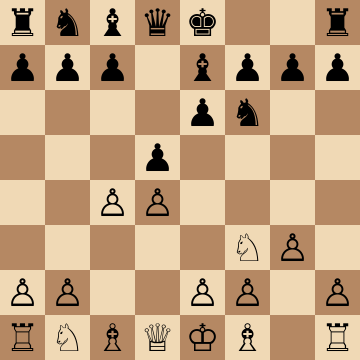
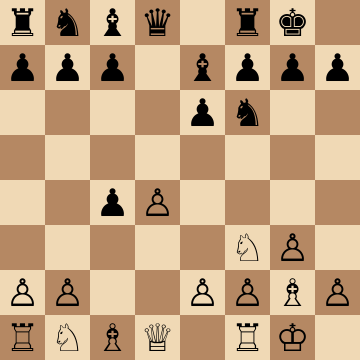
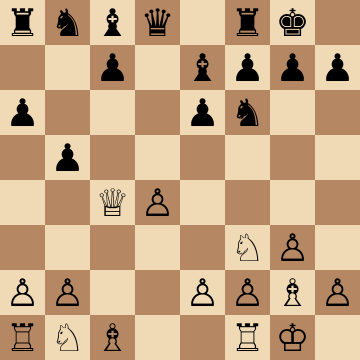
Open Catalan Main Line (6...dxc4 7.Qc2)
1.d4 Nf6 2.c4 e6 3.g3 d5 4.Bg2 Be7 5.Nf3 O-O 6.O-O dxc4 7.Qc2 a6 8.Qxc4 b5 9.Qc2 Bb7 10.Bd2
Modern practice runs straight through this position. White regains the pawn with Qc2 and Qxc4, invites ...b5, then strikes with a4 — the b5-pawn becomes a target rather than an asset. The flexible 10.Bd2 keeps both a4 and Ba5 available. Your compass in this structure: pressure down the c-file against c7, the recurring Ne5 ideas against b7, and simplified positions where the g2-bishop simply outclasses its counterpart.
Open Catalan: the Forcing 7.Ne5
1.d4 Nf6 2.c4 e6 3.g3 d5 4.Bg2 Be7 5.Nf3 O-O 6.O-O dxc4 7.Ne5 Nc6 8.Bxc6 bxc6 9.Nxc6 Qe8 10.Nxe7+ Qxe7
A forcing alternative to 7.Qc2: the knight leaps to e5, hitting both c6 and c4, and the sequence through 10.Nxe7+ Qxe7 leaves Black with a wrecked queenside. The straggler on c4 is usually rounded up by Qa4 and Nd2 within a few moves, after which White enjoys the healthier structure at zero risk. Choose this line when you want an early simplification and a long, one-sided endgame squeeze.
Closed Catalan with ...c6 and ...Nbd7
1.d4 Nf6 2.c4 e6 3.g3 d5 4.Bg2 Be7 5.Nf3 O-O 6.O-O Nbd7 7.Qc2 c6 8.Nbd2 b6 9.e4
When Black keeps the center locked with ...c6, White gets the purest version of the squeeze. The setup Qc2 and Nbd2 prepares the central break e4, claiming the ground Black declined to fight for. Do not release the tension carelessly — exchanging on d5 too early frees Black's game. Instead build up, meet ...Bb7 with e5 or with Rd1 and b3, and use the extra space to improve your pieces while Black shuffles behind three pawn chains.
Bogo-Catalan Hybrid: 4...Bb4+
1.d4 Nf6 2.c4 e6 3.g3 d5 4.Bg2 Bb4+ 5.Bd2 Be7 6.Nf3 O-O 7.O-O c6 8.Qc2
The check looks annoying but achieves little: after 5.Bd2 the bishop usually retreats to e7, having spent two tempi to make White play a useful move. Continue with the normal scheme — Nf3, O-O, Qc2 — and note that the d2-bishop already stands on its best diagonal, sliding to f4 or g5 in one move whenever the moment is right. Against the ...c6 setup, the familiar plans apply: Rd1, b3 when needed, and the central e4 break.
Early ...dxc4 with ...a6 and ...Nc6
1.d4 Nf6 2.c4 e6 3.g3 d5 4.Bg2 dxc4 5.Nf3 a6 6.O-O Nc6 7.e3 Bd7 8.Qe2
Grabbing on c4 before developing the kingside is Black's trickiest independent try, and 6...Nc6 aims to hold the pawn with ...Na5 or ...b5 next. White's cleanest answer is 7.e3 and 8.Qe2: the queen eyes c4 directly, Rd1 comes with tempo against the d7-bishop, and the pawn returns without concessions. Meanwhile the c6-knight blocks Black's own ...c5 break for a long time — a positional debt White exploits in the center.
Punishing the Pawn Grab: 5...b5?! 6.a4
1.d4 Nf6 2.c4 e6 3.g3 d5 4.Bg2 dxc4 5.Nf3 b5 6.a4 c6 7.axb5 cxb5 8.Ne5 Nd5 9.Nc3
Trying to keep the extra pawn with ...b5 and ...c6 is the greedy approach, and White punishes it concretely: 6.a4 undermines, and after the exchange on b5 the leap 8.Ne5 opens the g2-bishop's diagonal straight at a8. Black must block with 8...Nd5, and 9.Nc3 piles on b5 and d5 at once. White regains the material with a serious lead in development — a line worth knowing move by move, since club players grab this pawn often.
Key ideas
- Pressure the long light-squared diagonal with the fianchettoed bishop.
- Combine calm positional pressure with well-timed pawn breaks.
- Durable structures that give White a safe, long-term pull.
- A favorite of elite players for its balance of safety and ambition.
Typical plans and structures
In the Open Catalan (6...dxc4), White calmly regains the pawn with Qc2 or Ne5 while the Bg2 pressures b7 and a8 — Black's queenside development stays tangled for many moves. In the Closed lines, White builds with Qc2, Rd1, b3 and Bb2 or e4 breaks, squeezing without ever exposing the king. The recurring themes — pressure on the c- and d-files, the e4 and d5 breaks, superior endgames — repeat across variations, which is why the Catalan rewards understanding over memorization.
Who should play it
Players who enjoy patient, positional chess and want a strategically rich White opening.
Study the Catalan Opening move by move
The first 3 lines of the interactive course, exactly as a signed-out visitor can play them — each move with the coaching note shown on the board.
Line 1 — punishing a blunder
1.d4 We start by taking control of the center. 1...d5 Our opponent fights for the center as well. 2.c4 We start the Queen's Gambit, offering a pawn for the center. 2...e6 Our opponent opts for a Queen's Gambit declined. 3.Nf3 We develop our kingside knight. Notice the other knight might someday jump to d2 or c3. 3...Nf6 Our opponent develops his knight. The move 3...Be7 is mostly equivalent. 4.g3 We start the Catalan Opening, the topic of this course! We plan to develop our bishop via g2. 4...Be7 Black continues developing. 5.Bg2 This "Catalan bishop" will create long-term pressure along the diagonal. 5...O-O Black will almost always castle short against the Catalan. 6.O-O White will almost always castle short in the Catalan. 6...dxc4 Accepting the pawn on c4 is one of the main lines. White will recapture it soon. 7.Qc2 Threatening to recapture the pawn with Qxc4. 7...b5 Defending the c4 pawn, but opening the long diagonal. 8.a4 Undermining the defender of the c4 pawn. 8...c6 Defending the pawn like this allows a nasty tactical trick, let's see it! 9.axb5 This capture is typically incorrect (it eliminates Black's doubled pawns), but here it works out tactically. 9...cxb5 This "natural response" is actually a blunder, as it exposes the rook on a8. 10.Ng5 The key move. White opens the diagonal to attack the rook on a8, while also attacking the h7 pawn with the knight. 10...Nd5 Black relies on this move to block the diagonal and save the rook, but here it fails:. 11.Qxh7# This was the point of 10.Ng5, game is over!
Line 2 — the main line
1.d4 We start by taking control of the center. 1...d5 Our opponent fights for the center as well. 2.c4 We start the Queen's Gambit, offering a pawn for the center. 2...e6 Our opponent opts for a Queen's Gambit declined. 3.Nf3 We develop our kingside knight. Notice the other knight might someday jump to d2 or c3. 3...Nf6 Our opponent develops his knight. The move 3...Be7 is mostly equivalent. 4.g3 We start the Catalan Opening, the topic of this course! We plan to develop our bishop via g2. 4...Be7 Black continues developing. 5.Bg2 This "Catalan bishop" will create long-term pressure along the diagonal. 5...O-O Black will almost always castle short against the Catalan. 6.O-O White will almost always castle short in the Catalan. 6...dxc4 Accepting the pawn on c4 is one of the main lines. White will recapture it soon. 7.Qc2 Threatening to recapture the pawn with Qxc4. 7...a6 Black wants to play ...b7 b5 followed by ...Bb7. 8.a4 We prevent ...b7 b5, to be able to capture on c4. 8...Bd7 Since ...b7 b5 could not be played, the bishop develops via d7 c6 instead. 9.Qxc4 Finally recapturing the pawn, and now White has a nicer control of the center, with a Slav structure. 9...Bc6 The bishop on c6 fights against the Catalan bishop on g2. 10.Bf4 Developing the bishop to a great square, creating some pressure on the c7 pawn. 10...a5 Turning the b4 square into an outpost for the knight. 11.Nc3 We want to have more space, so developing the knight via c3 is better than d2. 11...Na6 Aiming toward the outpost on b4. 12.Rac1 Using the only open file, and increasing the pressure on c7. 12...Nb4 The knight finally reaches its outpost. 13.Ne5 There's no reason to delay this trade further, but the point of this move is preparing to gain center with e2 e4. 13...Bxg2 Trades favor the side with less space, so we can expect Black to capture here. 14.Kxg2 Recapturing, and now ready to play e2 e4. 14...c6 Moving the pawn to c6 relieves the pressure it was under (from the queen, rook and bishop). 15.e4 White has a nice control of the center, and may launch an effective kingside attack later in the middlegame.
Line 3 — punishing a blunder
1.d4 We start by taking control of the center. 1...d5 Our opponent fights for the center as well. 2.c4 We start the Queen's Gambit, offering a pawn for the center. 2...e6 Our opponent opts for a Queen's Gambit declined. 3.Nf3 We develop our kingside knight. Notice the other knight might someday jump to d2 or c3. 3...Nf6 Our opponent develops his knight. The move 3...Be7 is mostly equivalent. 4.g3 We start the Catalan Opening, the topic of this course! We plan to develop our bishop via g2. 4...Be7 Black continues developing. 5.Bg2 This "Catalan bishop" will create long-term pressure along the diagonal. 5...O-O Black will almost always castle short against the Catalan. 6.O-O White will almost always castle short in the Catalan. 6...Nbd7 Black continues developing without reacting in the center. 7.Qc2 Protecting the c4 pawn, and preparing a central break with e2 e4. 7...c6 Reinforcing central control. 8.Nbd2 This knight prepares the break e2 e4 (Nc3 would have allowed Black to capture on c4). 8...b6 Preparing to develop the bishop via b7. 9.e4 Finally the pawn break, taking even more center and space. 9...dxe4 Trading on e4 increases the strength of the bishop on g2. 10.Nxe4 Now White has a favorable Carokann structure. Black needs to fight for the center with the .. .c6 c5 or ...e6 e5 breaks. 10...Bb7 The bishop develops, preparing the ...c6 c5 break. 11.Rd1 Centralizing the rook, anticipating a central break. 11...c5 This break is the right idea, at the wrong time. Let's see why:. 12.Nxf6+ This knight was under attack, we trade it. 12...Bxf6 Recapturing. The alternative 12...Nxf6 would have exposed the queen to 13.dxc5. 13.dxc5 Trading and opening the d file. 13...bxc5 Recapturing. 14.Ng5 Creating multiple threats (like Qxh7#), we win material now. 14...Bxg5 Eliminating the biggest threat (Qxh7#). 15.Bxb7 Regaining the piece, now threatening the rook. 15...Rb8 Moving the rook to safety. 16.Bxg5 Taking a second piece and attacking the queen. 16...Qxg5 Recapturing the piece, but now the knight on d7 is left hanging. 17.Rxd7 Capturing a piece and protecting the bishop. White's a piece up and wins.
The free preview ends here — continue with all 24 lines in the interactive course, with instant feedback on every move you play.
Frequently asked questions
Why do so many top players use the Catalan?
Because it offers the rare combination of safety and lasting pressure: White risks almost nothing, yet Black must defend precisely for a long time. World championship matches have featured it repeatedly, from Kramnik to Carlsen to Ding Liren.
What happens when Black takes the c4-pawn in the Catalan?
The Open Catalan (6...dxc4) is the main line: White regains the pawn with Qc2 and Qxc4 or with Ne5, and in return for the brief inconvenience gets enduring pressure against Black's queenside — especially the b7-pawn staring down the Bg2's diagonal.
Is the Catalan hard to learn?
Less than its reputation suggests: the same fianchetto structure, piece placements and pawn breaks recur in nearly every line. This course teaches the plans schematically first, so the concrete theory has a framework to hang on.
Learn the Catalan Opening with AI feedback
This page pairs the guide above with an interactive ChessMind AI course: a GM-authored repertoire you study move by move on a real board, then practice against a human-like chess AI opponent with instant feedback and spaced-repetition review, so the key positions actually stick. Start learning, jump straight into practice, or browse all opening courses.
New to a concept? Every term is defined in the chess terms glossary.