Scandinavian Defense
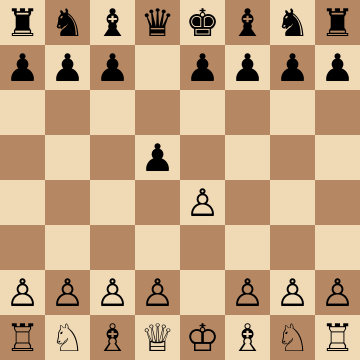
1.e4 d5
The Scandinavian Defense (1.e4 d5) challenges White's center on the very first move and clears the theory board at a stroke: no Italian, no Ruy Lopez, no King's Gambit — just your structure, your plans, from move one. Direct, practical, and far sounder than its rebel reputation.
Mainline
1.e4 d5 2.exd5 Qxd5 3.Nc3 Qa5 4.d4 Nf6 5.Nf3 c6 6.Bc4 Bf5
Main Line with 8.Qe2 Bb4
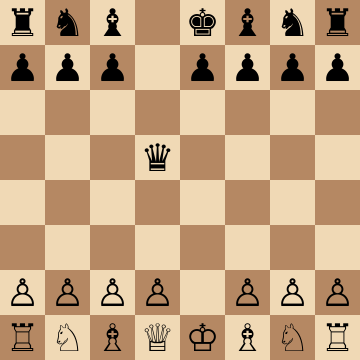
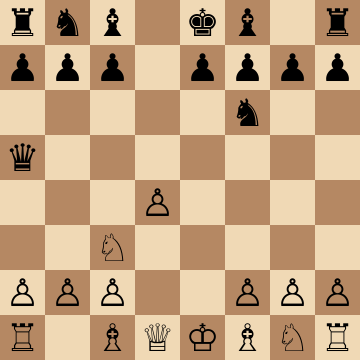
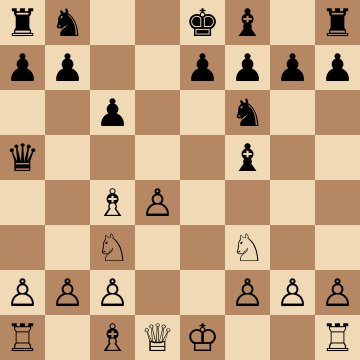
1.e4 d5 2.exd5 Qxd5 3.Nc3 Qa5 4.d4 Nf6 5.Nf3 c6 6.Bc4 Bf5 7.Bd2 e6 8.Qe2 Bb4 9.O-O-O Nbd7
This is the tabiya your whole repertoire funnels into: bishop out to f5 before ...e6, the c6-Qa5 battery securing the queen, and now 8...Bb4 pinning against White's long castling. Black's position mirrors a dream Caro-Kann. The plans from here are concrete — ...Bxc3 at the right moment, ...O-O or ...O-O-O by taste, and the ...c5 or ...e5 breaks once development finishes. Solid does not mean passive.
8.Nd5 Trick Line
1.e4 d5 2.exd5 Qxd5 3.Nc3 Qa5 4.d4 Nf6 5.Nf3 c6 6.Bc4 Bf5 7.Bd2 e6 8.Nd5 Qd8 9.Nxf6+ Qxf6
Every Scandinavian player must know this one cold: 8.Nd5 unleashes the d2 bishop against your queen while eyeing c7. Keep calm — 8...Qd8! steps back through the cleared diagonal, and after 9.Nxf6+ Qxf6 Black has conceded nothing: development is level, the structure is intact, and the f6 queen stands actively. White's trick has fizzled into an equal middlegame where Black's plan of ...Nd7, ...Bd6 and ...O-O flows naturally.
Aggressive 7.Ne5 with g4
1.e4 d5 2.exd5 Qxd5 3.Nc3 Qa5 4.d4 Nf6 5.Nf3 c6 6.Bc4 Bf5 7.Ne5 e6 8.g4 Bg6 9.h4 Nbd7 10.Nxd7 Nxd7 11.h5 Be4
The critical attacking try: White throws the g- and h-pawns at your bishop and hopes you crack. The defense is precise but logical — 9...Nbd7! challenges the e5 knight at the peak of the tension, and after 11.h5 the bishop slips to e4, hitting h1 and forcing White to make concessions to dislodge it. Once the dust settles, White's advanced pawns are weaknesses, not attackers. Study this line first; it is the one direct attempt to refute your opening.
6.Ne5 Sideline
1.e4 d5 2.exd5 Qxd5 3.Nc3 Qa5 4.d4 Nf6 5.Nf3 c6 6.Ne5 Nbd7
Jumping to e5 before Black's bishop leaves home looks menacing but meets a clean equalizer: 6...Nbd7 challenges the knight immediately. Trades on d7 solve all of Black's development questions at once, while retreating moves like 7.Nc4 hit the queen but leave the knight having spent three tempi to reach a square where ...Qc7 calmly sidesteps. Either way Black completes the standard setup — ...Bf5 or ...g6, ...e6 and castling — without a scratch.
3.Nf3 Sideline with ...Bg4
1.e4 d5 2.exd5 Qxd5 3.Nf3 Bg4 4.Be2 Nc6 5.d4 O-O-O
White's quiet 3.Nf3 skips Nc3 and lets the queen sit on d5 — so use the extra time ambitiously. With 3...Bg4, 4...Nc6 and the striking 5...O-O-O, every Black piece hits d4 while White is still tying his shoes: the rook, queen, knight and bishop all converge on the center. Ideas like ...e5 or ...Bxf3 followed by ...Qxd4 or ...e5 breaks appear immediately. This is the line where the Scandinavian turns from solid to genuinely dangerous.
Key ideas
- Strike immediately with 1...d5 and trade White's proud e-pawn off the board at once.
- Build the granite setup: ...c6, ...Bf5, ...e6 — a light-squared wall with no weaknesses.
- Keep the queen active but safe on a5: pinning tricks against Nc3 and pressure that persists.
- Cut White's preparation to nothing: most 1.e4 players know the Scandinavian only by name.
Typical plans and structures
Black's setup assembles the same way nearly every game — ...c6, ...Bf5, ...e6, ...Nbd7 and ...O-O-O or ...Be7 with short castling — and then plays against White's center with ...Rd8 pressure and the ...c5 or ...e5 breaks. The structure resembles a favorable Caro-Kann where the c8-bishop developed for free. White's aggressive tries burn out against the wall; the patient ones face a Black position with plans as clear as White's.
How to reach the Scandinavian Defense
The Scandinavian is 1.e4 d5, and after 2.exd5 Black chooses between 2...Qxd5, the main line, and 2...Nf6, the Modern or Marshall treatment that delays the recapture. After 2...Qxd5 3.Nc3 the queen retreats to a5 in the classical line, to d6 in the fashionable modern line, or to d8 in the Banker Variation; White follows with d4, Nf3 and Bc4 and Black sets up with ...c6, ...Nf6, ...Bf5 or ...Bg4 and ...e6. White can also decline the fight with 2.Nc3, 2.e5 or 2.d4, though 2.exd5 is universal at master level.
Pros and cons of the Scandinavian Defense
Pros
- One reply to 1.e4 that avoids every main line: no Italian, Ruy Lopez, King's Gambit or Vienna theory to learn.
- A compact, repeatable setup with ...c6, ...Nf6, ...Bf5 and ...e6 that works against almost everything White does.
- Sound: the early queen sortie costs a tempo but Black's structure has no weaknesses and the light-squared bishop develops freely.
- Excellent in faster time controls and for players who prefer understanding to memorization.
Cons
- White gets a lead in development from the tempo gained on the queen, and can build a comfortable center with d4 and Nf3.
- Objectively White keeps a small but steady edge; Black plays for equality first and winning chances later.
- The queen on a5 or d6 can be a target for Bd2, Nb5 or Ne4 tricks, and the lines with g4 against the f5-bishop are sharp.
- The Modern 2...Nf6 line concedes a pawn or a structure White can keep with accurate play.
How to play against the Scandinavian Defense
White's most reliable plan is to develop with tempo and build the center: 2.exd5 Qxd5 3.Nc3 Qa5 4.d4 Nf6 5.Nf3 c6 6.Bc4 Bf5 and then either the sharp 7.Ne5 with g4 to harass the bishop and attack, or the calmer 7.Bd2 and Qe2 with queenside castling. Against 3...Qd6, the modern main line, 4.d4 Nf6 5.Nf3 and the plan of Nb5 or Ne4 hitting the queen is the test, and the setup with g3 and Bg2 is the positional alternative. Against 2...Nf6, keep the pawn with 3.c4 c6 4.d4 or return it with 3.d4 Nxd5 4.Nf3 for a comfortable game. In every line, the point is to use the tempi Black spends on the queen: get the center, castle, and put pressure on the f5-bishop and the e6-square before Black's solid setup is complete.
Plans for both sides
White's plan
Develop with tempo against the queen, take the center with d4, and use the lead in development for an attack on the kingside or in the center with Ne5, g4 and h4 against the f5-bishop, or for a queenside-castled setup with Bd2 and Qe2 and a central break with d5. Keep an eye on the b5- and e4-squares for knight jumps against the queen.
Black's plan
Complete the setup before anything else: ...c6, ...Nf6, ...Bf5 or ...Bg4, ...e6 and ...Be7 or ...Bb4, with the queen safe on a5 or d6. Then play ...Nbd7 and ...O-O, break with ...c5 or ...e5 at the right moment, and use the solid structure and the active bishop for a comfortable middlegame. Trade queens gladly when it removes White's initiative.
Who should play it
Practical players who want one dependable, low-theory defense to 1.e4 with a repeatable setup — ideal for busy players and faster time controls.
History of the Scandinavian Defense
The opening is one of the oldest recorded, appearing in the Göttingen manuscript of the 1490s, but it takes its name from the Scandinavian masters who developed it in the nineteenth century, and it is still called the Center Counter in older books. Mieses and later Bent Larsen, who beat Karpov with it in 1979, kept it respectable; Anand played it against Kasparov in their 1995 world championship match, and the modern 3...Qd6 line was popularized by Tiviakov in the 2000s. Online it has become one of the most played replies to 1.e4 at club level, prized for its simplicity.
Frequently asked questions
Doesn't bringing the queen out early break opening principles?
It spends a tempo, yes — but in return Black trades a center pawn for a flank pawn's worth of structure and reaches a setup with zero weaknesses. A century of practice (and modern engine checks) confirms White's edge is small and hard to grow.
Is the Scandinavian respectable at higher levels?
Yes — grandmasters have used it as a practical weapon for decades, and it even appeared in a World Championship game (Anand chose it against Kasparov in 1995). Its soundness is not in question; only its ambition is debated.
What is the main setup Black aims for?
The classic triangle: pawns on c6 and e6, bishop outside on f5 first, knights on f6 and d7, queen on a5 (or retreating to c7/d8 when useful). One setup against nearly everything — which is exactly the Scandinavian's practical selling point.
Is the Scandinavian Defense good for beginners?
Yes. It gives Black one setup against every 1.e4 line, its plans are simple, and the structure is hard to attack. The tempo lost with the early queen move is real but manageable, and beginners learn faster from a defense whose ideas repeat every game.
How do you play against the Scandinavian Defense?
Take on d5, develop with tempo against the queen, and build the center with d4, Nf3 and Bc4. Against ...Qa5 the sharp 7.Ne5 with g4 or the calm Bd2 and Qe2 setup both keep an edge; against ...Qd6 use the Nb5 and Ne4 ideas against the queen. Never let Black complete the ...c6, ...Bf5, ...e6 setup for free.
Which Scandinavian line should I play: ...Qa5, ...Qd6 or ...Nf6?
...Qa5 is the classical main line with the most literature, ...Qd6 is the modern, more flexible choice favored at grandmaster level, and 2...Nf6 leads to livelier, gambit-like positions. Beginners do well with ...Qa5 and the ...c6, ...Bf5, ...e6 setup; ambitious players tend to prefer ...Qd6.
Learn the Scandinavian Defense with AI feedback
This page pairs the guide above with an interactive ChessMind AI course: a GM-authored repertoire you study move by move on a real board, then practice against a human-like chess AI opponent with instant feedback and spaced-repetition review, so the key positions actually stick. Start learning, jump straight into practice, or browse all opening courses.
New to a concept? Every term is defined in the chess terms glossary.