English Opening
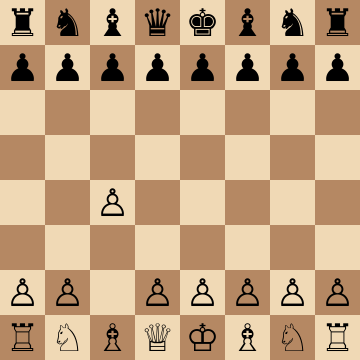
1.c4
The English Opening (1.c4) is the great flank opening: White fights for the center with pieces and the c-pawn instead of committing the king's pawns early. Flexible, sound and endlessly rich, it can transpose into favorable d4 structures or stay in pure English territory where White's setup knowledge dominates.
Mainline
1.c4 e5 2.Nc3 Nf6 3.g3 d5 4.cxd5 Nxd5 5.Bg2 Nb6 6.Nf3
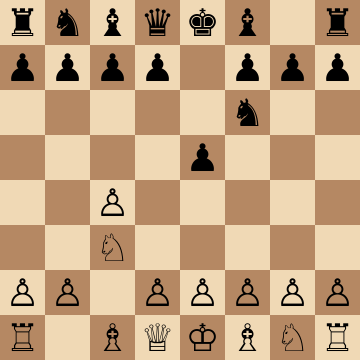
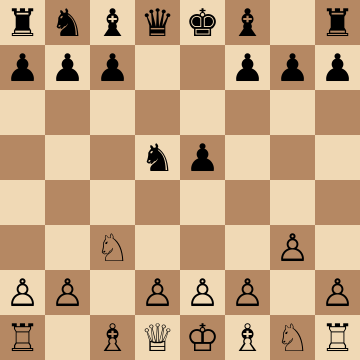
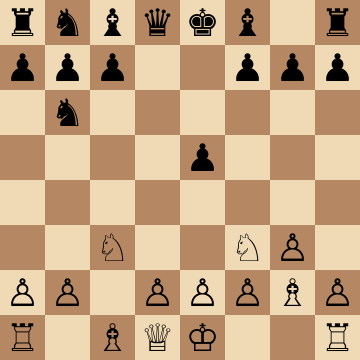
Reversed Dragon: Main Line with 9.b4
1.c4 e5 2.Nc3 Nf6 3.g3 d5 4.cxd5 Nxd5 5.Bg2 Nb6 6.Nf3 Nc6 7.O-O Be7 8.a3 O-O 9.b4 Be6 10.d3
The main event after 1...e5: Black stakes the center with ...d5 and White gets a Dragon Sicilian with an extra tempo. That tempo goes into the queenside — a3 and b4 gain space and prepare b5, harassing the c6 knight while the g2 bishop rakes the long diagonal. Typical play continues Bb2, Rc1 and Nd2-c4 or Ne4; Black's kingside ambitions with ...f5 always arrive one move too slow. Master this structure deeply — it appears in half your English games.
Four Knights: 4.g3 Bb4
1.c4 e5 2.Nc3 Nf6 3.Nf3 Nc6 4.g3 Bb4 5.Bg2 O-O 6.O-O e4 7.Ng5 Bxc3 8.bxc3 Re8
Black's most classical setup: rapid development and the thrust ...e4 to chase White's knight. Don't fear it — 7.Ng5 attacks the e4 pawn immediately, and after ...Bxc3 White's doubled c-pawns control d4 and open the b-file for the rook. The standard plan is f3 or d3 to liquidate the e4 pawn, after which the two bishops take over. White scores excellently here precisely because the position looks comfortable for Black and isn't.
Symmetrical: Botvinnik System
1.c4 c5 2.Nc3 Nc6 3.g3 g6 4.Bg2 Bg7 5.e4 d6 6.Nge2 Nf6 7.O-O O-O 8.d3 a6 9.h3
Against the Symmetrical English, the Botvinnik setup — pawns on c4, d3, e4, knights on c3 and e2 — gives White a clamp that requires understanding, not memorization. The plans are evergreen: Be3 and Qd2 with Bh6 to trade the fianchetto bishop, f4-f5 for a kingside pawn storm, or a well-timed d4 break in the center. Black's usual counterplay with ...b5 runs into a4 or simply cxb5. Slow, strategic, and very hard to face unprepared.
1...e6 Agincourt: Double Fianchetto
1.c4 e6 2.Nf3 d5 3.g3 Nf6 4.Bg2 Be7 5.O-O O-O 6.b3 b6 7.Bb2 Bb7 8.e3
Queen's Gambit players meet 1.c4 with ...e6 and ...d5, hoping for their usual structures — and the double fianchetto denies them everything familiar. Both White bishops bear down on the center from long range, and the flexible pawn chain keeps every break available: d4 in one go, or the thematic cxd5 followed by pressure down the c-file. White's play is easy and nearly risk-free, while Black must constantly watch both long diagonals.
2...Bb4: Doubled Pawns, Bishop Pair
1.c4 e5 2.Nc3 Bb4 3.g3 Bxc3 4.bxc3 d6 5.Bg2 Nf6 6.Nf3 Nc6 7.O-O O-O 8.d3
Some opponents trade on c3 immediately to damage White's structure. Take the trade gladly: the doubled c-pawns control the key d4 square, the half-open b-file becomes a highway for the rook, and the unopposed dark-squared bishop grows stronger with every pawn trade. White's plan writes itself — Rb1, Nd2-e4, then pressure against b7 and d6. The bishop pair wins these middlegames far more often than the pawns lose them.
Bellon Gambit: Punishing 4...b5
1.c4 e5 2.Nc3 Nf6 3.Nf3 e4 4.Ng5 b5 5.d3 bxc4 6.dxe4
A trappy gambit you must know exists: after 3...e4 4.Ng5, Black throws in 4...b5!? hoping for 5.Nxb5 d5 with a dangerous initiative. Decline correctly — 5.d3! strikes the e4 pawn first, and after 5...bxc4 6.dxe4 White has simply won the center: e4 and e5 belong to White, the g5 knight eyes f7, and Black's queenside is full of holes. The whole trick collapses against one accurate move, which is exactly why it belongs in your preparation.
Key ideas
- Control d5 with the c4-pawn and Nc3, often fianchettoing with g3 and Bg2 for lasting pressure.
- Play reversed Sicilian structures with an extra tempo against 1...e5 — your opponent's weapons, one move faster.
- Choose your battlefield: pure English setups, or transpositions to favorable d4 lines when it suits you.
- Build positional pressure on the queenside with b4-b5 expansion while the Bg2 restrains Black's center.
Typical plans and structures
Against 1...e5, White plays a Sicilian a tempo up: Bg2, Nf3 or Nge2, O-O and the b4 expansion or a well-timed d4 break. Against symmetrical ...c5 setups, plans revolve around d4 or the slow squeeze with a3, Rb1 and b4. Against ...Nf6 and ...e6, White can steer toward Catalan-style positions. The recurring assets — the long-diagonal bishop, the half-open c-file, the queenside space — make English middlegames feel familiar even in brand-new positions.
How to reach the English Opening
The English begins 1.c4. Black's reply chooses the family: 1...e5 is the Reversed Sicilian, where 2.Nc3 Nf6 3.g3 leads to the Reversed Dragon after ...d5 or the Four Knights after 3.Nf3 Nc6; 1...c5 is the Symmetrical English, with the Botvinnik setup c4, Nc3, e4 and g3 among White's plans; 1...Nf6 and 1...e6 keep options to transpose into Queen's Gambit, Nimzo-Indian or Catalan positions after a later d4; 1...c6 and 1...f5 are the Slav and Dutch treatments. White decides on move two or three whether to stay in pure English territory with g3 and Bg2 or transpose with d4.
Pros and cons of the English Opening
Pros
- The most flexible first move: White can steer into a Sicilian with an extra tempo, a Catalan, a Queen's Gambit or a pure English setup depending on Black's reply.
- Sound and hard to attack; there is no forcing refutation and few early tactics against White.
- The g2-bishop and the c4-pawn give lasting pressure on d5 and the long diagonal in every line.
- The plans are strategic and repeat: b4-b5 on the queenside, the d4 or e4 breaks, and the reversed Sicilian attacks.
Cons
- It does not fight for the center at once, so Black gets a free choice of setups and can equalize comfortably with ...e5 or ...c5.
- Requires broad knowledge: the same first move can lead to a dozen different structures.
- Symmetrical positions can be dry, and a passive English hands Black the initiative.
- Transpositions to d4 openings mean White must know those too, or lose the flexibility that is the point.
How to play against the English Opening
Black's most principled answer is 1...e5, taking the center White declined, and meeting 2.Nc3 with 2...Nf6 and either 3...d5 for a Reversed Dragon or 3...Bb4 to double White's c-pawns; the extra tempo for White is real but not decisive, and Black gets every Sicilian plan in reverse. The Symmetrical 1...c5 is the solid, well-mapped choice and the Hedgehog setup with ...b6, ...e6, ...a6 and ...d6 behind it is one of the most resilient structures in chess. Players who prefer their usual 1.d4 defenses can play 1...Nf6 and 1...e6 and steer for a Nimzo-Indian or Queen's Gambit Declined when White plays d4, or answer with a King's Indian setup that ignores the c-pawn. Whatever the choice, contest the d5-square and the long diagonal, and do not let the b4-b5 expansion arrive unopposed.
Plans for both sides
White's plan
Fianchetto the bishop, control d5 with c4, Nc3 and Bg2, and expand on the queenside with a3, Rb1 and b4-b5, using the half-open c-file after a later cxd5. Choose the moment for d4 or e4 by Black's setup; in the reversed Sicilians use the extra tempo for the Nd5 jump and pressure down the long diagonal.
Black's plan
Occupy the center with ...e5 or ...c5 and ...d5, complete development, and meet the queenside expansion with ...a5 or counterplay on the kingside with ...f5. Trade the g2-bishop when possible, fight for d4 and d5 with pieces, and use the ...d5 break to open the position before White's slow buildup matures.
Who should play it
Positional players who value flexibility and structure over forcing lines, and anyone who wants a sophisticated lifetime opening that grows with them.
History of the English Opening
The opening takes its name from Howard Staunton, the English master who used 1.c4 in his 1843 match against Saint-Amant and championed it in his writings. It was considered eccentric until the hypermodern era, when Nimzowitsch and Réti showed the strength of controlling the center from the flank, and Botvinnik built whole systems around it. Its golden age came in the 1970s and 1980s: Karpov, Kasparov and Korchnoi all used it in world championship matches, and Kasparov won the decisive final game of his 1987 title defense with it. It remains a main weapon of positional players from Kramnik to Carlsen.
Frequently asked questions
Is the English Opening good for club players?
Yes — its plans are thematic and repeatable, and opponents get no forcing targets to aim preparation at. You do trade some early aggression for long-term pressure, which suits players who like to outplay opponents rather than out-book them.
Why is 1.c4 called a flank opening?
Because White stakes a claim in the center with a wing pawn rather than occupying it directly with e4 or d4. The center is controlled from the side — by the c4-pawn, the Nc3 and the fianchettoed bishop — and occupied later on White's terms.
What is the reversed Sicilian in the English?
After 1.c4 e5, the position is a Sicilian Defense with colors reversed and White effectively a tempo up. Setups like the reversed Dragon (with g3 and Bg2) let White use well-known Sicilian ideas with the extra move turning defense into initiative.
Is the English Opening good for beginners?
It is sound and safe, but it is a strategic opening that rewards understanding of many structures, so beginners often find it hard to know what to do. Most coaches suggest learning 1.e4 or 1.d4 first and adding the English later, when transpositions become an asset rather than a puzzle.
How do you play against the English Opening?
Take the center White declined with 1...e5 for a reversed Sicilian, or play the solid Symmetrical 1...c5, or steer for your usual 1.d4 defense with 1...Nf6 and 1...e6. Fight for d5 and the long diagonal, and meet the b4-b5 queenside expansion with ...a5 or kingside play.
Is the English Opening aggressive?
Usually not in the opening itself, which is positional and flexible, but the reversed Sicilian lines with e5, f4 or g4 and the Botvinnik system with e4 and f4 can become very sharp. The aggression comes in the middlegame, from the extra tempo and the long diagonal.
Learn the English Opening with AI feedback
This page pairs the guide above with an interactive ChessMind AI course: a GM-authored repertoire you study move by move on a real board, then practice against a human-like chess AI opponent with instant feedback and spaced-repetition review, so the key positions actually stick. Start learning, jump straight into practice, or browse all opening courses.
New to a concept? Every term is defined in the chess terms glossary.