Nimzowitsch-Larsen Attack
1.b3
The Nimzowitsch-Larsen Attack (1.b3) fianchettos the queen's bishop on move one and lets your opponent's preparation rot unused. Hypermodern, flexible and sneakily venomous — the b2-bishop's pressure on e5 and g7 shapes the whole game.
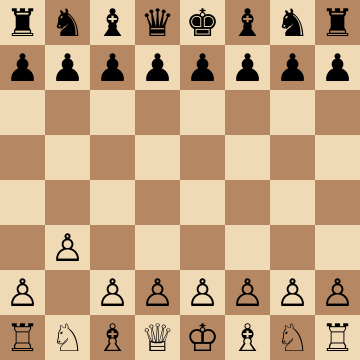
Mainline
1.b3 e5 2.Bb2 Nc6 3.e3 Nf6 4.Bb5 Bd6
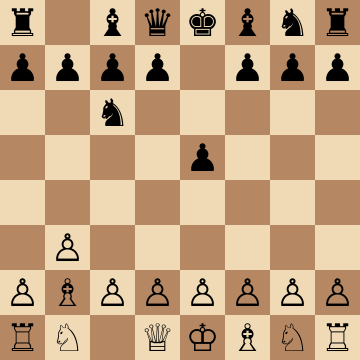
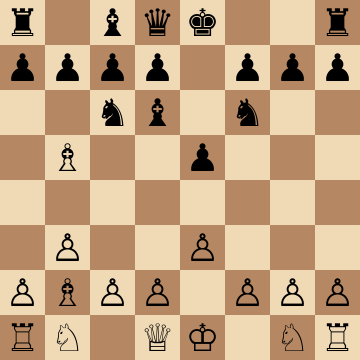
Nimzo-Larsen: Classical 1...e5 Main Line
1.b3 e5 2.Bb2 Nc6 3.e3 Nf6 4.Bb5 Bd6 5.f4 exf4 6.exf4
Black takes the centre and White immediately challenges it from the flank. The pin on c6 and the f4 break are the two ideas that give 1.b3 its bite: White trades the centre pawn for open lines and long-diagonal pressure against g7, which is exactly the Larsen recipe.
Nimzo-Larsen vs 1...d5 Setup
1.b3 d5 2.Bb2 Nf6 3.e3 e6 4.Nf3 Be7 5.c4
Against the solid ...d5 and ...e6 wall, White transposes into a reversed Queen's Indian with an extra tempo. The play is slow and manoeuvring: c4, Nc3 and the d4 break at the right moment, with the b2-bishop as the long-term asset. Ideal for players who want to avoid theory without giving up the initiative.
Nimzo-Larsen vs Indian Setups
1.b3 Nf6 2.Bb2 g6 3.e3 Bg7 4.Nf3 O-O 5.c4
Both bishops end up on the long diagonals staring at each other, and the game becomes a fight over d4 and e5. White has the extra tempo and can grab space with c4 and d4; the practical value is that King's Indian and Grünfeld players are dragged out of their preparation from move one.
Nimzo-Larsen: Modern Variation (2...d6)
1.b3 e5 2.Bb2 d6 3.e3 Nf6 4.Nf3 Nbd7 5.c4
Black defends e5 with the d-pawn rather than the knight, keeping a compact structure. White proceeds with c4, Nc3 and d4, treating the position as a reversed Old Indian. The knight on d7 is passive, and pointing that out with a well-timed d4 is White's whole plan.
Nimzo-Larsen vs the Dutch Setup
1.b3 f5 2.Bb2 Nf6 3.e3 e6 4.Nf3 Be7 5.c4
Dutch players walk into a version where White has already fianchettoed on the queenside and never committed the d-pawn. The e5-square is the battleground: if White lands a knight there the Dutch structure becomes a liability, and the b2-bishop supports the outpost from a distance.
Larsen Opening: Reversed Sicilian Ideas
1.b3 e5 2.Bb2 Nc6 3.c4 Nf6 4.e3 d5 5.cxd5 Nxd5
White plays c4 and the position becomes an English Opening with b3 and Bb2 already inserted — effectively a reversed Sicilian a tempo up. Black's ...d5 break is the critical response, and after the exchange the game revolves around the strong knight on d5 and White's pressure down the long diagonal.
Key ideas
- Fianchetto first, commit later: 1.b3 keeps every central and structural option open.
- Aim the b2-bishop at e5 and g7 — half of Black's natural setups walk straight into it.
- Choose your fight: quiet positional squeezes or the sharp Bb5 lines against ...e5 setups.
- Skip the theory race entirely — by move three, both players think for themselves, but you know the plans.
Typical plans and structures
Against 1...e5, White pressures it with Bb2 and the modern 4.Bb5 pin ideas, often trading on c6 and playing against the doubled pawns with Ne2-g3 and c4. Against ...d5 setups, White plays e3, Nf3, c4 and a timely Ne5 — a reversed Queen's Indian with an extra tempo. Kingside fianchetto double-attack setups (b3 plus g3) are also on the menu. The common thread: the long diagonal never stops mattering, and endgames inherit its pressure.
Who should play it
Independent-minded players who want a sound sidestep from mainstream theory — and enjoy winning strategic battles their opponents never studied.
Frequently asked questions
Is 1.b3 a serious opening?
Entirely — Bent Larsen beat world-class opposition with it, Nimzowitsch pioneered its ideas, and modern elite players (including Magnus Carlsen in faster chess) keep using it. It concedes nothing objectively; it just relocates the fight away from your opponent's preparation.
What is Black's most critical response to 1.b3?
Grabbing the center with 1...e5 and ...Nc6 is the principled test, when White's 3.e3 and 4.Bb5 keeps real pressure on e5 — the course's main line. Solid ...d5 and ...Nf6 setups get comfortable reversed-Indian treatment instead.
Does the Nimzo-Larsen transpose to other openings?
It can — into reversed Nimzo/Queen's Indian structures or English setups with c4 — and that flexibility is a feature: you choose which transpositions to allow. The course flags the useful ones and shows when staying in pure Larsen territory is stronger.
Learn the Nimzowitsch-Larsen Attack with AI feedback
This page pairs the guide above with an interactive ChessMind AI course: a GM-authored repertoire you study move by move on a real board, then practice against a human-like chess AI opponent with instant feedback and spaced-repetition review, so the key positions actually stick. Start learning, jump straight into practice, or browse all opening courses.
New to a concept? Every term is defined in the chess terms glossary.