Beat the rare ...e6 Sicilians
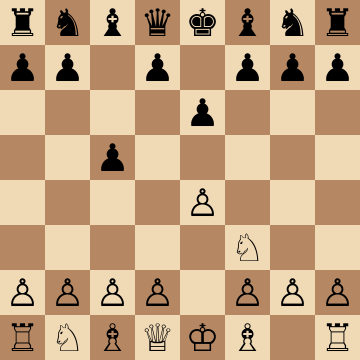
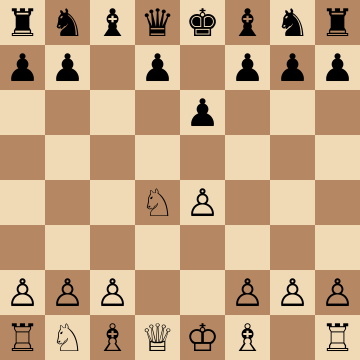
1.e4 c5 2.Nf3 e6 3.d4 cxd4 4.Nxd4
After 1.e4 c5 2.Nf3 e6 3.d4 cxd4 4.Nxd4 Nf6 5.Nc3, most players expect a Taimanov or Scheveningen — and then comes 5...Bb4, the Pin Variation, or 5...Nc6, the Four Knights. These rare continuations are designed to ambush autopilot players. This course gives you the critical, advantage-seeking answer to each.
Mainline
1.e4 c5 2.Nf3 e6 3.d4 cxd4 4.Nxd4 Nf6 5.Nc3 Bb4 6.e5
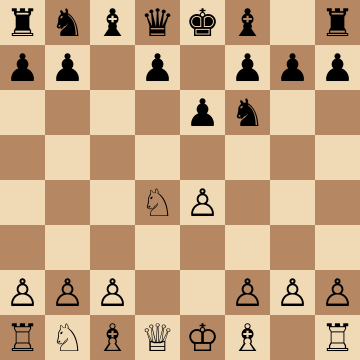
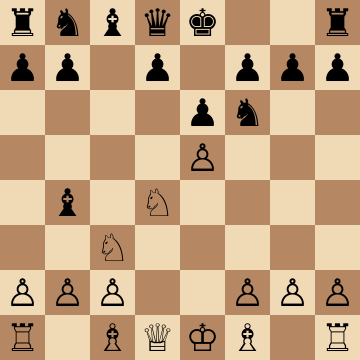
Pin Variation Main Line (6.e5 Nd5 7.Bd2)
1.e4 c5 2.Nf3 e6 3.d4 cxd4 4.Nxd4 Nf6 5.Nc3 Bb4 6.e5 Nd5 7.Bd2 Nxc3 8.bxc3 Be7 9.Qg4
The critical answer to the Pin: 6.e5 gains space with tempo, and the calm 7.Bd2 defuses every tactic on c3. Once the bishop retreats to e7, 9.Qg4! is the punchline — g7 is attacked, and both 9...O-O and 9...g6 leave lasting weaknesses for White's h4-h5 or Bh6 plans. Black's early piece commitments have bought nothing: White holds the space, the safer structure, and the initiative on the kingside.
Pin Variation: 6...Ne4? Punished
1.e4 c5 2.Nf3 e6 3.d4 cxd4 4.Nxd4 Nf6 5.Nc3 Bb4 6.e5 Ne4 7.Qg4 Nxc3 8.Qxg7 Rf8 9.a3
The move Black wants to play is 6...Ne4, keeping the knight active — and it fails concretely. 7.Qg4! double-attacks g7 and the e4-knight; after 7...Nxc3 8.Qxg7 Rf8 9.a3 the b4-bishop must abandon its colleague, and White regains the piece with Black's kingside in ruins and the rook stuck on f8. Memorize this short sequence: it converts the Pin Variation's main trick into a near-decisive advantage by move ten.
Four Knights: 6.Nxc6 and the e5 Wedge
1.e4 c5 2.Nf3 e6 3.d4 cxd4 4.Nxd4 Nf6 5.Nc3 Nc6 6.Nxc6 bxc6 7.e5 Nd5 8.Ne4 Qc7 9.f4 Qb6 10.c4 Bb4+ 11.Ke2
Against the Four Knights, this forcing line is the theoretical test: trade on c6, wedge the pawn into e5, and centralize with 8.Ne4. Black's queen checks and jabs, but the shocking 11.Ke2! ends the fun — the king is perfectly safe, the b4-bishop hangs in several lines, and d6 beckons for the knight. Black's queenside pawns are wrecked for the rest of the game, and White's simple plan (Nd6+, a3, Be3) plays itself.
Four Knights: 6.Ndb5 Alternative
1.e4 c5 2.Nf3 e6 3.d4 cxd4 4.Nxd4 Nf6 5.Nc3 Nc6 6.Ndb5 Bb4 7.a3 Bxc3+ 8.Nxc3 d5 9.exd5 exd5 10.Bg5
A second respectable weapon worth knowing: the knight hop to b5 immediately targets d6. Black's best is to trade on c3 and free the position with ...d5, accepting an isolated queen's pawn after 9.exd5 exd5. Then 10.Bg5 begins the classic IQP siege — pin the knight, control d4, and trade minor pieces until the pawn is simply weak. Choose this line if you prefer quiet structural pressure to the sharper 6.Nxc6 lines.
The ...f5 Break Met by exf6 and Nd6+
1.e4 c5 2.Nf3 e6 3.d4 cxd4 4.Nxd4 Nf6 5.Nc3 Nc6 6.Nxc6 bxc6 7.e5 Nd5 8.Ne4 f5 9.exf6 Nxf6 10.Nd6+ Bxd6 11.Qxd6
Club players regularly try 8...f5 to blunt the e4-knight — and it walks straight into the thematic punishment. Capturing en passant rips open the position while Black's king still sits on e8, and 10.Nd6+! forces Black to surrender the dark-squared bishop. With 11.Qxd6 White owns the d6-square and every dark square around Black's king; castling is difficult, ...c5 never comes for free, and the bind often lasts the whole game.
Key ideas
- Meet the Pin Variation (5...Bb4) with the critical 6.e5 — the only move that punishes Black's idea.
- Against the Four Knights (5...Nc6), know the precise sequence that denies Black easy equality.
- Recognize the sideline early: the whole battle is won or lost in the first accurate response.
- Turn ambush lines into scoring opportunities — prepared players beat surprise weapons.
Typical plans and structures
In the Pin Variation after 6.e5, White gains space with tempo and meets ...Ne4 tries with Qg4 ideas, when Black's kingside becomes indefensible without concessions. In the Four Knights, White steers toward structures where the d6-square and the e5 space wedge define a stable plus. Both systems share the theme of exploiting Black's early piece commitments: the sidelines skip ...a6 or ...d6 for speed, and accurate play makes that speed look like haste.
Who should play it
Open Sicilian players who want zero weak spots in their repertoire — the rare lines covered as concretely as the main ones.
Frequently asked questions
What is the Pin Variation of the Sicilian?
It is 1.e4 c5 2.Nf3 e6 3.d4 cxd4 4.Nxd4 Nf6 5.Nc3 Bb4, pinning the knight and threatening ...Nxe4 — a tactical ambush rather than a positional system. The critical answer is 6.e5, gaining time and exposing the drawbacks of Black's early commitment.
Why can't White just play a normal developing move against the Pin Variation?
Because casual moves let Black execute the point: ...Nxe4 tricks or a favorable ...Bxc3 leaving White's structure damaged with nothing to show for it. Sidelines like this exist precisely to punish natural play — the antidote is one prepared line, which this course provides.
Is the Sicilian Four Knights a serious system?
It is sounder than the Pin Variation and occasionally appears at grandmaster level as a route toward Sveshnikov-adjacent positions. White keeps an edge with accurate play, but the move order matters — the course shows exactly which sequence keeps Black's idea under control.
Learn Beat the rare ...e6 Sicilians with AI feedback
This page pairs the guide above with an interactive ChessMind AI course: a GM-authored repertoire you study move by move on a real board, then practice against a human-like chess AI opponent with instant feedback and spaced-repetition review, so the key positions actually stick. Start learning, jump straight into practice, or browse all opening courses.
New to a concept? Every term is defined in the chess terms glossary.