Modern Defense
1.d4 d6
The Modern Defense (1...g6 against virtually anything) is the universal counterpuncher's opening: Black fianchettos first, keeps every pawn commitment in reserve, and invites White to build a center that will become the target. One setup, playable against 1.e4, 1.d4 and the rest — with a fraction of the theory.
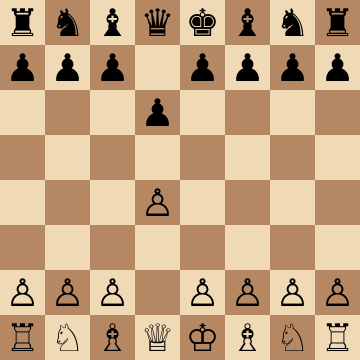
Mainline
1.d4 d6 2.c4 g6 3.Nc3 Bg7 4.e4 e5 5.Nf3
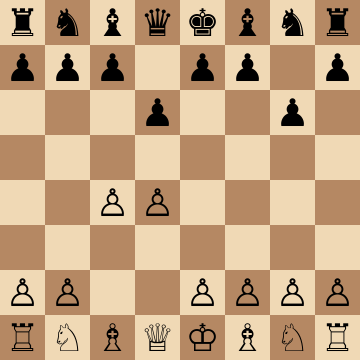
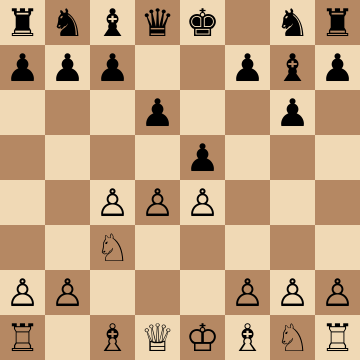
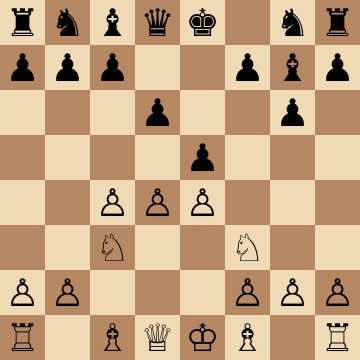
Austrian Attack (4.f4) with ...a6 and ...b5
1.e4 g6 2.d4 Bg7 3.Nc3 d6 4.f4 a6 5.Nf3 b5 6.Bd3 Nd7 7.O-O c5
White's most violent setup, and the reason the Modern's flexibility matters: because Black has not committed the g8-knight, the queenside rush ...a6 and ...b5 comes with maximum speed. While White dreams of e5 and f5, Black hits the base of the center with ...c5, develops with ...Bb7, and often leaves the king in the middle until the situation clarifies. The overextended white center, not the black king, becomes the story of the game.
Main Line with 4...a6 (Tiger's Modern)
1.e4 g6 2.d4 Bg7 3.Nc3 d6 4.Nf3 a6 5.Be2 b5 6.O-O Nd7 7.a4 b4 8.Nd5 a5
Against classical development, Black plays the modern tabiya: ...a6, ...b5 and ...Nd7, taking queenside territory before White generates anything. When White challenges with 7.a4, the calm 7...b4 8.Nd5 a5 fixes the structure — the d5-knight looks pretty but bites on granite and gets evicted by ...e6 at the right moment. Black follows with ...Bb7 and ...Ngf6, enjoying a flexible game with the g7-bishop as a permanent trump.
150 Attack Setup (Be3 and Qd2)
1.e4 g6 2.d4 Bg7 3.Nc3 d6 4.Be3 a6 5.Qd2 b5 6.f3 Nd7 7.h4 h6 8.Nh3 Bb7
The Be3-Qd2 battery aims for Bh6 and a caveman h4-h5 attack, and meeting it correctly is essential Modern knowledge. The restrained 7...h6! is the key move — it halts h5 in its tracks and keeps the g7-bishop on the board, since trading it now costs White two tempi. Black then proceeds with ...b5, ...Bb7 and ...c5, hitting the center while White's attack stalls. Castling waits; in this structure the black king decides its address late.
Modern vs 1.d4: ...Nc6 and ...e5
1.d4 g6 2.c4 Bg7 3.Nc3 d6 4.e4 Nc6 5.Be3 e5 6.d5 Nce7
One of the Modern's best-kept secrets against the queen's pawn: the provocative 4...Nc6 pressures d4 and forces White to declare. After 5.Be3 e5 6.d5 the knight drops back to e7, and Black has a King's Indian-style structure ahead of schedule in the fight for f5 — the g8-knight can go straight to h6 or f6 as needed, and ...f5 arrives quickly. White's space means little once the kingside pawn storm begins rolling.
Pterodactyl: Early ...c5 with ...Qa5
1.e4 g6 2.d4 Bg7 3.Nc3 c5 4.dxc5 Qa5 5.Bd2 Qxc5
The sharpest Modern sideline: 3...c5 offers a pawn White cannot comfortably keep. The point is 4.dxc5 Qa5! — the queen pins the c3-knight, attacks c5, and regains the pawn by force, delivering the Sicilian-style game Black wanted without permitting an Open Sicilian. The g7-bishop breathes down the whole long diagonal from move three. White does better keeping the tension with 4.Nf3, when ...cxd4 heads for Accelerated Dragon territory.
Hippopotamus Setup
1.e4 g6 2.d4 Bg7 3.Nf3 d6 4.Nc3 e6 5.Be2 Ne7 6.O-O b6 7.Be3 Nd7 8.Qd2 Bb7
The ultimate low-theory weapon inside a low-theory opening: both bishops fianchettoed, both knights on the second rank, every pawn on the third. Black concedes the center on purpose and waits — then strikes at the exact point where White commits, with ...c5, ...d5 or ...f5. Petrosian and Spassky both used the Hippo in world championship play. The skill lies in timing the counterstrike, and that is precisely what this course drills.
Key ideas
- Play ...g6 and ...Bg7 against everything — one flexible system instead of five defenses.
- Delay ...Nf6 to keep options: ...c5, ...e5 or ...b5 strikes come on your terms, not White's.
- Use the modern ...a6 move order to prepare queenside expansion and dodge the sharpest theory.
- Turn White's big center into a target with well-timed pawn breaks and the ever-present Bg7.
Typical plans and structures
Black typically strikes with ...c5 (Benoni-style), ...e5 (King's Indian-style) or the queenside rush ...b5-b4 with ...Bb7, choosing whichever fits White's commitment. The g7-bishop is the constant: every plan feeds its diagonal. Against aggressive setups like the Austrian-style f4, Black counterattacks the overextended center rather than meeting force with force. The course teaches the structures as a decision tree — which strike against which setup — instead of an encyclopedia of lines.
Who should play it
Independent-minded players who want one flexible, theory-light defense for both 1.e4 and 1.d4 and enjoy counterattacking chess with rich transpositions.
Study the Modern Defense move by move
The first 3 lines of the interactive course, exactly as a signed-out visitor can play them — each move with the coaching note shown on the board.
Line 1 — the main line
1.d4 White seeks the center with the queen's pawn. 1...d6 We launch the Modern Defense, a great weapon. It's technically correct, but still manages to be tricky from the start. 2.c4 Our opponent gains more space in the center. 2...e5 we counterstrike in the center. 3.dxe5 White decides to capture the central pawn. 3...dxe5 we recapture maintaining the center. 4.Qxd8+ White leaves the Black King without castling. 4...Kxd8 we capture, we remain with the King in the center, without queens on the board. 5.Nc3 natural development, controlling the d5 square. 5...Be6 we develop the bishop on an active square. 6.b3 they control c4 and seek to develop their bishop by fianchetto. 6...Nd7 we develop our knight controlling e5 and c5. 7.Bb2 they occupy the diagonal. 7...c6 very important move and we control d5. 8.O-O-O White protects the King, obtaining the d file. 8...Kc7 we get out of the pin. 9.Nf3 natural development, with jumps to g5. 9...f6 we strengthen e5 and control weak squares. 10.e3 they seek to complete their development. 10...Nh6 we develop from the corner, to seek a better square. 11.h3 prevents knight jumps on g4. 11...Nf7 we control better squares. 12.Be2 they complete their development. 12...a5 we gain space on the queenside and the pieces are very well placed.
Line 2 — against an inaccuracy
1.d4 White seeks the center with the queen's pawn. 1...d6 We launch the Modern Defense, a great weapon. It's technically correct, but still manages to be tricky from the start. 2.c4 Our opponent gains more space in the center. 2...e5 we counterstrike in the center. 3.dxe5 White decides to capture the central pawn. 3...dxe5 we recapture maintaining the center. 4.Qxd8+ White leaves the Black King without castling. 4...Kxd8 we capture, we remain with the King in the center, without queens on the board. 5.Nc3 natural development, controlling the d5 square. 5...Be6 we develop the bishop on an active square. 6.e4 they defend c4, but leave the d4 square weak. 6...Nd7 we develop and seek to control c5. 7.Be3 they develop and improve their bishop. 7...Bb4 we pin and threaten to damage the pawn structure. 8.Rc1 they seek to maintain their pawn structure. 8...Ngf6 we complete our development. 9.f3 strengthening the center. 9...c6 important control of the d5 square. 10.a3 they expel our bishop. 10...Bc5 we propose a bishop exchange. 11.Bxc5 they decide to capture and help us improve the knight. 11...Nxc5 without any weakness, with better initiative on the queenside.
Line 3 — the main line
1.d4 White seeks the center with the queen's pawn. 1...d6 We launch the Modern Defense, a great weapon. It's technically correct, but still manages to be tricky from the start. 2.c4 Our opponent gains more space in the center. 2...e5 we counterstrike in the center. 3.dxe5 White decides to capture the central pawn. 3...dxe5 we recapture maintaining the center. 4.Qxd8+ White leaves the Black King without castling. 4...Kxd8 we capture, we remain with the King in the center, without queens on the board. 5.Nf3 they develop and attack the central pawn. 5...f6 we defend with a pawn chain. 6.Nc3 they develop, controlling central squares. 6...Be6 we develop and attack on c4. 7.e3 they defend and free the bishop. 7...c6 super important move to control d5. 8.Be2 natural development and clear castling. 8...Nd7 we develop and control the c5 square. 9.O-O they protect their King. 9...Kc7 we remove the King from the open file. 10.Rd1 they seek control of the open file. 10...a5 we gain space and control key squares like b4. 11.b3 they strengthen c4 and seek the fianchetto of their bishop. 11...Nh6 we develop on the corner to seek a better square. 12.Bb2 they complete the development of their pieces. 12...Nc5 we control an important control point square. 13.Rac1 improving the rook on an active square. 13...Bf5 we improve on a more open diagonal. 14.h3 a window for their King. 14...Nf7 we place the knight in a central position.
The free preview ends here — continue with all 26 lines in the interactive course, with instant feedback on every move you play.
Frequently asked questions
What is the difference between the Modern Defense and the Pirc?
The Pirc commits the knight early with ...Nf6; the Modern deliberately delays it, keeping extra options like ...c5, an early ...b5, or meeting f4 setups with ...f5 ideas. The cost is allowing White a broader center for a while — the Modern player sees that as bait.
Is the Modern Defense good for club players?
Yes, with the right expectations: you trade early central presence for flexibility, so you must genuinely enjoy counterattacking positions. In exchange you get one repertoire against everything and opponents who run out of preparation by move four.
How does Black handle White's big pawn center in the Modern?
By striking at it before it advances: ...c5 and ...e5 hit d4, ...b5-b4 undermines its support, and the Bg7 pressures whatever remains. The course shows the timing rules — break too early and you're worse, too late and you're squeezed.
Learn the Modern Defense with AI feedback
This page pairs the guide above with an interactive ChessMind AI course: a GM-authored repertoire you study move by move on a real board, then practice against a human-like chess AI opponent with instant feedback and spaced-repetition review, so the key positions actually stick. Start learning, jump straight into practice, or browse all opening courses.
New to a concept? Every term is defined in the chess terms glossary.