Beat the Scandinavian
1.e4 d5 2.exd5
The Scandinavian (1.e4 d5) breaks an opening principle on move one — Black's queen comes out early and White gets to develop with tempo. This course shows how to convert that classical advantage methodically: natural moves, a lasting space edge, and a position where Black can only wait.
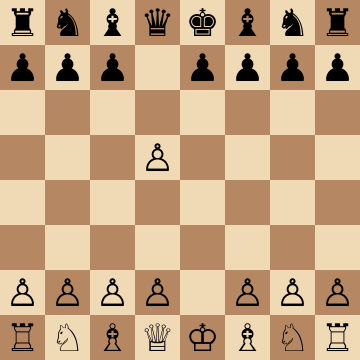
Mainline
1.e4 d5 2.exd5 Qxd5 3.Nc3 Qa5 4.d4 Nf6 5.Nf3 c6 6.Bc4 Bf5 7.Bd2
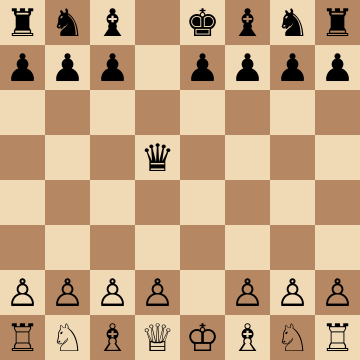
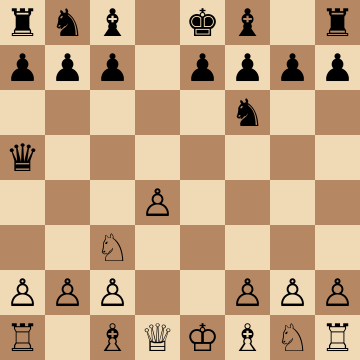
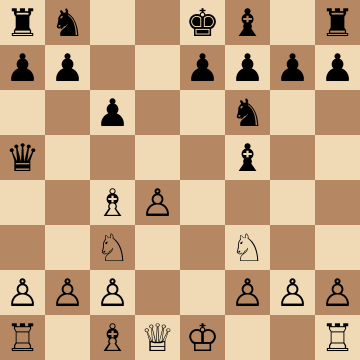
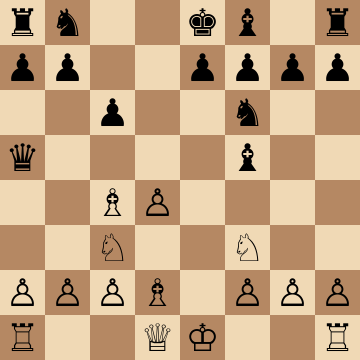
Main Line: 8.Qe2 and O-O-O
1.e4 d5 2.exd5 Qxd5 3.Nc3 Qa5 4.d4 Nf6 5.Nf3 c6 6.Bc4 Bf5 7.Bd2 e6 8.Qe2 Bb4 9.O-O-O Nbd7 10.a3 Bxc3 11.Bxc3 Qc7
The full main line of the course: White develops every piece with purpose, castles long, and asks Black what the queen on a5 accomplished. After 10.a3 Bxc3 11.Bxc3 the dark-squared bishop points at the kingside, Ne5 is coming, and White chooses between the d5 break and a direct g4-h4 storm. Black's setup is solid but has no active plan — exactly the slow suffocation this repertoire aims for.
...Bg4 Pin: 6.h3 and g4
1.e4 d5 2.exd5 Qxd5 3.Nc3 Qa5 4.d4 Nf6 5.Nf3 Bg4 6.h3 Bh5 7.g4 Bg6 8.Ne5 e6 9.h4
When the bishop goes to g4 instead of f5, White gets to play the most fun line in the repertoire: 6.h3, 7.g4 and 8.Ne5 win time on the bishop with every move, and 9.h4! threatens simply h5 trapping it. Black must weaken his structure or give up the bishop pair to survive. White castles long behind the advancing pawns and attacks — the kingside space wins games here almost by itself.
3...Qd6 Gubinsky-Melts
1.e4 d5 2.exd5 Qxd5 3.Nc3 Qd6 4.d4 Nf6 5.Nf3 a6 6.g3 b5 7.Bg2 Bb7 8.O-O
The modern 3...Qd6 keeps the queen closer to the action and prepares ...a6 and ...b5 expansion. White's cleanest answer is the kingside fianchetto: 6.g3 and 7.Bg2 neutralize the b7 bishop before it ever bites, and after castling White plays Re1, a4 and d5 at the right moment. The queen on d6 remains a target for Nb5, Bf4 and Ne4 tempo tricks throughout — one careless move and it costs Black the game.
3...Qd8 Retreat
1.e4 d5 2.exd5 Qxd5 3.Nc3 Qd8 4.d4 Nf6 5.Nf3 Bg4 6.h3 Bxf3 7.Qxf3 c6 8.Bc4 e6 9.O-O
Retreating all the way home is the Scandinavian at its most modest — Black concedes the opening battle for a compact shell. White should convert the free tempo into permanent pressure: after 6.h3 Bxf3 7.Qxf3, the bishop pair and center give a stable pull, with Rd1, Bf4 and d5 as the standard plan. There are no tricks to fall for; just develop, centralize, and let the extra space decide the middlegame.
Portuguese Gambit (3...Bg4)
1.e4 d5 2.exd5 Nf6 3.d4 Bg4 4.f3 Bf5 5.Bb5+ Nbd7 6.c4
The Portuguese is the Scandinavian's trickiest gambit — Black offers a pawn for rapid development and pressure on d4. Refuse the complications and refute it on principle: 4.f3! blunts the bishop, 5.Bb5+ trades off Black's best attacker or forces a concession, and 6.c4 keeps the extra pawn with a solid grip. Black's compensation evaporates within a few moves, leaving White up material with the better structure.
Modern 2...Nf6 with 4.c4
1.e4 d5 2.exd5 Nf6 3.d4 Nxd5 4.c4 Nb6 5.Nf3 g6 6.Nc3 Bg7 7.h3 O-O 8.Be3
Recapturing with the knight leads to an Alekhine-flavored position where White should grab the center gratefully: 4.c4 gains time, and the setup with Nf3, Nc3, h3 and Be3 defends d4 while preparing Qd2 and Rd1. Black's fianchetto pressure never quite lands because h3 stops ...Bg4 and the d4 pawn is overprotected. White plays a risk-free space advantage with all the standard plans — d5, b3 and a4-a5 against the b6 knight.
Key ideas
- Develop with tempo: Nc3 hits the queen, d4 takes the center, and every White move comes with interest.
- Set up against the main 3...Qa5 with Bc4, Bd2 and Qe2 — a scheme you can play from memory.
- Contain Black's only real ideas: the ...Bf5/...e6 fortress and the ...Nbd7-b6 maneuvers.
- Convert the space advantage patiently — the Scandinavian offers White the game's easier side for free.
Typical plans and structures
White's setup builds itself: d4, Nf3, Bc4, Bd2 with Qe2, castling either side depending on ambition. The middlegame plan is straightforward space play — Ne5, f4 or a well-timed d5 break — while Black's solid-but-passive structure waits for a chance that rarely comes. The course covers the offbeat tries too (3...Qd6, 3...Qd8, and the gambit 2...Nf6 lines) with clear, punishing recipes for each.
Who should play it
1.e4 players who want a complete, low-maintenance answer to the Scandinavian that turns Black's early queen into a lasting initiative.
Frequently asked questions
Why is the early queen a problem for Black in the Scandinavian?
Because 3.Nc3 develops a piece while attacking it — a free tempo White invests in the center with d4. Black's setup is solid, but starts the middlegame a step behind in development and space, and never fully catches up against accurate play.
What is the main line of the Scandinavian and how does White meet it?
The classical main is 2...Qxd5 3.Nc3 Qa5 with ...c6, ...Bf5 and ...e6 — a light-squared fortress. White's recipe is d4, Nf3, Bc4 and Bd2 with Qe2, castling long or short by taste, then expanding where Black cannot answer.
What about 3...Qd6 and the modern Scandinavian lines?
3...Qd6 is the modern preference and gets dedicated coverage: White develops actively with Nf3, g3 or Bc4 setups and again leans on the same trump — better development and more space, with the queen still a target on d6.
Learn Beat the Scandinavian with AI feedback
This page pairs the guide above with an interactive ChessMind AI course: a GM-authored repertoire you study move by move on a real board, then practice against a human-like chess AI opponent with instant feedback and spaced-repetition review, so the key positions actually stick. Start learning, jump straight into practice, or browse all opening courses.
New to a concept? Every term is defined in the chess terms glossary.