Horwitz Attack vs. French
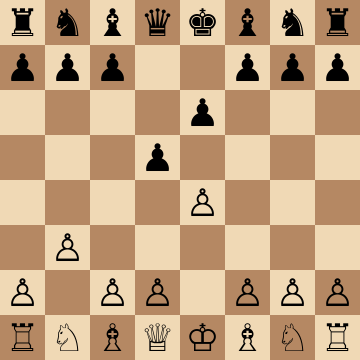
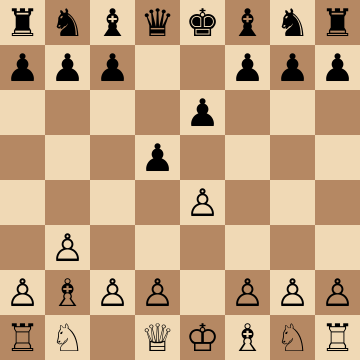
1.e4 e6 2.b3 d5 3.Bb2
The Horwitz Attack (1.e4 e6 2.b3!?) refuses to play the French on Black's terms: no locked pawn chains, no endless d4-versus-c5 tension. White fianchettos the queen's bishop onto the long diagonal and steers the game into open, piece-driven positions that French players almost never study.
Mainline
1.e4 e6 2.b3 d5 3.Bb2 dxe4 4.Nc3 Nf6 5.Qe2
Horwitz Attack: 3...dxe4 Main Line
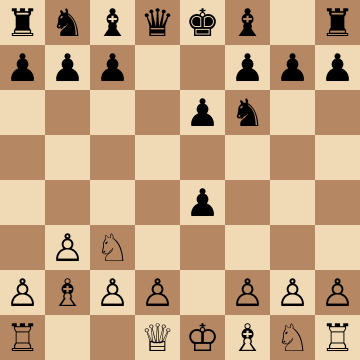
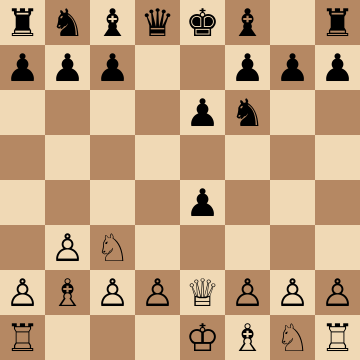
1.e4 e6 2.b3 d5 3.Bb2 dxe4 4.Nc3 Nf6 5.Qe2
The principled test. Black grabs the pawn on e4 and White develops with tempo, betting that the b2-bishop and the lead in development are worth more than a centre pawn. The point of 5.Qe2 is that the e-file pressure makes ...Be7 awkward and prepares O-O-O with a genuine initiative.
Horwitz Attack: 3...Nf6 Solid Reply
1.e4 e6 2.b3 d5 3.Bb2 Nf6 4.e5 Nfd7 5.f4
Black declines the pawn and White converts the position into a French Advance where the dark-squared bishop is already outside the pawn chain — precisely the piece that usually suffocates in the French. That single difference is the whole argument for 2.b3.
Horwitz Attack: 3...c5 Counter-Strike
1.e4 e6 2.b3 d5 3.Bb2 c5 4.exd5 exd5 5.Nf3
Black hits the centre immediately and accepts an open position with an isolated queen's pawn after the exchange on d5. White plays against the d5-pawn with pieces: Bb5+, O-O and Re1 come naturally, and the b2-bishop already eyes the long diagonal without needing a single tempo.
Horwitz Attack: Long Castling Plan
1.e4 e6 2.b3 d5 3.Bb2 dxe4 4.Nc3 Nf6 5.Qe2 Bb4 6.O-O-O
The sharpest interpretation. White castles into the queenside and prepares to throw the g- and h-pawns at Black's king, using the b2-bishop as the battering ram on the long diagonal. Black's ...Bb4 pin is the critical try, and knowing the resulting race is what makes this line practical rather than reckless.
Horwitz Attack: English Defence Setup (2...b6)
1.e4 e6 2.b3 b6 3.Bb2 Bb7 4.Bd3 Nf6 5.Qe2
Both sides fianchetto and the game becomes a battle of the long diagonals. White has the extra tempo and can claim the centre with d4 and f4, while Black relies on ...Bb4+ and the pressure against e4. Symmetrical-looking positions like this reward whoever understands the plans, not whoever memorised more.
Horwitz Attack: Delayed Nf3 Structure
1.e4 e6 2.b3 d5 3.Bb2 Nf6 4.e5 Nfd7 5.Nf3 c5 6.d4
White transposes into a French Advance with the bishop already developed. The standard Black break ...c5 arrives, White supports the centre with d4, and the resulting play is the familiar French tug-of-war over d4 — except that the piece Black usually trades off comfortably is sitting outside the chain and hitting g7.
Key ideas
- Fianchetto with b3 and Bb2, aiming at e5 and g7 instead of building a target on d4.
- After 2...d5, let the e-pawn go temporarily — Nc3 and Qe2 regain it with a lead in development.
- Keep the position open: without a pawn chain, French players lose their structural comfort zone.
- Attack with pieces on the e-file and long diagonal while Black searches for a plan.
Typical plans and structures
In the main line White regains the e4-pawn with Nc3, Qe2 and Nxe4, reaching an open middlegame where the Bb2 exerts lasting pressure and O-O-O with a kingside pawn advance is often available. If Black locks with ...d4 or defends e4's capture ambitiously, White gains time and open files. The recurring theme is piece activity against a structure the opponent chose for a completely different kind of game — the course turns that discomfort into a repeatable attacking plan.
Who should play it
1.e4 players who dislike the closed French middlegames and prefer rapid development, open diagonals and attacking chances from the first moves.
Study the Horwitz Attack vs. French move by move
The first 3 lines of the interactive course, exactly as a signed-out visitor can play them — each move with the coaching note shown on the board.
Line 1 — the main line
1.e4 We take the center. 1...e6 Black chooses the French Defense. 2.b3 We don't want to play the usual French-style positions, so we go for the Horwitz Attack! 2...d5 Our opponent plays their usual French setup. 3.Bb2 We develop our bishop on the long diagonal, and give up the pawn on e4. 3...dxe4 Accepting the pawn sacrifice. 4.Nc3 We develop our knight and threaten to recapture the pawn with a comfortable game. 4...Nf6 Developing the knight and protecting the pawn. 5.Qe2 We renew our threat against the e4 pawn, and plan to capture it in the next turn. 5...Be7 Developing to a modest square, protecting the knight on f6 and preparing to castle. 6.Nxe4 Having recaptured this pawn, we plan d2 d4 next, with a better control of the center. 6...O-O Castling short. 7.Nf3 We develop our knight, and we are heading to e5 or g5 in some lines. 7...b6 Our opponent wants to fianchetto their bishop. 8.O-O-O We castle long, creating the opportunity for an attack on opposite flanks. 8...Bb7 Developing the bishop and forcing our knight to either move or trade. 9.Nxf6+ We trade our knight, since the knight on f6 was just as good. 9...Bxf6 Recapturing the piece. 10.d4 We gain some space on the center and avoid further trades for now. 10...Nd7 Developing the knight. 11.Ne5 We have a more comfortable game, mostly due to having a little more space.
Line 2 — against an inaccuracy
1.e4 We take the center. 1...e6 Black chooses the French Defense. 2.b3 We don't want to play the usual French-style positions, so we go for the Horwitz Attack! 2...d5 Our opponent plays their usual French setup. 3.Bb2 We develop our bishop on the long diagonal, and give up the pawn on e4. 3...dxe4 Accepting the pawn sacrifice. 4.Nc3 We develop our knight and threaten to recapture the pawn with a comfortable game. 4...Nf6 Developing the knight and protecting the pawn. 5.Qe2 We renew our threat against the e4 pawn, and plan to capture it in the next turn. 5...Nc6 Developing the knight and hoping for a knight jump with ...Nd4. 6.O-O-O We castle long to secure our king and protect the c2 pawn before ...Nd4 is on the board. 6...Nd4 Our opponent centralizes their knight with a tempo. 7.Qe3 We are planning to capture on e4 next, somewhat relieving the pressure we are momentarily under. 7...Bc5?! Developing the bishop and threatening a discovered check with ...Nxb3 to win the queen. 8.Nxe4 We finally take the central pawn, and now the game gets more comfortable for us. 8...Nxe4 Trading knights and eliminating our threat against their bishop. 9.Qxe4 We recapture the piece. 9...O-O?! Castling short is not the best, since now we can build some pressure against the king. 10.Bd3 We develop our bishop threatening Qxh7#, notice how strong our bishops are on consecutive diagonals pointing toward the king. 10...f5 Our opponent blocks our threat attacking the queen, but creating a permanent hole on e5. 11.Qe5 We get out of the threat attacking the bishop on c5. 11...Qd5 Stopping the threat and using this chance to offer a queen trade. 12.Re1 We allow the queen trade as long as it means activating our rook. 12...Qxe5 Trading queens. 13.Rxe5 We recapture the queen. 13...Bb6 The bishop must go away. 14.Nh3 We have a very serious advantage due to the pressure we can build against the backward pawn on e6.
Line 3 — against an inaccuracy
1.e4 We take the center. 1...e6 Black chooses the French Defense. 2.b3 We don't want to play the usual French-style positions, so we go for the Horwitz Attack! 2...d5 Our opponent plays their usual French setup. 3.Bb2 We develop our bishop on the long diagonal, and give up the pawn on e4. 3...dxe4 Accepting the pawn sacrifice. 4.Nc3 We develop our knight and threaten to recapture the pawn with a comfortable game. 4...Nf6 Developing the knight and protecting the pawn. 5.Qe2 We renew our threat against the e4 pawn, and plan to capture it in the next turn. 5...Nc6 Developing the knight and hoping for a knight jump with ...Nd4. 6.O-O-O We castle long to secure our king and protect the c2 pawn before ...Nd4 is on the board. 6...Nd4 Our opponent centralizes their knight with a tempo. 7.Qe3 We are planning to capture on e4 next, somewhat relieving the pressure we are momentarily under. 7...Bc5?! Developing the bishop and threatening a discovered check with ...Nxb3 to win the queen. 8.Nxe4 We finally take the central pawn, and now the game gets more comfortable for us. 8...Nxe4 Trading knights and eliminating our threat against their bishop. 9.Qxe4 We recapture the piece. 9...Qd5 Our opponent offers a queen trade to reduce our potential for a kingside attack. 10.Re1 We accept the queen trade, but improve the activity of our rook in the process. 10...Qxe4 Trading queens. 11.Rxe4 We recapture the queen. 11...Nf5 This is the only move, as the knight needs to protect the pawn on g7. 12.g4 We play this to force the knight away, renewing our threat on the g7 pawn, as well as clearing the g2 square to develop our bishop. 12...Nd6 Attacking our rook. 13.Re2 We retreat, protecting our pawn on f2. 13...O-O Castling and protecting the pawn on g7. 14.Bg2 We have a better game, as our bishops are more active and we have a little more space. The pawn on g4 is not a weakness we need to worry about.
The free preview ends here — continue with all 15 lines in the interactive course, with instant feedback on every move you play.
Frequently asked questions
What is the Horwitz Attack against the French?
It is the fianchetto approach 1.e4 e6 2.b3, named after the 19th-century master Bernhard Horwitz. The bishop goes to b2, White avoids the standard French pawn structures entirely, and play stays open and piece-oriented.
Doesn't Black just win the e4-pawn?
Black can grab it after 2...d5 3.Bb2 dxe4, but White regains it comfortably with Nc3 and Qe2 while gaining development — this gambit-flavored sequence (sometimes called the Papa-Ticulat Gambit) is well tested and fully sound at practical level.
Why choose the Horwitz Attack over main-line French theory?
Efficiency and psychology: you invest a fraction of the study time, and your opponent's hundreds of hours of French preparation buy them nothing. From move two, both players are thinking — but only one of them has this course's plans.
Learn the Horwitz Attack vs. French with AI feedback
This page pairs the guide above with an interactive ChessMind AI course: a GM-authored repertoire you study move by move on a real board, then practice against a human-like chess AI opponent with instant feedback and spaced-repetition review, so the key positions actually stick. Start learning, jump straight into practice, or browse all opening courses.
New to a concept? Every term is defined in the chess terms glossary.