Beat the French with 3.Nc3
1.e4 e6 2.d4 d5 3.Nc3 dxe4
3.Nc3 is the most principled and ambitious answer to the French Defense — White defends e4 without blocking the c-pawn and keeps every attacking option open. This course covers the two critical branches, the Winawer (3...Bb4) and the Classical (3...Nf6), always choosing the most aggressive continuations.
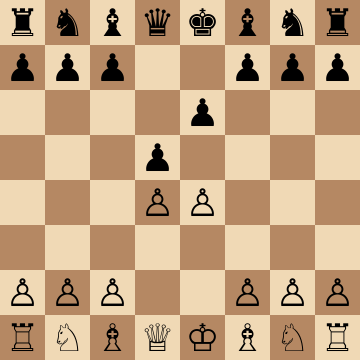
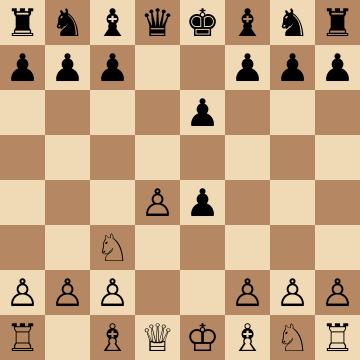
Mainline
1.e4 e6 2.d4 d5 3.Nc3 dxe4
Winawer Poisoned Pawn (7.Qg4 Qc7)
1.e4 e6 2.d4 d5 3.Nc3 Bb4 4.e5 c5 5.a3 Bxc3+ 6.bxc3 Ne7 7.Qg4 Qc7 8.Qxg7 Rg8 9.Qxh7 cxd4 10.Ne2 Nbc6 11.f4
The sharpest position in the entire French: White grabs both kingside pawns while Black demolishes the queenside. After 10.Ne2 and 11.f4 the h-pawn becomes a runner, and White's attack usually arrives first — provided you know the move orders. This is the line where preparation is worth a full piece; the course gives you the critical continuations so the complications favor the player who studied them.
Winawer with 7...O-O
1.e4 e6 2.d4 d5 3.Nc3 Bb4 4.e5 c5 5.a3 Bxc3+ 6.bxc3 Ne7 7.Qg4 O-O 8.Bd3 Nbc6 9.Qh5 Ng6 10.Nf3 Qc7
Castling into it! 7...O-O avoids the Poisoned Pawn chaos but hands White a ready-made attack: 8.Bd3 and 9.Qh5 force ...Ng6, and then Nf3-g5 or h4-h5 pries the king open while the doubled c-pawns hold the queenside shut. Black's counterplay with ...c4 and ...f5 needs perfect timing; White's plan needs only consistency. A dream version of the Winawer for the attacking player.
Armenian Variation (5...Ba5)
1.e4 e6 2.d4 d5 3.Nc3 Bb4 4.e5 c5 5.a3 Ba5 6.b4 cxd4 7.Qg4 Ne7 8.bxa5 dxc3 9.Qxg7 Rg8 10.Qxh7 Nbc6
Preserving the bishop with 5...Ba5 invites 6.b4! — a pawn sacrifice that wins the bishop pair or drags Black into a razor-sharp race. After 8.bxa5 dxc3 the material is roughly level but the positions are wild: White's queen feasts on the kingside while Black's c3 pawn cramps the queenside. The engine lines here are forcing and memorizable, which means the prepared side scores heavily.
Classical Steinitz (3...Nf6 4.e5)
1.e4 e6 2.d4 d5 3.Nc3 Nf6 4.e5 Nfd7 5.f4 c5 6.Nf3 Nc6 7.Be3 cxd4 8.Nxd4 Qb6 9.Qd2 Qxb2 10.Rb1 Qa3 11.Bb5
Against the Classical, 4.e5 claims space and 5.f4 cements it — White builds the broad center the French player must spend the whole game attacking. The critical test is the pawn grab 8...Qb6 and 9...Qxb2, met by 10.Rb1 and 11.Bb5 with a raging initiative for the pawn: O-O, f5 breaks and piece sacrifices on e6 are all in the air. Decline the pawn, and White attacks on the kingside at leisure.
Rubinstein Variation (3...dxe4)
1.e4 e6 2.d4 d5 3.Nc3 dxe4 4.Nxe4 Nd7 5.Nf3 Ngf6 6.Nxf6+ Nxf6 7.Bd3 c5 8.dxc5 Bxc5 9.Qe2
Solid players release the tension with 3...dxe4, trading central space for a headache-free structure. White's recipe keeps real winning chances: exchange on f6, develop the bishop to d3, and meet ...c5 with dxc5, reaching positions with a mobile kingside majority and the safer king. Castle long or short depending on Black's setup — the course shows both plans — and squeeze the slightly passive Rubinstein for the full game.
Key ideas
- Meet the Winawer with the sharpest ideas — including the famous 7.Qg4, attacking g7 while Black's king has nowhere safe.
- Against 3...Nf6, seize space with 4.e5 and build a kingside attack from the classic French pawn chain.
- Use the doubled c-pawns' compensation: the unopposed dark squares and open lines are worth more than the structure.
- Play the French positions with the initiative — Black defends cramped positions for the whole middlegame.
Typical plans and structures
In the Winawer main line, White attacks the kingside that ...Bxc3 left undefended: Qg4 targets g7 immediately, and the h4-h5 or Nf3-g5 plans follow. In the Classical with 4.e5, White supports the pawn chain with f4 and Nf3, plays for the f4-f5 break, and answers Black's ...c5 and ...f6 counterplay with well-timed piece activity. Both branches share the same story: White has the space and attacking chances, Black defends and waits.
Who should play it
Ambitious 1.e4 players who want the theoretically strongest strike against the French and enjoy attacking play from a stable space advantage.
Study Beat the French with 3.Nc3 move by move
The first 3 lines of the interactive course, exactly as a signed-out visitor can play them — each move with the coaching note shown on the board.
Line 1 — the main line
1.e4 We claim the center. 1...e6 Our opponent prepares to challenge the center with ..d7 d5. 2.d4 We gain more central space. 2...d5 Our opponent continues with their plan. 3.Nc3 We reinforce the e4 pawn with our knight. 3...Bb4 Our opponent pins the knight, renewing the threat on e4. 4.e5 We push the pawn to gain space. 4...c5 Black continues to put pressure in the center. 5.a3 We attack their bishop, forcing it to capture on c3. 5...Bxc3+ Our opponent takes the knight. 6.bxc3 We take back. 6...Ne7 Our opponent develops their knight, preparing to castle. 7.Qg4 We bring our queen into play, threatening to capture the g7 pawn. 7...Qc7 Black activates the queen with ideas of exchanging on d4 and checking on c3, at the cost of the g7 pawn. 8.Qxg7 We take the pawn, threatening their rook. 8...Rg8 Counterattacking our queen and activating the rook along the g file. 9.Qxh7 We take on h7. 9...cxd4 Our opponent trades on d4, threatening a fork on c3. 10.Ne2 We protect the c3 square with our knight, preventing their threat. 10...Nbc6 Our opponent brings out their knight, putting pressure on e5. 11.f4 We push the f pawn to reinforce e5. 11...Bd7 Black develops their bishop, preparing to castle long. 12.Qd3 We pull the queen back to safety. 12...dxc3 Our opponent trades before we can recapture on d4. 13.h4 Our plan is to push the passed pawn and keep Black's pieces under constant pressure. 13...O-O-O Our opponent castles. 14.h5 We keep pushing the pawn. 14...d4 Black reinforces the pawn on c3 and clears d5 for the knight, and we can't capture because it allows a discovered attack on our queen. 15.h6 We stick to our plan. 15...Kb8 This is a standard maneuver when castling long. 16.h7 We reach the 7th rank, gaining a tempo on their rook. 16...Rh8 Our opponent puts the rook on the promotion square to stop our pawn. 17.Rb1 We threaten on both sides of the board, maintaining constant pressure.
Line 2 — the main line
1.e4 We claim the center. 1...e6 Our opponent prepares to challenge the center with ..d7 d5. 2.d4 We gain more central space. 2...d5 Our opponent continues with their plan. 3.Nc3 We reinforce the e4 pawn with our knight. 3...Bb4 Our opponent pins the knight, renewing the threat on e4. 4.e5 We push the pawn to gain space. 4...c5 Black continues to put pressure in the center. 5.a3 We attack their bishop, forcing it to capture on c3. 5...Bxc3+ Our opponent takes the knight. 6.bxc3 We take back. 6...Ne7 Our opponent develops their knight, preparing to castle. 7.Qg4 We bring our queen into play, threatening to capture the g7 pawn. 7...Qc7 Black activates the queen with ideas of exchanging on d4 and checking on c3, at the cost of the g7 pawn. 8.Qxg7 We take the pawn, threatening their rook. 8...Rg8 Counterattacking our queen and activating the rook along the g file. 9.Qxh7 We take on h7. 9...cxd4 Our opponent trades on d4, threatening a fork on c3. 10.Ne2 We protect the c3 square with our knight, preventing their threat. 10...Nbc6 Our opponent brings out their knight, putting pressure on e5. 11.f4 We push the f pawn to reinforce e5. 11...Bd7 Black develops their bishop, preparing to castle long. 12.Qd3 We pull the queen back to safety. 12...dxc3 Our opponent trades before we can recapture on d4. 13.h4 Our plan is to push the passed pawn and keep Black's pieces under constant pressure. 13...O-O-O Our opponent castles. 14.h5 We keep pushing the pawn. 14...Nf5 Our opponent activates the knight, preparing to support ...d5 d4. 15.Rb1 We activate the rook along the b file. 15...d4 Reinforcing the c3 pawn. 16.Rg1 We prepare to advance the g pawn, forcing their knight back and gaining the initiative.
Line 3 — against an inaccuracy
1.e4 We claim the center. 1...e6 Our opponent prepares to challenge the center with ..d7 d5. 2.d4 We gain more central space. 2...d5 Our opponent continues with their plan. 3.Nc3 We reinforce the e4 pawn with our knight. 3...Bb4 Our opponent pins the knight, renewing the threat on e4. 4.e5 We push the pawn to gain space. 4...c5 Black continues to put pressure in the center. 5.a3 We attack their bishop, forcing it to capture on c3. 5...Bxc3+ Our opponent takes the knight. 6.bxc3 We take back. 6...Ne7 Our opponent develops their knight, preparing to castle. 7.Qg4 We bring our queen into play, threatening to capture the g7 pawn. 7...O-O Our opponent castles, defending g7. 8.Bd3 We develop the light squared bishop, aiming at h7. 8...f5 Targeting our queen and aiming to block the diagonal. 9.exf6 We capture en passant, reopening the diagonal. 9...Rxf6 Our opponent takes back with the rook. 10.Bg5 We activate our bishop with a tempo on their rook. 10...Rf7 Our opponent retreats their rook. 11.Qh5 We reposition the queen, threatening Qxh7 with a decisive attack. 11...g6 Our opponent blocks the diagonal with the pawn. 12.Qd1 We retreat the queen after weakening Black's kingside. 12...Nbc6 Our opponent brings out their knight, increasing pressure on d4. 13.Nf3 We develop the knight to reinforce d4. 13...Qa5 Black activates their queen, pinning the c3 pawn. 14.O-O We castle, giving up the pawn for initiative. 14...Qxc3 Our opponent accepts the sacrifice. 15.Bd2 We keep chasing their queen, gaining time to activate our pieces and maintain pressure on both flanks.
The free preview ends here — continue with all 25 lines in the interactive course, with instant feedback on every move you play.
Frequently asked questions
Why is 3.Nc3 considered the best move against the French?
It develops a piece, defends e4 and keeps maximum flexibility — unlike 3.Nd2, which blocks the queenside, or 3.e5, which commits the structure at once. Most of the French's theoretical problems historically come from the 3.Nc3 complex.
What is the point of 7.Qg4 in the Winawer?
After 5.a3 Bxc3+ 6.bxc3, Black's dark-squared bishop is gone — so 7.Qg4 attacks g7, the square that bishop used to defend. Black must make a serious concession: weaken the kingside, give up castling, or enter the double-edged Poisoned Pawn lines.
Do I need to fear the French pawn chain as White?
No — in these lines the chain is White's friend: e5 cramps Black's kingside and gains attacking space. The course shows how to meet the standard ...c5 and ...f6 breaks so that the chain's strengths persist and its base stays defended.
Learn Beat the French with 3.Nc3 with AI feedback
This page pairs the guide above with an interactive ChessMind AI course: a GM-authored repertoire you study move by move on a real board, then practice against a human-like chess AI opponent with instant feedback and spaced-repetition review, so the key positions actually stick. Start learning, jump straight into practice, or browse all opening courses.
New to a concept? Every term is defined in the chess terms glossary.