French Defense
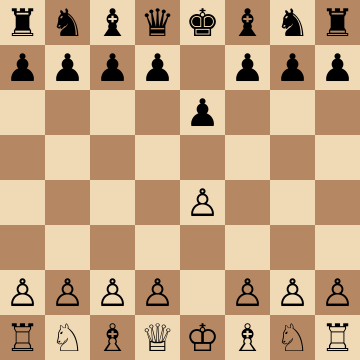
1.e4 e6
The French Defense (1.e4 e6) is one of chess's great fighting defenses: Black concedes space, builds an unbreakable pawn chain, and counterattacks it at the base. Annoying to face, rich to play — a complete strategy, not just an opening.
Mainline
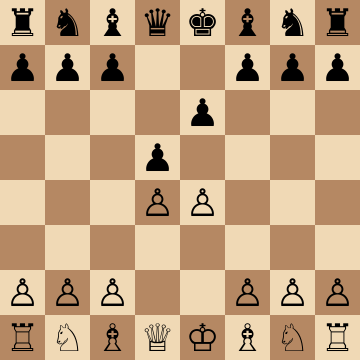
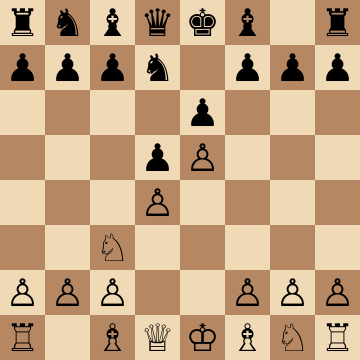
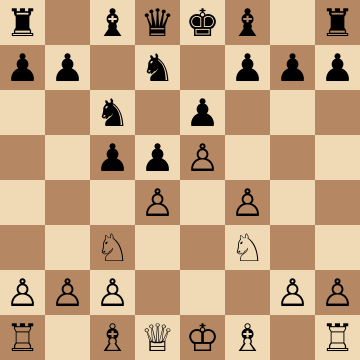
1.e4 e6 2.d4 d5 3.Nc3 Nf6 4.e5 Nfd7 5.f4 c5 6.Nf3 Nc6
French Advance Variation (3.e5)
1.e4 e6 2.d4 d5 3.e5 c5 4.c3 Nc6
White grabs space and closes the center, and the whole game becomes a fight over the d4 pawn. Black hits it immediately with ...c5, adds ...Nc6 and ...Qb6, and often ...Nh6-f5 to pile on. This is the line to know first: it is what most club opponents play, and Black's plan repeats almost move for move.
French Winawer Variation (3.Nc3 Bb4)
1.e4 e6 2.d4 d5 3.Nc3 Bb4 4.e5 c5 5.a3 Bxc3+
The sharpest main line: Black pins the knight and trades it off, wrecking White's queenside pawns in exchange for the bishop pair and central space. The resulting positions are unbalanced from move five and reward the player who knows the plans — Black plays on the doubled c-pawns and the c-file, White attacks on the kingside.
Study the Beat the French with 3.Nc3 course
French Classical Variation (3.Nc3 Nf6)
1.e4 e6 2.d4 d5 3.Nc3 Nf6 4.Bg5 Be7 5.e5 Nfd7
The solid alternative to the Winawer: Black develops naturally and accepts a space disadvantage in return for a healthy structure and clear counterplay with ...c5 and ...f6. If you like the French but not the razor-sharp Winawer forcing lines, this is the practical choice.
French Tarrasch Variation (3.Nd2)
1.e4 e6 2.d4 d5 3.Nd2 c5 4.exd5 exd5 5.Ngf3 Nc6
White sidesteps the Winawer pin by developing the knight to d2. Black's most testing reply is the immediate ...c5, when the position often opens into an isolated-queen's-pawn structure — comfortable for the side who knows the blockade and piece-trade technique.
French Exchange Variation (3.exd5)
1.e4 e6 2.d4 d5 3.exd5 exd5 4.Nf3 Nf6 5.Bd3 Bd6
The symmetrical line White plays for a quiet draw — and Black's chance to prove otherwise. The structure is level, so the game is decided by piece activity and understanding: castle on opposite sides, avoid mirroring every move, and the symmetry breaks in favor of whoever plays with a plan.
King's Indian Attack vs the French (2.d3)
1.e4 e6 2.d3 d5 3.Nd2 Nf6 4.Ngf3 c5
A system rather than a variation: White plays the same setup against almost anything, aiming for e4-e5 and a kingside attack. Black should grab the center with ...d5 and ...c5 and expand on the queenside — the side that gets its own attack going first usually wins the race.
French Wing Gambit (4.b4)
1.e4 e6 2.Nf3 d5 3.e5 c5 4.b4 cxb4 5.d4
White throws in a wing pawn to deflect the ...c5 break and keep the center intact — a surprise weapon that leaves Black on the wrong side of a fast development lead if unprepared. Accepting is critical, but Black must know the follow-up.
Study the French Wing Gambit course
Horwitz Attack vs the French (2.b3)
1.e4 e6 2.b3 d5 3.Bb2 dxe4 4.Nc3 Nf6
White fianchettoes the dark-squared bishop and aims it straight at g7, avoiding all the main-line French theory. Black gets a free hand in the center but must respect the long diagonal — a good practical choice for White against well-prepared French players.
Study the Horwitz Attack vs. French course
Key ideas
- Stake your claim with ...d5 and meet e5 with the eternal counterblows ...c5 and ...f6.
- Play against the pawn chain's base: pressure on d4 is the French's beating heart.
- Know your bishop: solving (or trading) the c8-bishop transforms Black's position.
- Punish overextension — White's space advantage becomes a liability the moment it is pushed too far.
Typical plans and structures
In the advance structures Black attacks d4 with ...c5, ...Nc6 and ...Qb6, sometimes castling long or leaving the king central while the queenside play rolls. Against the exchange lines Black plays actively for a win despite the symmetry, and against the Tarrasch (3.Nd2) the course gives a clear equalizing path. The thematic French endings — good knight against bad bishop, or the liberated ...f6 breaks — get their own treatment, because the French is won in the middlegame plans, not move-one memorization.
How to reach the French Defense
The French is 1.e4 e6, followed almost always by 2.d4 d5. White's third move defines the variation: 3.Nc3 is the main line, met by 3...Bb4 (Winawer), 3...Nf6 (Classical, with 4.Bg5 or the Steinitz 4.e5) or 3...dxe4 (Rubinstein); 3.Nd2 is the Tarrasch, keeping the c-pawn free of pins; 3.e5 is the Advance, closing the center at once; 3.exd5 exd5 the Exchange. Anti-French systems include 2.d3 with the King's Indian Attack and the Wing Gambit 4.b4 in the Advance. The position also arises from 1.d4 e6 2.e4 d5.
Pros and cons of the French Defense
Pros
- A sound, strategic defense with a clear plan in every line: attack the pawn chain at its base with ...c5 and ...f6.
- The pawn structure gives Black a safe king and a durable position that does not lose to early tactics.
- Black often gets the better endgame thanks to the queenside majority after ...cxd4 and the central pawn on d5.
- Rich winning chances: the Winawer and the Classical are among the most combative defenses to 1.e4.
Cons
- The c8-bishop is locked behind e6 and d5 for much of the game; freeing it is the French player's lifelong problem.
- Black concedes space, and against the Advance or the Steinitz White gets a comfortable kingside initiative.
- The Winawer demands deep theoretical knowledge of very sharp positions.
- The Exchange Variation gives White an easy, symmetrical game that some French players find frustrating.
How to play against the French Defense
White's most testing tries are the Advance 3.e5, taking space and asking Black to prove the ...c5 and ...Qb6 pressure is enough, and the main line 3.Nc3, where the Winawer 4.e5 c5 5.a3 Bxc3+ 6.bxc3 gives White the bishop pair and attacking chances against the black king for the damaged structure. The Tarrasch 3.Nd2 avoids the Winawer pin and leads to isolated-pawn positions after 3...c5 that are comfortable for White. Whatever the variation, the recurring plan is to keep the c8-bishop locked in, defend the base of the chain on d4 with c3 and Nf3 and Be3, and attack the kingside with Bd3, Qg4 or the f4-f5 push once the center is closed. The Exchange Variation is the low-risk option, but it hands Black easy equality and should be played only with a concrete plan such as c4 to unbalance the structure.
Plans for both sides
White's plan
Gain space with e5, defend the chain with c3, Nf3 and Be3, and attack the kingside where Black is cramped: Bd3, Qg4 against the Winawer, the f4-f5 lever, and the knight to g5 or h5. Answer ...f6 with exf6 only when the e5-square can be occupied by a piece, and use the bishop pair after Bxc3 in the Winawer.
Black's plan
Attack the base of the pawn chain with ...c5 and ...Qb6, then ...f6 to break e5, and develop the c8-bishop via d7 to b5 or a4 or with ...b6 and ...Ba6. Play on the queenside with ...cxd4 and the c-file, castle when the kingside is safe or leave the king in the center behind the chain, and aim for the endgame where the extra central pawn counts.
Who should play it
Players who want a sound, combative defense to 1.e4 with clear strategic logic — and enjoy positions their opponents find annoying to face.
History of the French Defense
The opening is named after a correspondence match between the cities of London and Paris in 1834, which the French side won using 1...e6. It was championed by the world champion Wilhelm Steinitz and became a main weapon of Botvinnik, whose Winawer games in the 1940s and 1950s shaped the theory, and of Korchnoi, Uhlmann and Petrosian in the following generation. Nimzowitsch's writings on the pawn chain used the French as their model. Today it is the choice of Ding Liren, Nepomniachtchi and many top players as a fighting alternative to the Sicilian, and it remains the most popular strategic defense to 1.e4 at club level.
Study the French Defense move by move
The first 3 lines of the interactive course, exactly as a signed-out visitor can play them — each move with the coaching note shown on the board.
Line 1 — the main line
1.e4 Our opponent plays for the center. 1...e6 We fight back with the French Defense! Our plan is to play ...d7 d5 next move, with a solid center and a strategy of controlling the light squares. 2.d4 Our opponent completes the perfect center. 2...d5 We fight back, offering a trade and forcing our opponent to decide whether to trade, advance or maintain the tension by protecting the pawn. 3.e5 Our opponent closes the center, the advance variation. 3...c5 We strike with a pawn break to put pressure on their d4 pawn. 4.c3 Our opponent creates a pawn chain to reinforce d4. 4...Nc6 Increasing pressure in the center. 5.Nf3 Reinforcing d4. 5...Qb6 We activate the queen, targeting d4 and b2. 6.a3 We continue by developing the knight, increasing pressure in the center. 6...c4 We close the queenside, limiting their pieces and fixing their pawn structure. 7.Nbd2 Our opponent brings out the knight. 7...Na5 We maneuver the knight on the queenside, controlling b3 while opening the e8 a4 diagonal for our light squared bishop. 8.Be2 White develops the bishop and prepares to castle. 8...Bd7 We activate the bishop. 9.O-O Our opponent castles. 9...Ne7 We develop the knight, planning to reroute it to the queenside via c8 and b6. 10.Rb1 Our opponent plans to push the b pawn to eliminate the weakness. 10...Qc7 We move the queen out of the rook's X-ray, preventing their plan. 11.Re1 Making room on f1 for their pieces to maneuver. 11...Nc8 We stick to the plan. 12.Nf1 White repositions their knight, freeing their dark squared bishop. 12...Nb6 We place the knight on the ideal square, coordinating with the bishop to control a4. 13.Bf4 Our opponent develops their bishop. 13...O-O-O We castle long. 14.Qd2 Connecting the rooks. 14...h6 We dominate the queenside, and we can start building a kingside attack with ideas like ...Be7 and ...Rdg8.
Line 2 — punishing a blunder
1.e4 Our opponent plays for the center. 1...e6 We fight back with the French Defense! Our plan is to play ...d7 d5 next move, with a solid center and a strategy of controlling the light squares. 2.d4 Our opponent completes the perfect center. 2...d5 We fight back, offering a trade and forcing our opponent to decide whether to trade, advance or maintain the tension by protecting the pawn. 3.e5 Our opponent closes the center, the advance variation. 3...c5 We strike with a pawn break to put pressure on their d4 pawn. 4.c3 Our opponent creates a pawn chain to reinforce d4. 4...Nc6 Increasing pressure in the center. 5.Nf3 Reinforcing d4. 5...Qb6 We activate the queen, targeting d4 and b2. 6.a3 We continue by developing the knight, increasing pressure in the center. 6...c4 We close the queenside, limiting their pieces and fixing their pawn structure. 7.Nbd2 Our opponent brings out the knight. 7...Na5 We maneuver the knight on the queenside, controlling b3 while opening the e8 a4 diagonal for our light squared bishop. 8.Be2 White develops the bishop and prepares to castle. 8...Bd7 We activate the bishop. 9.O-O Our opponent castles. 9...Ne7 We develop the knight, planning to reroute it to the queenside via c8 and b6. 10.Rb1 Our opponent plans to push the b pawn to eliminate the weakness. 10...Qc7 We move the queen out of the rook's X-ray, preventing their plan. 11.b4? Threatening our knight but allowing ...c4xb3. 11...cxb3 We capture en passant. 12.Nxb3 Our opponent takes back with the knight. 12...Ba4 We pin their knight, threatening to win the exchange. 13.Nfd2 White brings their kingside knight to reinforce on b3. 13...Qxc3 We win the c3 pawn. 14.Bb2 Targeting our queen. 14...Qc7 We retreat the queen, with an extra pawn and pressure on the queenside.
Line 3 — against an inaccuracy
1.e4 Our opponent plays for the center. 1...e6 We fight back with the French Defense! Our plan is to play ...d7 d5 next move, with a solid center and a strategy of controlling the light squares. 2.d4 Our opponent completes the perfect center. 2...d5 We fight back, offering a trade and forcing our opponent to decide whether to trade, advance or maintain the tension by protecting the pawn. 3.e5 Our opponent closes the center, the advance variation. 3...c5 We strike with a pawn break to put pressure on their d4 pawn. 4.c3 Our opponent creates a pawn chain to reinforce d4. 4...Nc6 Increasing pressure in the center. 5.Nf3 Reinforcing d4. 5...Qb6 We activate the queen, targeting d4 and b2. 6.a3 We continue by developing the knight, increasing pressure in the center. 6...c4 We close the queenside, limiting their pieces and fixing their pawn structure. 7.Nbd2 Our opponent brings out the knight. 7...Na5 We maneuver the knight on the queenside, controlling b3 while opening the e8 a4 diagonal for our light squared bishop. 8.g3 Our opponent opens lines for their bishop. 8...Bd7 We bring out the bishop, aiming to reach a4. 9.h4 White expands on the kingside and prepares to bring their bishop to h3. 9...Ne7 We maneuver the knight toward the queenside. 10.Bh3 Activating the bishop and preparing to castle. 10...h6 We control the g5 square to prevent Nf3 g5 with threats on the kingside. 11.O-O Our opponent castles. 11...O-O-O We castle long. 12.Rb1 White places their rook on the b file, X-raying our queen and preparing a b2 b4 push. 12...Kb8 Freeing the c8 square for the knight. 13.Re1 Activating the rook along the e file. 13...Nc8 We continue maneuvering the knight. 14.b4 Threatening our knight and allowing ...c4xb3. 14...cxb3 We trade pawns. 15.Nxb3 Our opponent takes back with the knight. 15...Ba4 We pin their knight, with a lasting pressure on the queenside.
The free preview ends here — continue with all 19 lines in the interactive course, with instant feedback on every move you play.
Frequently asked questions
Is the French Defense good for improving players?
Yes — it teaches structures: pawn chains, breaks, good and bad bishops, space versus counterplay. The plans repeat across variations, so study compounds, and the defense stays viable from club level to the world elite.
What is the problem bishop in the French and how do I handle it?
The c8-bishop starts behind its own pawn chain. Black solves it by trading via ...b6 and ...Ba6, rerouting via d7 to the kingside after ...f6 breaks, or accepting a temporary passivity that the extra central control pays for. Managing that bishop well is half of French mastery.
How does Black meet the Advance Variation?
With immediate pressure on the chain's base: ...c5, ...Nc6, ...Qb6 and often ...Nh6-f5 hitting d4 again. If White defends passively Black wins the strategic battle; if White overextends the position opens in Black's favor — the course maps both scenarios in detail.
Is the French Defense good for beginners?
Yes, with one caveat. The plans are clear and repeat in every line, which makes it easier to learn than the Sicilian, but beginners must accept a cramped position and learn to free the c8-bishop. The Advance and Exchange variations, which they will face most often, are a good place to start.
How do you beat the French Defense?
Keep the c8-bishop locked in and attack on the kingside where Black is cramped: the Advance 3.e5 and the Winawer main line with Qg4 are the sharpest tries, the Tarrasch 3.Nd2 the safest. Defend the base of the pawn chain on d4 with c3, Nf3 and Be3, and use the f4-f5 lever once the center is closed.
French or Caro-Kann: which is better?
They are equally sound. The French keeps the c8-bishop inside the chain but gives Black sharper counterplay with ...c5 and ...f6 and more winning chances; the Caro-Kann frees the bishop first and leads to quieter, more comfortable positions. Attacking players tend to prefer the French.
Learn the French Defense with AI feedback
This page pairs the guide above with an interactive ChessMind AI course: a GM-authored repertoire you study move by move on a real board, then practice against a human-like chess AI opponent with instant feedback and spaced-repetition review, so the key positions actually stick. Start learning, jump straight into practice, or browse all opening courses.
New to a concept? Every term is defined in the chess terms glossary.