French Wing Gambit
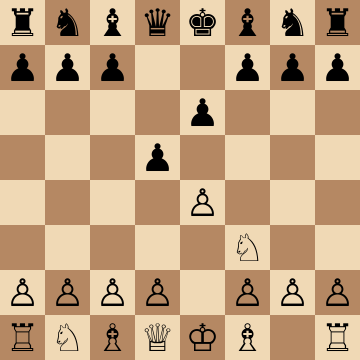
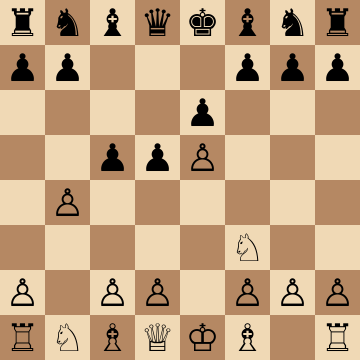
1.e4 e6 2.Nf3 d5 3.e5 c5 4.b4
The Wing Gambit against the French (1.e4 e6 2.Nf3 d5 3.e5 c5 4.b4!?) solves White's eternal French problem in one stroke: instead of defending d4 against ...c5 pressure all game, White deflects the c5-pawn with b4 and builds an unchallenged pawn center. Even Magnus Carlsen has wheeled it out in faster time controls.
Mainline
1.e4 e6 2.Nf3 d5 3.e5 c5 4.b4 cxb4 5.a3
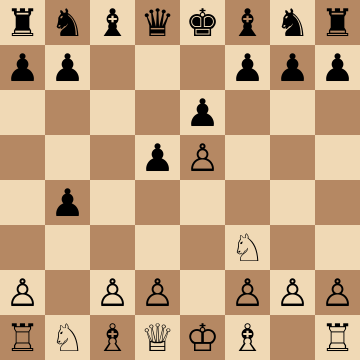
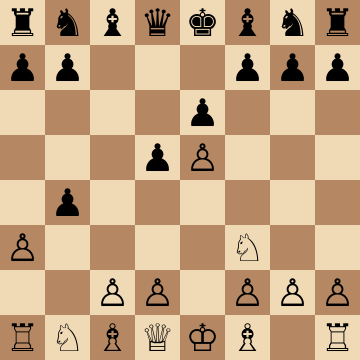
French Wing Gambit: 5.a3 Main Line
1.e4 e6 2.Nf3 d5 3.e5 c5 4.b4 cxb4 5.a3 bxa3 6.Bxa3 Bxa3 7.Nxa3
The purest version of the gambit. White gives a pawn to deflect the c-pawn, then trades the dark-squared bishops so that Black's kingside is left without its natural defender. The compensation is real and long-term: an open a-file, a big centre and a Black queenside that will need several tempi to untangle.
French Wing Gambit: 5.d4 Space Line
1.e4 e6 2.Nf3 d5 3.e5 c5 4.b4 cxb4 5.d4 Nc6 6.a3 bxa3 7.c3
White builds the full French Advance centre first and only then recovers the pawn. It is the least forcing treatment and the easiest to play with no preparation: the structure is familiar to any French player from the White side, but Black's usual ...c5 lever has already been spent.
French Wing Gambit: 4...c4 Declined
1.e4 e6 2.Nf3 d5 3.e5 c5 4.b4 c4 5.a3 Nc6 6.d3 cxd3 7.Bxd3
Black declines by pushing past, refusing to open lines. White answers with d3 to undermine the advanced pawn and get the bishop to its best square in one move. The resulting structures are pleasant for White: the c4-pawn was Black's only queenside asset, and once it disappears the space advantage is permanent.
French Wing Gambit: 5...d4 Central Counter
1.e4 e6 2.Nf3 d5 3.e5 c5 4.b4 cxb4 5.a3 d4 6.axb4 Bxb4 7.c3
Black's most testing reply: instead of grabbing a second pawn, the d-pawn advances and cramps White's queenside development. The critical moment comes right here — c3 challenges the intruder and Black must decide whether to keep the extra pawn or return it for activity. Knowing this branch is what separates a gambit you can play from one you merely admire.
French Wing Gambit: Bishop Recapture Plan
1.e4 e6 2.Nf3 d5 3.e5 c5 4.b4 cxb4 5.a3 Nc6 6.axb4 Bxb4 7.c3 Be7
Black develops before touching the a3-pawn, and White simply regains material with axb4. The bishop trade on b4 costs Black a tempo and hands White the half-open a-file for free. From here the game is a normal French Advance in which White is effectively a full tempo and a file ahead.
Study the Beat the French with 3.Nc3 course
French Wing Gambit: 4...a5 Refusal
1.e4 e6 2.Nf3 d5 3.e5 c5 4.b4 a5 5.c3 axb4 6.cxb4 cxb4 7.d4
The cleanest way for Black to avoid the gambit's main ideas: hit the b4-pawn immediately and force matters on the queenside. White ends up with the same big centre but a slightly damaged pawn structure, which makes this the line to study first if you want to know where the gambit is genuinely tested.
Key ideas
- Deflect Black's ...c5 break with b4 — the entire counterplay plan of the French disappears.
- Build the center with c3 and d4, unharassed: the classic French pressure against d4 never arrives.
- Use the e5 space wedge to attack on the kingside, exactly where French players are weakest.
- Get a strategically one-sided game for a single pawn — compensation that lasts the whole middlegame.
Typical plans and structures
After 4...cxb4 5.a3, White recovers time (and often the pawn) while erecting the c3-d4-e5 chain. Pieces flow to natural squares — d3 or b5 for the bishop, a3 regaining the pawn or opening the a-file — and the kingside attack with Bd3, Qe2 and h4 or Nf3-g5 plays itself, since Black cannot generate the usual ...c5xd4 counterplay. The course covers Black's attempts to return the pawn or hold it, and the correct plan against each.
Who should play it
1.e4 players frustrated by the French's dull defensive walls who want space, attacking chances and a clear strategic story for the price of one pawn.
Study the French Wing Gambit move by move
The first 3 lines of the interactive course, exactly as a signed-out visitor can play them — each move with the coaching note shown on the board.
Line 1 — the main line
1.e4 We take the center. 1...e6 Our opponent launches the French Defense! 2.Nf3 We avoid the typical 2.d4 and instead develop our knight. We are getting ready to play the Wing Gambit! 2...d5 As usual, Black plays ...d5 cementing their control of the center. 3.e5 We avoid the trade and close the center gaining some space on the kingside. 3...c5 Our opponent takes plays ...c5 to increase their central influence and be prepared for when we decide to play d2 d4 to build our central pawn chain. 4.b4!? We play the Wing Gambit! We give up this pawn in order to distract our opponent from controlling the d4 square. If we can get the pawn on c5 out of the way, we have a great chance of building a strong pawn chain after we play d2 d4. 4...cxb4 Our opponent accepts the gift, and loses control of the d4 square. 5.a3 We immediately offer this trade to get the pawn out of the way (so that we can play c2 c3 without our pawn being traded). 5...Nc6 Developing the knight and adding a bit of pressure against our pawn on e5. 6.axb4 We trade this pawn, which was our goal all along. Next we'll be able to play c2 c3 and d2 d4 as we wanted. 6...Bxb4 Our opponent recaptures while developing a piece. This is better than taking with knight, because after we kick out the bishop, it can go straight to e7. 7.c3 We expel the bishop and prepare to take the center with d2 d4. 7...Be7 The bishop retreats to e7, where it prevents certain threats like a Ng5 jump. 8.d4 We take control of the center, the whole purpose of the Wing Gambit. 8...f6 Our opponent challenges our center immediately, by attacking our e5 pawn. 9.Bd3 We continue developing and building up the pressure against the kingside. We don't want to trade on f6 ourselves because we like having a pawn on e5 to prevent Black's knight from developing there. 9...fxe5 Trading pawns makes sense, it opens some lines for our attack, but it also makes our center a bit more vulnerable than it was before. 10.dxe5 We recapture with the pawn to guard the f6 square and make it harder for our opponent to complete their development. 10...Nh6 This is thematic for Black, they need to develop, and don't mind it as much if we double their pawns on the h file. 11.Bxh6 We must take the knight before it can make a favorable jump with ...Nf5. 11...gxh6 Recapturing the piece. 12.Qd2 We develop our queen attacking the pawn on h6. 12...O-O Our opponent gives up the pawn to complete their development. 13.Qxh6 We regain the pawn and are threatening mate in one. 13...Rf7 Stopping the mate. 14.O-O We have a comfortable game with balanced material but a safer king.
Line 2 — against an inaccuracy
1.e4 We take the center. 1...e6 Our opponent launches the French Defense! 2.Nf3 We avoid the typical 2.d4 and instead develop our knight. We are getting ready to play the Wing Gambit! 2...d5 As usual, Black plays ...d5 cementing their control of the center. 3.e5 We avoid the trade and close the center gaining some space on the kingside. 3...c5 Our opponent takes plays ...c5 to increase their central influence and be prepared for when we decide to play d2 d4 to build our central pawn chain. 4.b4!? We play the Wing Gambit! We give up this pawn in order to distract our opponent from controlling the d4 square. If we can get the pawn on c5 out of the way, we have a great chance of building a strong pawn chain after we play d2 d4. 4...cxb4 Our opponent accepts the gift, and loses control of the d4 square. 5.a3 We immediately offer this trade to get the pawn out of the way (so that we can play c2 c3 without our pawn being traded). 5...Nc6 Developing the knight and adding a bit of pressure against our pawn on e5. 6.axb4 We trade this pawn, which was our goal all along. Next we'll be able to play c2 c3 and d2 d4 as we wanted. 6...Bxb4 Our opponent recaptures while developing a piece. This is better than taking with knight, because after we kick out the bishop, it can go straight to e7. 7.c3 We expel the bishop and prepare to take the center with d2 d4. 7...Be7 The bishop retreats to e7, where it prevents certain threats like a Ng5 jump. 8.d4 We take control of the center, the whole purpose of the Wing Gambit. 8...f6 Our opponent challenges our center immediately, by attacking our e5 pawn. 9.Bd3 We continue developing and building up the pressure against the kingside. We don't want to trade on f6 ourselves because we like having a pawn on e5 to prevent Black's knight from developing there. 9...fxe5 Trading pawns makes sense, it opens some lines for our attack, but it also makes our center a bit more vulnerable than it was before. 10.dxe5 We recapture with the pawn to guard the f6 square and make it harder for our opponent to complete their development. 10...Qc7 Developing the queen and putting pressure against the pawn on e5. 11.Qe2 We protect our central pawn. 11...Bd7 Developing the bishop. 12.O-O We castle short as usual. 12...O-O-O?? Our opponent castles long to avoid the kingside pressure we are building, but actually this is even worse. 13.Na3 We develop our knight threatening to jump to b5. 13...a6 Preventing the knight jump, but weakening the b6 square. 14.Be3 This may surprise you, but we already have a +4 advantage according to Stockfish, the reason is our opponent's king is too exposed on the kingside. Let's see just one example:. 14...Nh6 Developing the knight, like nothing is wrong. 15.Rfb1 We activate our rook threatening Bb6 to win the exchange. 15...Rde8 Our opponent moves the rook away protecting the exchange (honestly, our advantage is so big we may not even care to take it). 16.Bxa6! We give up our bishop and are breaking through decisively. 16...bxa6 Every response is losing, this is just an example. 17.Qxa6+ We capture giving a check and forcing the king into a bad square. 17...Kd8 The only move. 18.Bb6! We win the queen and the game. Most lines where Black castles long will end with a crushing attack like this one.
Line 3 — against an inaccuracy
1.e4 We take the center. 1...e6 Our opponent launches the French Defense! 2.Nf3 We avoid the typical 2.d4 and instead develop our knight. We are getting ready to play the Wing Gambit! 2...d5 As usual, Black plays ...d5 cementing their control of the center. 3.e5 We avoid the trade and close the center gaining some space on the kingside. 3...c5 Our opponent takes plays ...c5 to increase their central influence and be prepared for when we decide to play d2 d4 to build our central pawn chain. 4.b4!? We play the Wing Gambit! We give up this pawn in order to distract our opponent from controlling the d4 square. If we can get the pawn on c5 out of the way, we have a great chance of building a strong pawn chain after we play d2 d4. 4...cxb4 Our opponent accepts the gift, and loses control of the d4 square. 5.a3 We immediately offer this trade to get the pawn out of the way (so that we can play c2 c3 without our pawn being traded). 5...Nc6 Developing the knight and adding a bit of pressure against our pawn on e5. 6.axb4 We trade this pawn, which was our goal all along. Next we'll be able to play c2 c3 and d2 d4 as we wanted. 6...Bxb4 Our opponent recaptures while developing a piece. This is better than taking with knight, because after we kick out the bishop, it can go straight to e7. 7.c3 We expel the bishop and prepare to take the center with d2 d4. 7...Be7 The bishop retreats to e7, where it prevents certain threats like a Ng5 jump. 8.d4 We take control of the center, the whole purpose of the Wing Gambit. 8...Bd7 Developing the bishop and preparing to activate the rook along the c file. 9.Bd3 We continue our standard development setup. 9...Rc8 Activating the rook. 10.O-O We castle short, the only option in this variation. 10...a6 Our opponent is a little stuck looking for something to do. This move helps a little to consolidate, but does not do much. 11.Re1 We play this to increase our rook's influence in the center. The main point is discouraging our opponent from breaking with ...f7 f6, as it would give activity to our rook along the file. 11...Na5 The knight wants to maneuver toward c4. 12.h4! We play this move to gain space in the kingside, and potentially support a knight jump to g5. The pawn can't be captured because the queen would be overloaded protecting the bishop and the knight on a5. 12...h5 Our opponent stops us from expanding further, but gives up the control of the g5 square. 13.Ng5 We make use of the square our opponent has given us. This is annoying because it puts pressure against the pawn on f7. 13...Nh6 This is the only good move, protecting the pawn on f7 before we threaten it. 14.g3 We can't take the pawn on h5 just yet, as we don't want to allow a knight jump into b3. Either way, our position is solid and very comfortable.
The free preview ends here — continue with all 18 lines in the interactive course, with instant feedback on every move you play.
Frequently asked questions
Is the French Wing Gambit sound?
It is a respectable practical gambit — strong grandmasters, including Magnus Carlsen in rapid play, have used it. White's structural compensation is real and long-lasting; Black must play accurately just to reach a balanced middlegame.
What is the main idea of b4 against the French?
The French's whole counterplay is pressure on d4 via ...c5. By deflecting the c-pawn with b4, White keeps an unassailable center and free hands to attack on the kingside — the strategic problem French players prepare for never appears.
What if Black declines the Wing Gambit?
Declining with 4...c4 or ...Nc6 setups lets White claim queenside space for free and continue with c3 and d4 anyway. The course shows how each declining move concedes something, so you profit whether or not the pawn is taken.
Learn the French Wing Gambit with AI feedback
This page pairs the guide above with an interactive ChessMind AI course: a GM-authored repertoire you study move by move on a real board, then practice against a human-like chess AI opponent with instant feedback and spaced-repetition review, so the key positions actually stick. Start learning, jump straight into practice, or browse all opening courses.
New to a concept? Every term is defined in the chess terms glossary.