Bogo-Indian Defense
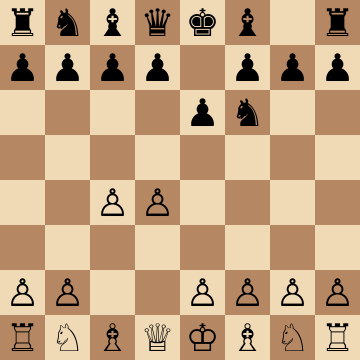
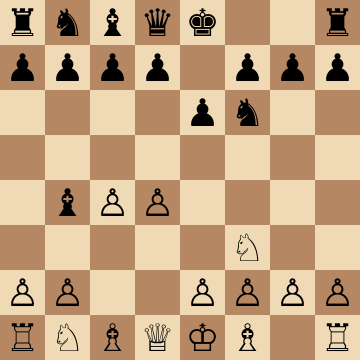
1.d4 Nf6 2.c4 e6 3.Nf3 Bb4+
The Bogo-Indian (1.d4 Nf6 2.c4 e6 3.Nf3 Bb4+) answers White's Nimzo-dodge with a check on move three. Simple development, a sound structure, and positions where understanding beats memorization — the thinking player's reply to 3.Nf3.
Mainline
1.d4 Nf6 2.c4 e6 3.Nf3 Bb4+ 4.Bd2 Qe7 5.g3 Nc6 6.Bg2 Bxd2+ 7.Nbxd2 d6
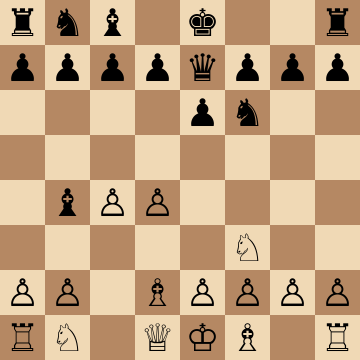
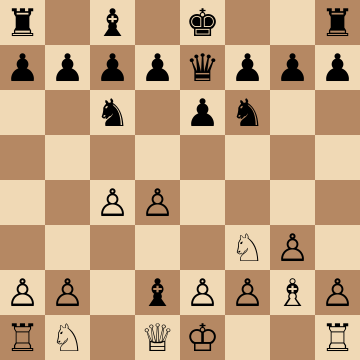
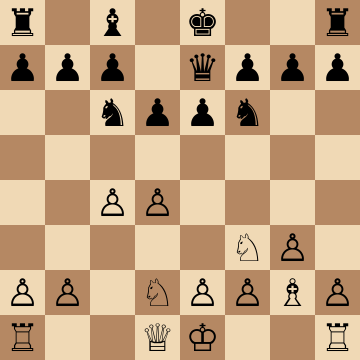
Main Line: 8.O-O e5 9.d5 Nb8
1.d4 Nf6 2.c4 e6 3.Nf3 Bb4+ 4.Bd2 Qe7 5.g3 Nc6 6.Bg2 Bxd2+ 7.Nbxd2 d6 8.O-O e5 9.d5 Nb8 10.e4 a5
This is the position the whole repertoire aims for: the ...e5 break lands, and when White closes with 9.d5, the retreat 9...Nb8! begins the classic regroup toward d7 and c5 or a6 and c5. The structure resembles a King's Indian where Black has already traded the bad bishop — a real achievement. Play ...a5 to anchor the c5-square, castle, and maneuver; White's space means little with no targets to attack.
9.dxe5 Simplification Line
1.d4 Nf6 2.c4 e6 3.Nf3 Bb4+ 4.Bd2 Qe7 5.g3 Nc6 6.Bg2 Bxd2+ 7.Nbxd2 d6 8.O-O e5 9.dxe5 dxe5 10.e4 O-O 11.Qc2 Rd8
Releasing the tension with 9.dxe5 is White's low-ambition choice, and Black should welcome it: after 9...dxe5 the structure is symmetrical, but the pieces are not. Black seizes the d-file first with 11...Rd8, the c8-bishop finally develops to e6 or g4, and the d4-square becomes a permanent landing spot for a knight via ...Nd4 ideas. Equal chances with clearer plans — exactly the trade the Bogo-Indian player is happy to make.
4.Nbd2: Keeping the Bishop Pair
1.d4 Nf6 2.c4 e6 3.Nf3 Bb4+ 4.Nbd2 b6 5.a3 Be7 6.e4 Bb7 7.Bd3 d6 8.O-O Nbd7
Blocking with the knight invites Black to preserve the bishop: after 5.a3 the cool retreat 5...Be7 keeps the pair, and the d2-knight stands worse than it would on c3. Black sets up a compact Queen's Indian shell — ...b6, ...Bb7, ...d6, ...Nbd7 — and strikes later with ...c5 or ...e5 once White's center commits. A perfect illustration of the Bogo philosophy: small positional gains, no weaknesses, all the play ahead.
5.Nc3 Doubled-Pawn Line
1.d4 Nf6 2.c4 e6 3.Nf3 Bb4+ 4.Bd2 Qe7 5.Nc3 Bxc3 6.Bxc3 Ne4 7.Rc1 O-O 8.g3 d6
Developing the knight to c3 walks into the thematic capture: 5...Bxc3 6.Bxc3 Ne4 immediately jumps on the weakened squares, harassing the c3-bishop and preparing ...d6 with ...f5 or ...e5. Black plays a Nimzo-style game a full setup ahead — the dark-squared bishop problem is solved, the e4-knight is a rock, and White's bishop pair stares at its own pawns. Simple, sound, and surprisingly annoying for White.
Avoiding the Monticelli Trap
1.d4 Nf6 2.c4 e6 3.Nf3 Bb4+ 4.Bd2 Bxd2+ 5.Qxd2 b6 6.g3 Bb7 7.Bg2 O-O 8.Nc3 Ne4 9.Qc2 Nxc3 10.Ng5 Ne4 11.Bxe4 Bxe4 12.Qxe4 Qxg5 13.Qxa8
Every Bogo player must know the famous Monticelli Trap — from the losing side. After the routine 4...Bxd2+ and ...Ne4, White uncorks 10.Ng5!, hitting h7 and b7 at once, and the forced sequence ends with 13.Qxa8 winning the exchange. This is exactly why the course's move order keeps the queen on e7 and delays ...Bxd2: the trap never gets the chance to exist. Study the mechanism once and you are vaccinated for life.
Key ideas
- Check on b4 and make White commit: Bd2, Nbd2 and Nc3 each get their own clear plan.
- Follow the classical recipe with ...Qe7, ...Nc6 and ...e5 — Black's play develops naturally.
- Trade the b4-bishop on your terms and build a light-square blockade that endures all game.
- Skip the theory arms race: the Bogo's ideas fit in an afternoon, and refreshing them takes minutes.
Typical plans and structures
Against the main 4.Bd2, Black plays ...Qe7, ...Nc6 and the central ...e5 break, reaching flexible positions with a healthy structure and clear piece placement. Against 4.Nbd2, Black keeps the bishop pair with ...b6 or ...d5 setups and plays against the slightly passive knight. The recurring strategy is dark-square control: ...d6 and ...e5, knights to d7 and g6 or e4, and patient maneuvering that suits players who like plans over variations.
Who should play it
1.d4 Nf6 players who face 3.Nf3 constantly and want a sound, low-theory companion to the Nimzo-Indian with genuine winning chances.
Study the Bogo-Indian Defense move by move
The first 3 lines of the interactive course, exactly as a signed-out visitor can play them — each move with the coaching note shown on the board.
Line 1 — the main line
1.d4 Our opponent claims the center. 1...Nf6 We develop the knight, controlling e4. 2.c4 Our opponent expands on the queenside. 2...e6 We free the dark squared bishop. 3.Nf3 Our opponent brings out their knight. 3...Bb4+ We activate the bishop with check, entering the Bogo-Indian Defense! 4.Bd2 Our opponent blocks with the bishop. 4...Qe7 We defend the bishop with the queen. 5.g3 Our opponent plans to fianchetto the light squared bishop. 5...Nc6 We bring out the knight. 6.Bg2 Developing the bishop and preparing to castle. 6...Bxd2+ We trade bishops on d2. 7.Nbxd2 Our opponent takes back with the knight. 7...d6 We keep a flexible pawn structure, preparing to break in the center. 8.O-O Our opponent castles. 8...O-O We castle too. 9.e4 Taking central space. 9...e5 We break in the center, forcing White to make a decision. 10.d5 Our opponent pushes the d pawn, threatening the knight and closing the center. 10...Nb8 We pull the knight back to its initial square. 11.b4 Our opponent gains space on the queenside. 11...a5 We challenge their pawn structure. 12.a3 Reinforcing b4. 12...Na6 We activate the rook, increasing pressure on b4. 13.Qb3 Our opponent brings out the queen. 13...Bd7 We develop the bishop and connect the rooks. 14.Rfc1 Our opponent activates their rook along the c file. 14...axb4 We trade on b4, planning to neutralize their attack with ...c7 c5 and then focus on the kingside.
Line 2 — the main line
1.d4 Our opponent claims the center. 1...Nf6 We develop the knight, controlling e4. 2.c4 Our opponent expands on the queenside. 2...e6 We free the dark squared bishop. 3.Nf3 Our opponent brings out their knight. 3...Bb4+ We activate the bishop with check, entering the Bogo-Indian Defense! 4.Bd2 Our opponent blocks with the bishop. 4...Qe7 We defend the bishop with the queen. 5.g3 Our opponent plans to fianchetto the light squared bishop. 5...Nc6 We bring out the knight. 6.Bg2 Developing the bishop and preparing to castle. 6...Bxd2+ We trade bishops on d2. 7.Nbxd2 Our opponent takes back with the knight. 7...d6 We keep a flexible pawn structure, preparing to break in the center. 8.O-O Our opponent castles. 8...O-O We castle too. 9.e4 Taking central space. 9...e5 We break in the center, forcing White to make a decision. 10.d5 Our opponent pushes the d pawn, threatening the knight and closing the center. 10...Nb8 We pull the knight back to its initial square. 11.Ne1 Our opponent maneuvers the knight toward d3. 11...a5 We expand on the queenside to prevent their advance. 12.Nd3 Our opponent completes the maneuver. 12...Na6 We develop the knight. 13.a3 Controlling b4. 13...Bg4 We activate the bishop with tempo on their queen. 14.f3 Counterattacking the bishop. 14...Bd7 We retreat, having damaged their pawn structure and controlling both flanks.
Line 3 — against an inaccuracy
1.d4 Our opponent claims the center. 1...Nf6 We develop the knight, controlling e4. 2.c4 Our opponent expands on the queenside. 2...e6 We free the dark squared bishop. 3.Nf3 Our opponent brings out their knight. 3...Bb4+ We activate the bishop with check, entering the Bogo-Indian Defense! 4.Bd2 Our opponent blocks with the bishop. 4...Qe7 We defend the bishop with the queen. 5.g3 Our opponent plans to fianchetto the light squared bishop. 5...Nc6 We bring out the knight. 6.Bg2 Developing the bishop and preparing to castle. 6...Bxd2+ We trade bishops on d2. 7.Nbxd2 Our opponent takes back with the knight. 7...d6 We keep a flexible pawn structure, preparing to break in the center. 8.O-O Our opponent castles. 8...O-O We castle too. 9.e4 Taking central space. 9...e5 We break in the center, forcing White to make a decision. 10.d5 Our opponent pushes the d pawn, threatening the knight and closing the center. 10...Nb8 We pull the knight back to its initial square. 11.Ne1 Our opponent maneuvers the knight toward d3. 11...a5 We expand on the queenside to prevent their advance. 12.Nd3 Our opponent completes the maneuver. 12...Na6 We develop the knight. 13.f4 Our opponent expands on the kingside, pressuring e5. 13...Nd7 We pull the knight back to reinforce the pawn. 14.f5 Our opponent keeps advancing, closing the center. 14...Nac5 We activate the knight to exploit the weaknesses creates by their overextension.
The free preview ends here — continue with all 18 lines in the interactive course, with instant feedback on every move you play.
Frequently asked questions
When do I need the Bogo-Indian in my repertoire?
Whenever White plays 3.Nf3 instead of 3.Nc3 to avoid the Nimzo-Indian. The Bogo (3...Bb4+) keeps your setup consistent — same first moves, same spirit — without learning the massive Queen's Indian complex.
Is the Bogo-Indian drawish?
It is solid, not sterile: Black routinely plays for ...e5 with real middlegame chances, and the closed maneuvering positions reward the better strategist. At club level its surprise value alone wins games — many White players know only a move or two of theory.
What happens after White blocks with 4.Bd2?
The classical answer is 4...Qe7, defending the bishop and preparing ...Nc6 and ...e5. Black often exchanges on d2 at the right moment and enjoys easy development with a clear central plan — the course walks through every branch of this main line.
Learn the Bogo-Indian Defense with AI feedback
This page pairs the guide above with an interactive ChessMind AI course: a GM-authored repertoire you study move by move on a real board, then practice against a human-like chess AI opponent with instant feedback and spaced-repetition review, so the key positions actually stick. Start learning, jump straight into practice, or browse all opening courses.
New to a concept? Every term is defined in the chess terms glossary.